AffordVLA:通过隐特征对齐将Affordance表征注入视觉-语言-动作(VLA)模型
26年5月来自浙大和杭州Torch Kernel 公司的论文“AffordVLA: Injecting Affordance Representations into Vision-Language-Action Models via Implicit Feature Alignment”。
核心思想可以用一句话概括:不在推理阶段显式告诉 VLA“应该抓哪里”,而是在训练阶段用一个 Affordance Teacher 教会 VLA 自己形成“应该抓哪里/作用在哪里”的内部视觉表征。这是这篇工作的价值所在。
1. 论文到底解决什么问题?
传统 VLA 的基本形式是:
(Image, Language, Robot State) → Action
例如:
“Use the knife to cut the banana.”
VLA 能够知道:
这是 knife;
这是 banana;
任务是 cut;
但这并不意味着它真正理解:
knife 的 handle 是应该 grasp 的地方,而 blade 是应该接触 banana 的地方。
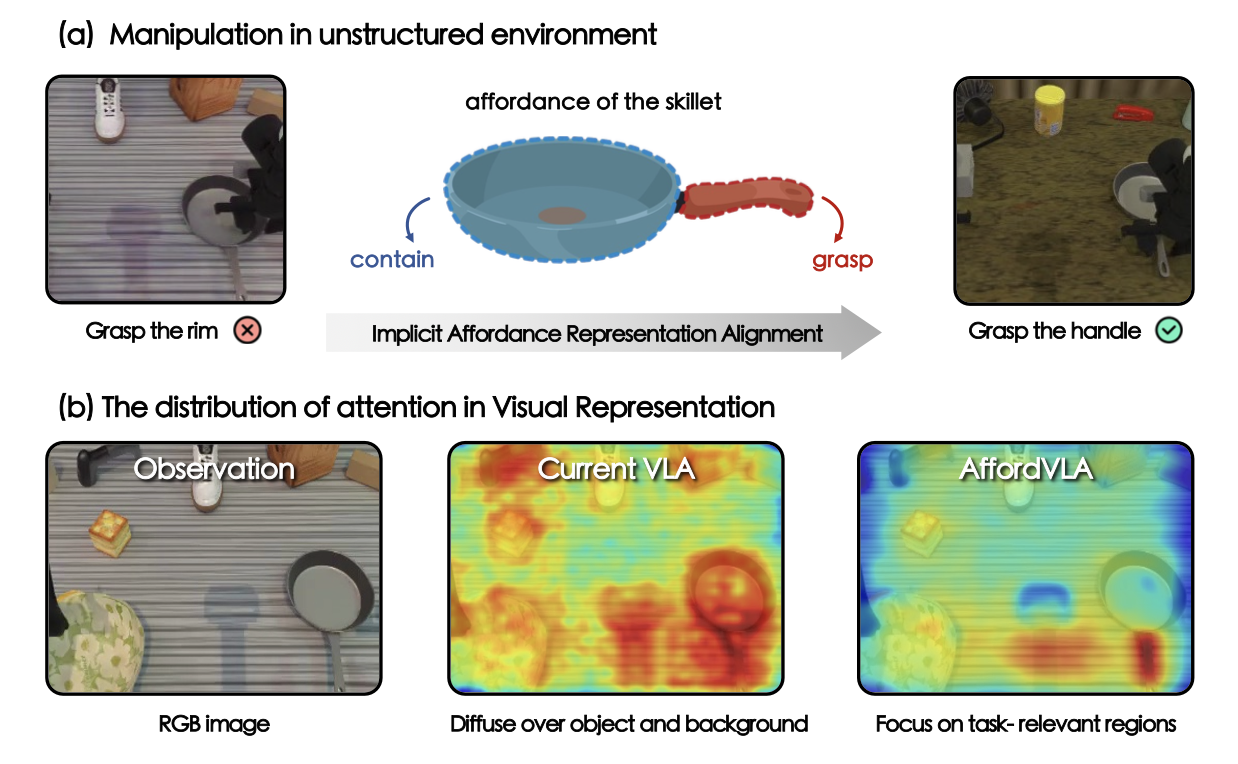
当前 VLA 的一个关键弱点在于:VLM 预训练主要学习的是global semantics / object appearance,因此视觉注意力容易散布在整个物体甚至背景,而机器人操作真正需要的是 task-conditioned functional interaction region。
这实际上是:
Object Recognition ≠ Manipulation Understanding
比如看到锅:
“这是 skillet”
不等于:
“为了拿起 skillet,应该抓 handle”\text{“为了拿起 skillet,应该抓 handle”
论文 Fig.1 就是在表达这个问题:普通 VLA 的视觉注意力较为 diffuse,而 AffordVLA 希望把注意力集中到 task-relevant functional region。
这也是作者引入 Affordance(可供性/功能可供性) 的原因。
2. 什么是这里的 Affordance?
这篇论文里的 affordance 最好不要简单理解为“物体功能”。
它实际上是:
在给定任务条件下,物体上与当前动作相关的功能性交互区域。
也就是:
A=f(I,L)
其中:
I:图像
L:任务语言
A:task-conditioned affordance
同一个物体由于任务不同,affordance 可以不同。
例如 hammer:
“pick up the hammer” → handle
“strike the nail” → hammer head/handle 的任务相关结构
因此它不是简单的 segmentation:
Image→ObjectMaskImage \rightarrow Object\ Mask
而更接近:
(Image,Task) → FunctionalInteractionRepresentation(Image,Task)
作者特别强调,机器人中的 affordance 是 task-relevant functional interaction regions。
3. 为什么不直接把 Affordance Mask 输入 VLA?
这恰恰是论文比较有意思的地方。
最直接的方案其实是:
RGB → AffordanceDetector → Mask → VLA → Action
但是作者认为这种 Explicit Affordance Injection 有三个问题:
需要大量 affordance annotation;
inference 时依赖额外 detector,前级错误会传播到 VLA;
detector 增加推理延迟。
论文的实验很好地说明了第 3 点:

所以作者的思路不是:
“让 VLA 每次推理都调用一个 affordance detector。”
而是:
训练时让 affordance teacher 教 VLA,部署时把 teacher 扔掉。
这可以看作一种 privileged supervision / representation distillation。
4. AffordVLA 的整体架构
论文 Fig.2 是最重要的一张图。
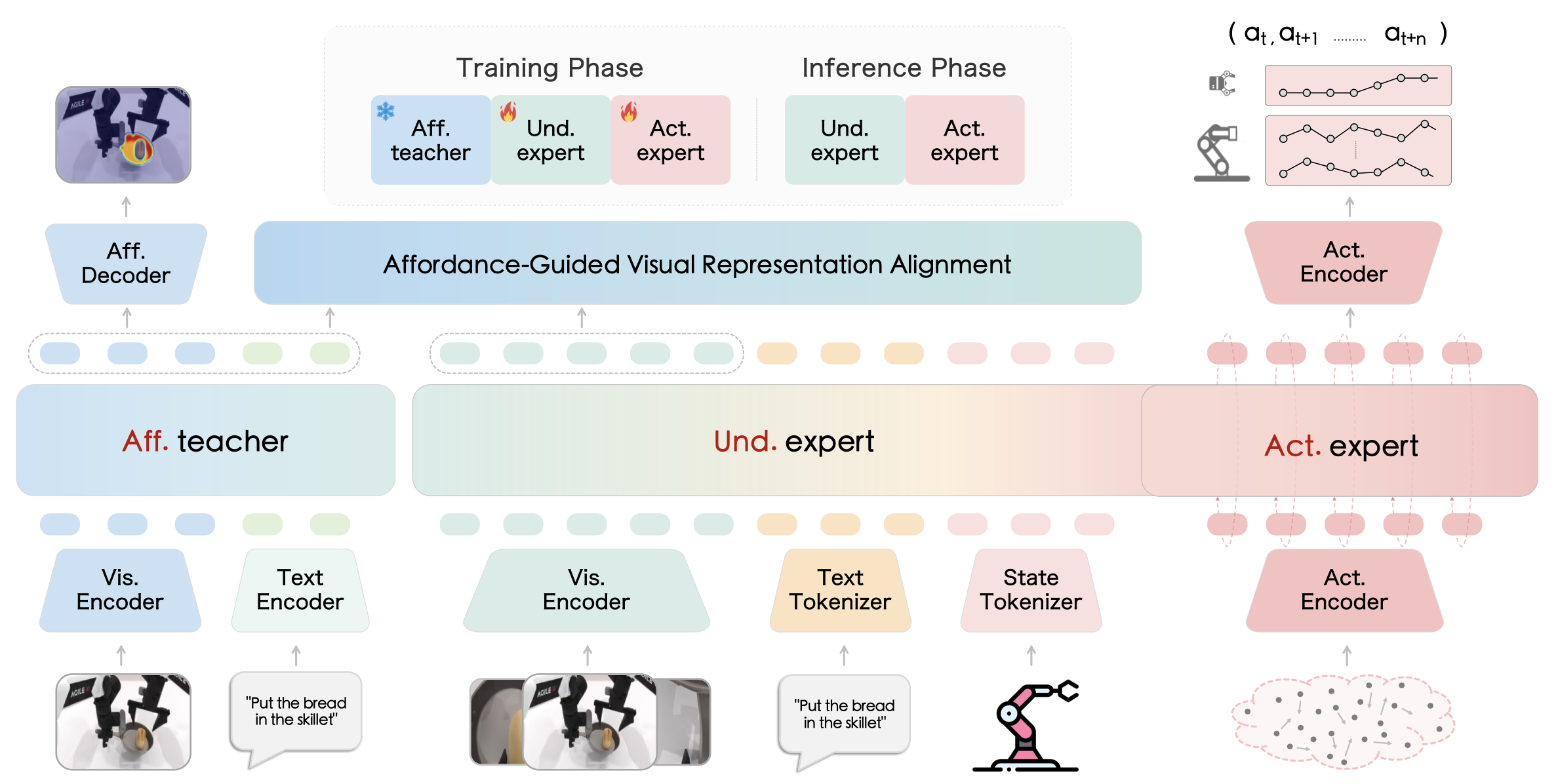
整个系统有三个主要模块:
Affordance Teacher
Understanding Expert
Action Expert
训练时:
RGB + Instruction → Affordance Teacher→Z_af
与此同时:
RGB+Instruction+State → Understanding Expert → X_V
然后进行:
X_V ↔ Z_aff
的 feature alignment。
最后:
Understanding Expert → Action Expert → Robot Action
而推理阶段则直接:
RGB+Language+State → Understanding → Action
Affordance Teacher 完全删除。
因此 Fig.2 的真正意义是:
Teacher during Training → Internalized Affordance → Teacher-free Inference
论文明确说明 teacher 在训练时冻结,推理时完全移除,因此不会改变标准 VLA 的 inference pipeline。
5. 第一个核心创新:Zero-Shot Affordance Teacher
Teacher 本身也比较值得研究。
论文 Fig.3 给出的结构实际上可以拆成两阶段:
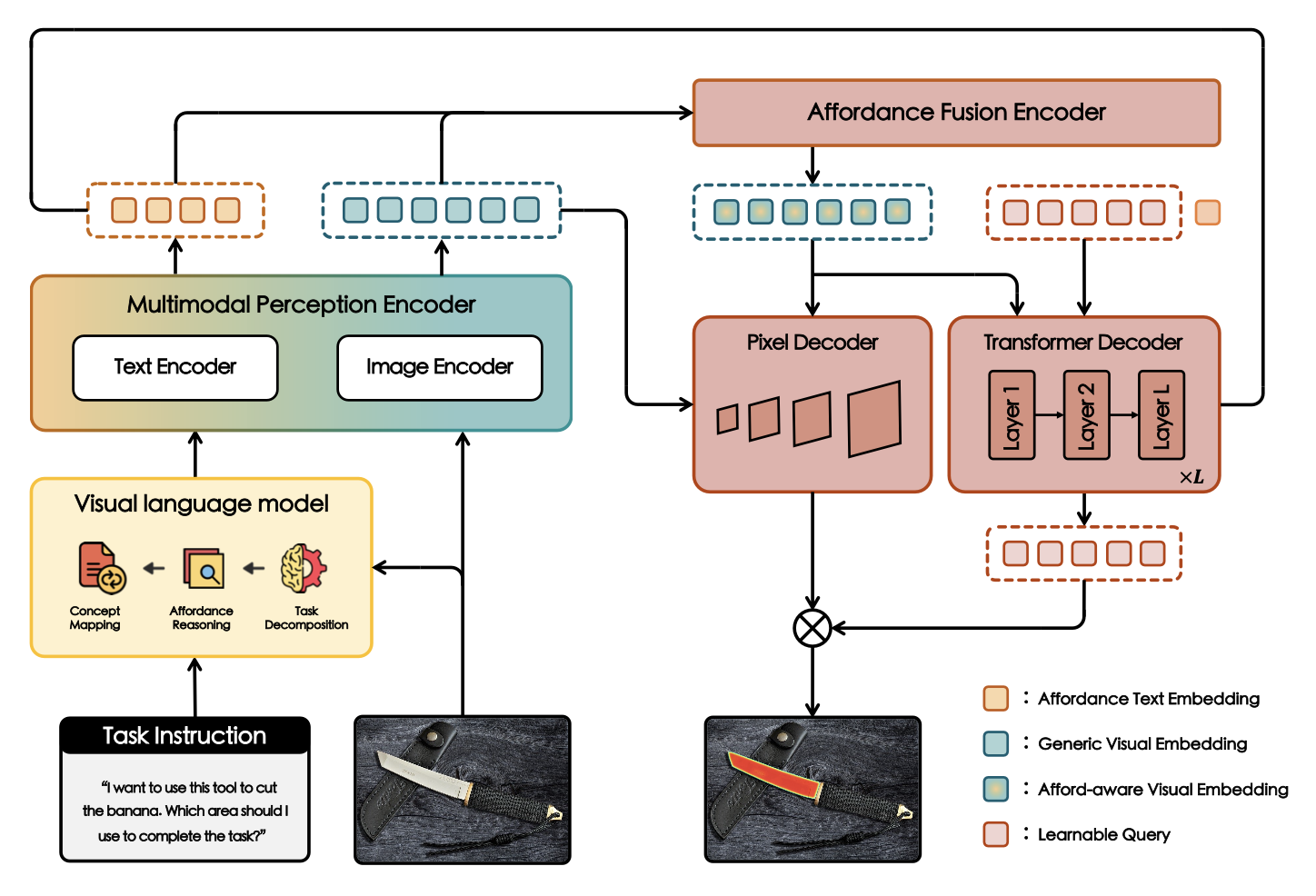
第一步:任务解析
作者用 Qwen3-VL:
(I_t,l_t) → (Qwen3−VL) p_t
把抽象任务转成 part-level affordance concept prompt。
例如:
hammer the nail with the hammer
不会只输出:
hammer
而会形成类似:
hammer handle
hammer head
这样的部件级概念。
这一步实际上非常重要,因为它完成:
Task Semantics → Manipulation Concept
6. 第二步:Open-Vocabulary Affordance Perception
然后:
(Image, Affordance Prompt)→Affordance Representation
Teacher 使用基于 SAM3 的视觉/文本编码和 cross-modal fusion,将普通 visual embedding 转成:
Z_taff
即 affordance-aware visual representation。
同时也可以产生 pixel-level affordance mask:
Maff_t
但有一个很容易忽略、却是整篇论文非常关键的设计:
真正拿来训练 VLA 的不是 mask,而是 intermediate affordance representation。
作者认为 Z_taff 同时保留:
task semantics;
local spatial structure;
所以比 binary/pixel mask 更适合进行 representation supervision。
这是这篇论文非常值得注意的设计点。
7. 第二个核心创新:Implicit Affordance Representation Alignment
假设 VLA 第 m 层的视觉特征为:
XV,(m)_t
Teacher 给出的 affordance representation 为:
Zaff_t
两边 feature space 不同,因此作者先进行:
XV,(m)_t = W_2 (σ(W_1 Norm(Resize(XV,(m)_t)))
也就是:
resize → normalization → MLP projection
然后使用 cosine similarity 做 alignment:
L_align = −∑_i cos(x_t,iV,(m), z~_t,iaff)/N
最终:
L=L_action + λ L_alig
其中设置:
λ=0.5
所以它没有改变 action learning 的基本目标,而是增加了一个:
“你的中间视觉表示应该更像 manipulation affordance representation”
的辅助监督。
8. 为什么选择中间层?
这个设计也很合理。
作者认为:
浅层
→ texture/local details
虽然空间细节多,但是经过后续 Transformer 后,监督效果容易消失。
而:
最深层
→ abstract/global/modality-agnostic semantics
又已经丢失较多局部视觉结构。
所以作者选择 intermediate-deep layer。
具体实验里是:
Understanding Expert 的第 12/18 层
与 teacher 的 affordance feature 对齐。
这其实是一个很值得推广的思想:
Early: pixels/textures
Middle: task-conditioned embodied representation
Late: semantic/action abstraction
10. 实验结果:Affordance Teacher 本身怎么样?
作者首先单独测试 Teacher。
在 AGD20K Unseen 上:

而且它没有在 AGD20K 上训练或 fine-tune,是直接 zero-shot evaluation。
因此其首先建立一个重要前提:
Teacher Affordance Representation
确实有一定质量,否则后面的 representation alignment 就没有意义。
11. RoboTwin2.0 的结果相当明显
其选了五个 manipulation tasks,而且每个任务只使用:
50 条 disturbance-free Easy demonstrations
训练。
结果平均成功率:
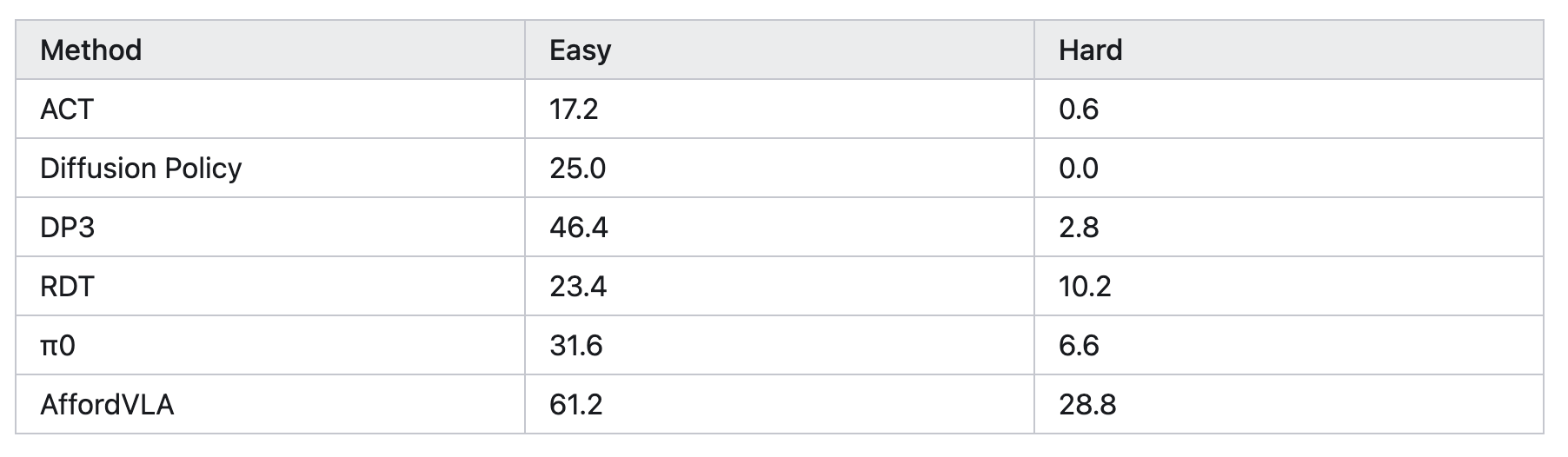
说明什么?Hard setting 比 Easy 更有说服力。
因为 Hard 包含:
clutter;
texture variation;
lighting change;
domain randomization;
distracting objects。
换句话说,它恰恰测试:
“模型到底看 object appearance, 还是看 task-relevant interaction region?“
AffordVLA 的 Hard:
28.8%
明显高于:
RDT: 10.2%, π0: 6.6%
这与论文的核心 hypothesis 是一致的。
12. Real-world 实验也比较完整
真实机器人平台:如图 6所示
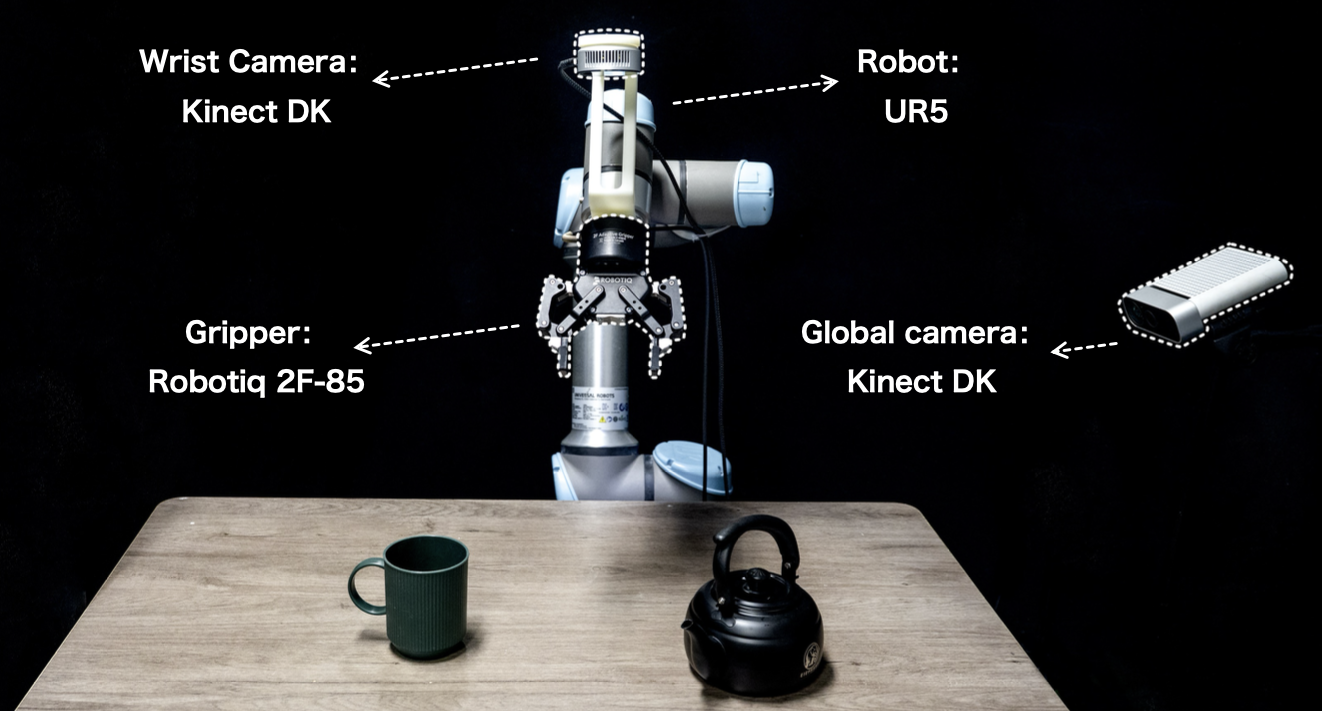
UR5;
Robotiq 2F-85 gripper;
Kinect DK / RealSense;
A100 inference server。
设计 8 个任务:
pour water、hang mug、cut banana、hammer block、wipe table、sweep table、place marker、place carrot 等。每个任务使用 50 条真实
轨迹训练。
尤其是:
cut banana with knife
这个例子很能说明 affordance:
Knife → Handle for grasp
而不是简单:
Knife detection
Fig.7 的任务设置其实是在有意识测试:
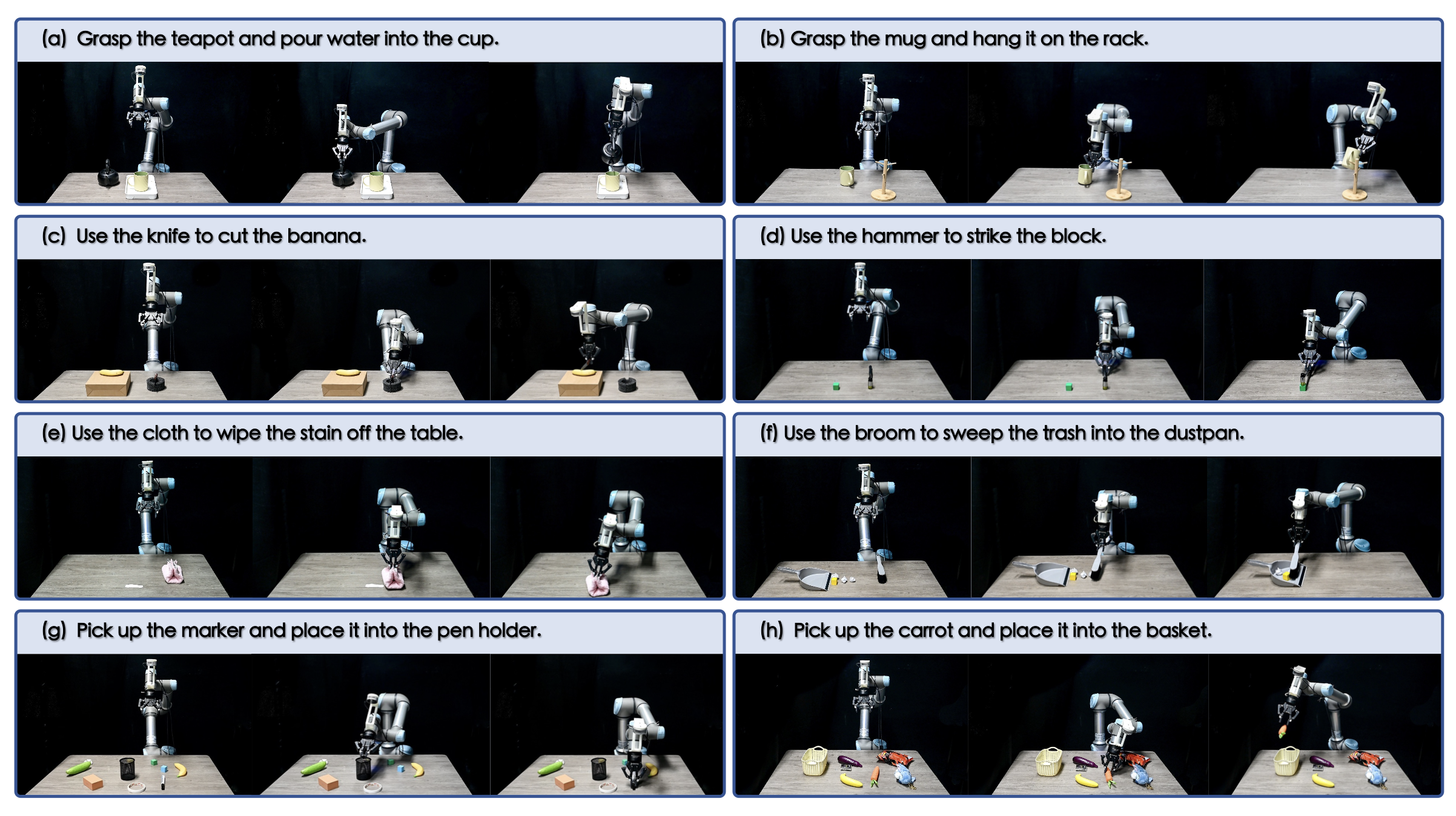
functional part localization;
tool pose control;
deformable contact;
precise placement;
distractor suppression。
最后Fig.9是第12-层视觉表征的视觉注意可视化结果例子:
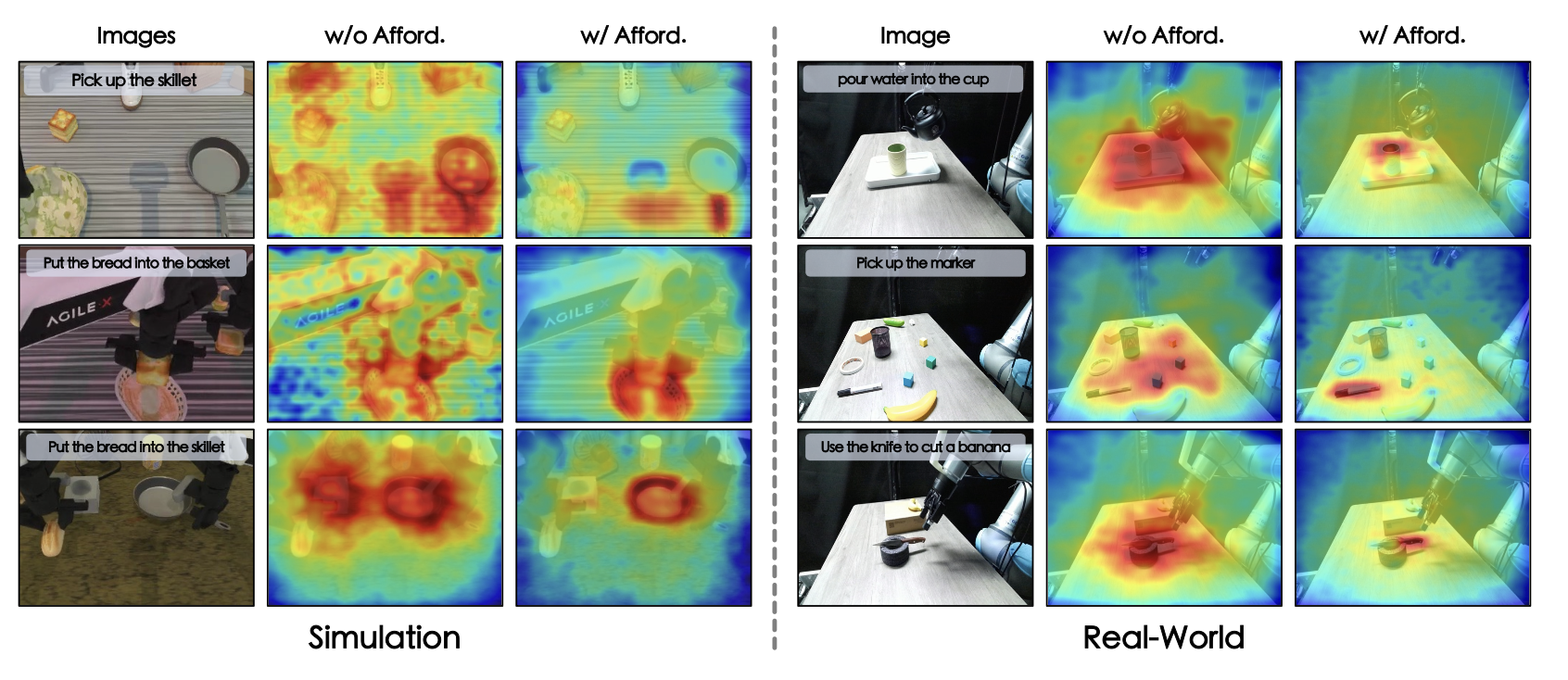
12. 真正的贡献是什么?
如果把所有工程细节去掉,贡献其实不是“又做了一个 VLA”。
而是提出了一种很有价值的范式:
External Intelligence → Training Supervision Internal Representation
而不是:
External Module → Runtime Policy
也就是从:
Tool-at-inference
转变成:
Knowledge-at-training
或者更准确一点:
Runtime Augmentation → Representation Internalization
这比“加一个 affordance detector”更有研究意义。
13. 论文一个非常值得肯定的地方:它没有破坏 VLA inference interface
普通 VLA:
(I,L,S) → A
AffordVLA 推理时仍然:
(I,L,S) → A
不是:
(I,L,S,M_aff) → A
所以它仍然保持 end-to-end policy interface。
从系统工程角度,这一点非常重要:
不增加 perception pipeline;
不增加 runtime dependency;
不增加 cascading errors;
不增加明显 latency;
deployment architecture 不改变。
实验中的 12.5 Hz → 12.4 Hz 基本印证了这一点。
14. 几个局限点
第一,训练仍依赖 affordance teacher,所以:
Teacher Error → Representation Error
复杂场景中的 teacher noise 会影响训练。
第二,它主要作用在 visual representation:
Affordance → Visual Feature
而没有直接进入:
Affordance → Action Generation
所以对于:
precise contact;
continuous adjustment;
force interaction;
可能仍然不足。
第三,目前还没有充分验证:
long-horizon;
multi-subgoal;
cross-robot;
different embodiments。
这些也是最后 Conclusion 明确指出的限制。
15. 没有充分讨论的问题
一个问题是:它学到的是 Affordance,还是 Teacher 的 Representation Bias?
训练实际上在优化:
X_VLA ≈ Z_Teacher
因此严格地说:
Z_Teacher ≠ Ground Truth Affordance
Teacher 本身由 Qwen3-VL + open-vocabulary perception 构成。
因此最终模型可能学习的是:
Teacher-defined affordance
而不是:
Physical interaction affordance
两者并不完全等价。
真正物理意义上的 affordance 应该还涉及:
Geometry+Dynamics+Contact+ForceGeometry + Dynamics + Contact + Force
而论文主要还是:
RGB+Language → Visual Functional Region
因此它更准确地说是:
visual-semantic affordance
而不是完整的 physical affordance。
16. 第二个问题:Affordance 不应该只有“where”,还应该有“how”
论文主要解决:
Where to interact?
例如:
grasp handle
但真正机器人操作还需要:
How to interact?
包括:
approach direction;
grasp orientation;
contact force;
compliance;
trajectory;
temporal evolution。
所以更完整的 affordance 应该是:
A=(region,pose,action,dynamics,constraint)
而 AffordVLA 目前主要解决其中的:
region
和部分 task semantics。
这也解释了为什么作者承认 precise contact / continuous action adjustment 仍然可能受限。
17. 第三个问题:Long-horizon task 中 affordance 本身会变化
比如:
Make a cup of coffee.
可能是:
grasp cup → place cup → grasp kettle → pour → release
此时 affordance 是:
A_t = f(I_t,L,g_t,state_t)
而不是简单:
A=f(I,L)
其中:
g_t = current subgoal
也就是说,需要:
Planner→Subgoal→Affordance→Action
AffordVLA 目前主要针对短时 manipulation,因此距离这种 hierarchical embodied agent 还有明显距离,估计需要世界模型才行。
18. 可以进一步推导成一个很有意思的新方向
AffordVLA 只 internalize:
Affordance
但同样的方法完全可以 internalize:
Geometry
Affordance
World Model
Safety Constraints
Task Progress
Failure Prediction
也就是说:
Harness−to−Policy Internalization
可以成为一个新的研究范式。
训练阶段:
World Model→Z_world
Affordance Model→Z_aff
Safety Critic→Z_safe
Planner→Z_plan
共同监督:
Z_VLA
而部署阶段:
Image+Language+State→VLA→Action
这就比 AffordVLA 更进一步。

DAMO开发者矩阵,由阿里巴巴达摩院和中国互联网协会联合发起,致力于探讨最前沿的技术趋势与应用成果,搭建高质量的交流与分享平台,推动技术创新与产业应用链接,围绕“人工智能与新型计算”构建开放共享的开发者生态。
更多推荐
 0
0 0
0- 0


 已为社区贡献428条内容

所有评论(0)