java mysql 公交车换乘查询算法_公交车路线查询系统后台数据库设计--换乘算法改进与优化...
公交车路线查询系统后台数据库设计系列文章
数据库下载(该数据库已经输入了广州市350条公交车路线作为测试数据)
在《查询算法》一文中已经实现了换乘算法,但是,使用存储过程InquiryT2查询从“东圃镇”到“车陂路口”的乘车路线时,发现居然用了5分钟才查找出结果,这样的效率显然不适合实际应用。因此,有必要对原有的换乘算法进行优化和改进。在本文中,将给出一种改进的换乘算法,相比原有的算法,改进后的算法功能更强,效率更优。
1.“压缩”RouteT0
假设RouteT0有以下几行
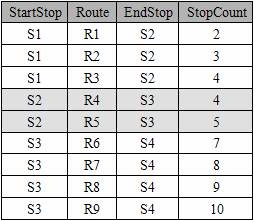
如下图所示,当查询S1到S4的二次换乘路线时,将会产生3×2×4=24个结果
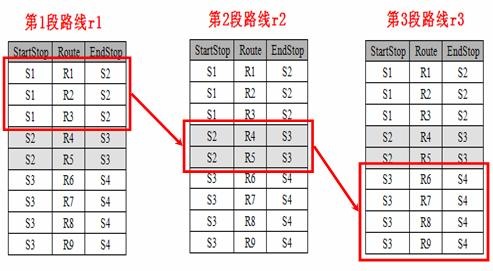
从图中可以看出,第1段路线中的3条线路的起点和站点都相同(第2、3段路线也是如此),事实上,换乘查询中关心的是两个站点之间有无线路可通,而不关心是乘坐什么路线,因此,可以将RouteT0压缩为:
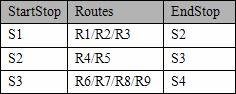
如下图所示,压缩后,查询结果有原来的24条合并1组

查询结果为:

那么,为什么要对视图RouteT0进行压缩呢,原因如下:
(1)RouteT0是原有换乘算法频繁使用的视图,因此,RouteT0的数据量直接影响到查询的效率,压缩RouteT0可以减少RouteT0的数据量,加速查询效率。
(2)压缩RouteT0后,将中转站点相同的路线合并为1组,加速了对结果集排序的速度。
2.视图GRouteT0
在数据库中,将使用GRouteT0来描述压缩的RouteT0,由于本文使用的数据库的关系图与《查询算法》中有所不同,在给出GRouteT0的代码前,先说明一下:
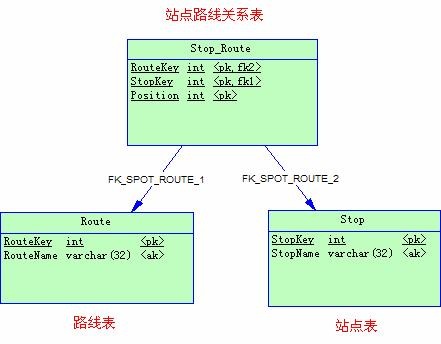
主要的改变是Stop_Route使用了整数型的RouteKey和StopKey引用Route和Stop,而不是用路线名和站点名。
GRouteT0定义如下: create viewGRouteT0
as
selectStartStopKey,
EndStopKey,
min(StopCount) asMinStopCount,
max(StopCount) asMaxStopCount
fromRouteT0
group byStartStopKey,EndStopKey
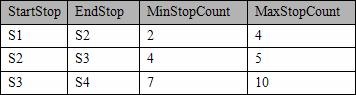
注意,视图GRouteT0不仅有StartStopKey和EndStopKey列,还有MinStopCount列,MinStopCount是指从StartStop到EndStop的最短线路的站点数。例如:上述RouteT0对应的GRouteT0为:
3.二次查询算法
以下是二次换乘查询的存储过程GInquiryT2的代码,该存储过程使用了临时表来提高查询效率:
GInquiryT2
/*
查询站点@StartStops到站点@EndStops之间的二次换乘乘车路线,多个站点用'/'分开,结果以分组方式给出,如:
exec InquiryT2 '站点1/站点2','站点3/站点4'
*/CREATE procGInquiryT2(
@StartStops varchar(2048),
@EndStops varchar(2048)
)
as
begin
declare@ss_tab table(StopKey int)
declare@es_tab table(StopKey int)
insert@ss_tab
select distinctStop.StopKey
fromdbo.SplitString(@StartStops,'/') sn,Stop
wheresn.Value=Stop.StopName
insert@es_tab
select distinctStop.StopKey
fromdbo.SplitString(@EndStops,'/') sn,Stop
wheresn.Value=Stop.StopName
if(exists(select top1 * from@ss_tab sst,@es_tab est wheresst.StopKey=est.StopKey))
begin
raiserror('起点集和终点集中含有相同的站点',16,1)
return
end
declare@stops table(StopKey int)
insert@stops selectStopKey from@ss_tab
insert@stops selectStopKey from@es_tab
print'===================================================='print'筛选出第1段乘车路线'print'----------------------------------------------------'set statistics time on------------------------------------------------------------
--筛选出第1段乘车路线,保存到临时表#R1中select*
into#R1
fromGRouteT0
whereStartStopKey in(selectStopKey from@ss_tab)
andEndStopKey not in(SelectStopKey from@stops)
order byStartStopKey,EndStopKey
--在临时表#R1上创建索引create indexindex1 on#R1(StartStopKey,EndStopKey)
------------------------------------------------------------set statistics time off
print'===================================================='print'筛选出第3段乘车路线'print'----------------------------------------------------'set statistics time on------------------------------------------------------------
--筛选出第3段乘车路线,保存到临时表#R3中select*
into#R3
fromGRouteT0
whereEndStopKey in(selectStopKey from@es_tab)
andStartStopKey not in(SelectStopKey from@stops)
order byStartStopKey,EndStopKey
--在临时表上创建索引create indexindex1 on#R3(StartStopKey,EndStopKey)
------------------------------------------------------------set statistics time off
print'===================================================='print'筛选出第2段乘车路线'print'----------------------------------------------------'set statistics time on------------------------------------------------------------
--筛选出第2段乘车路线,保存到临时表#R2中select*
into#R2
fromGRouteT0
whereStartStopKey in(selectEndStopKey from#R1)
andEndStopKey in(SelectStartStopKey from#R3)
--在临时表上创建索引create clustered indexindex1 on#R2(StartStopKey,EndStopKey)
create indexindex2 on#R2(EndStopKey,StartStopKey)
------------------------------------------------------------set statistics time off
print'===================================================='print'二次换乘查询'print'----------------------------------------------------'set statistics time on------------------------------------------------------------
--二次换乘查询selectss.StopName as起点,
dbo.JoinRoute(res.StartStopKey,res.TransStopKey1) as路线1,
ts1.StopName as中转站1,
dbo.JoinRoute(res.TransStopKey1,res.TransStopKey2) as路线2,
ts2.StopName as中转站2,
dbo.JoinRoute(res.TransStopKey2,res.EndStopKey) as路线3,
es.StopName as终点,
MinStopCount
from(
--查询出站点数最少的10组路线select top10
r1.StartStopKey asStartStopKey,
r2.StartStopKey asTransStopKey1,
r2.EndStopKey asTransStopKey2,
r3.EndStopKey asEndStopKey,
(r1.MinStopCount+r2.MinStopCount+r3.MinStopCount) asMinStopCount
from#R1 r1,#R2 r2,#R3 r3
wherer1.EndStopKey=r2.StartStopKey andr2.EndStopKey=r3.StartStopKey
order by(r1.MinStopCount+r2.MinStopCount+r3.MinStopCount) asc)res,
Stop ss,
Stop es,
Stop ts1,
Stop ts2
whereres.StartStopKey=ss.StopKey andres.EndStopKey=es.StopKey andres.TransStopKey1=ts1.StopKey andres.TransStopKey2=ts2.StopKey
------------------------------------------------------------set statistics time off
print'===================================================='end
4.测试
(1) 测试环境
测试数据:广州市350条公交车路线
操作系统:Window XP SP2
数据库:SQL Server 2000 SP4 个人版
CPU:AMD Athlon(tm) 64 X2 Dual 2.4GHz
内存:2G
(2)选择用于测试的的站点
二次换乘查询的select语句使用的三张表#R1,#R2,#R3,因此,这三张表的数据量直接影响到二次换乘查询使用的时间:
显然,R1的数据量由起点决定,查询起始站点对应的#R1的数据量的SQL语句如下:
selectStop.StopName as'站点',count(StartStopKey) '#R1的数据量'fromRouteT0 full joinStop onRouteT0.StartStopKey=Stop.StopKey
group byStop.StopName
order by count(StartStopKey) desc
运行结果如下:
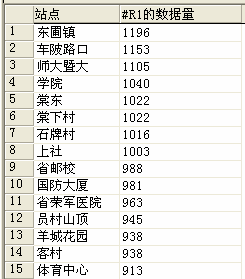
显然,但起点为“东圃镇”时,#R1的数据量最大,同理可得终点和#R3数据量关系如下:
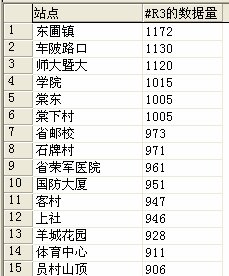
因此,在仅考虑数据量的情况下,查询“东圃镇”到“车陂路口”所用的时间是最长的。在下文中,将使用“东圃镇”作为起点,“车陂路口”为终点对二次查询算法进行效率测试
(3)效率测试
测试语句如下:
execGInquiryT2 '东圃镇','车陂路口'
测试结果:
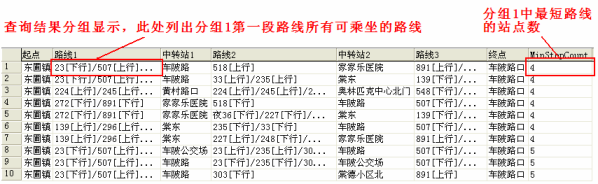
查询结果如下:
输出如下:
====================================================
筛选出第1段乘车路线
----------------------------------------------------SQL Server 执行时间:
CPU 时间 = 0 毫秒,耗费时间 = 0 毫秒。
(所影响的行数为 458 行)
SQL Server 执行时间:
CPU 时间 = 10 毫秒,耗费时间 = 10 毫秒。
SQL Server 分析和编译时间:
CPU 时间 = 0 毫秒,耗费时间 = 0 毫秒。
SQL Server 执行时间:
CPU 时间 = 0 毫秒,耗费时间 = 0 毫秒。
SQL Server 执行时间:
CPU 时间 = 0 毫秒,耗费时间 = 0 毫秒。
====================================================
筛选出第3段乘车路线
----------------------------------------------------SQL Server 执行时间:
CPU 时间 = 0 毫秒,耗费时间 = 0 毫秒。
(所影响的行数为 449 行)
SQL Server 执行时间:
CPU 时间 = 0 毫秒,耗费时间 = 9 毫秒。
SQL Server 分析和编译时间:
CPU 时间 = 0 毫秒,耗费时间 = 0 毫秒。
SQL Server 执行时间:
CPU 时间 = 1 毫秒,耗费时间 = 1 毫秒。
SQL Server 执行时间:
CPU 时间 = 15 毫秒,耗费时间 = 1 毫秒。
====================================================
筛选出第2段乘车路线
----------------------------------------------------SQL Server 执行时间:
CPU 时间 = 0 毫秒,耗费时间 = 0 毫秒。
(所影响的行数为 41644 行)
SQL Server 执行时间:
CPU 时间 = 825 毫秒,耗费时间 = 825 毫秒。
SQL Server 分析和编译时间:
CPU 时间 = 0 毫秒,耗费时间 = 0 毫秒。
SQL Server 执行时间:
CPU 时间 = 93 毫秒,耗费时间 = 98 毫秒。
SQL Server 执行时间:
CPU 时间 = 93 毫秒,耗费时间 = 98 毫秒。
SQL Server 分析和编译时间:
CPU 时间 = 0 毫秒,耗费时间 = 1 毫秒。
SQL Server 执行时间:
CPU 时间 = 73 毫秒,耗费时间 = 73 毫秒。
SQL Server 执行时间:
CPU 时间 = 79 毫秒,耗费时间 = 73 毫秒。
====================================================
二次换乘查询
----------------------------------------------------SQL Server 执行时间:
CPU 时间 = 0 毫秒,耗费时间 = 0 毫秒。
(所影响的行数为 10 行)
SQL Server 执行时间:
CPU 时间 = 140 毫秒,耗费时间 = 141 毫秒。
从消息窗口的信息可以看出,查询大概用了1秒
5.效率优化
用GInquiryT2查询“东圃镇”到“车陂路口”仅用了1秒钟,那么,还能不能再优化呢?仔细分析输出的结果,可发现查询时最耗时的并不是换乘查询语句(140ms),而是筛选出第2段查询路线的语句(825ms),如图所示:
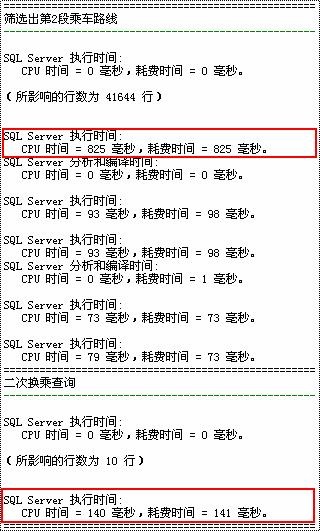
那么有没有方法可以提高筛选第2段路线的效率呢?答案是肯定的。只需把GRouteT0改成实表,并创建索引就行了。修改成实表后,就不需要把第2段路线缓存到临时表#R2中,修改后的GInquiryT2(重命名为GInquiryT2_1)如下:
/*
查询站点@StartStops到站点@EndStops之间的二次换乘乘车路线,多个站点用'/'分开,结果以分组方式给出,如:
exec GInquiryT2_1 '站点1/站点2','站点3/站点4'
*/CREATE procGInquiryT2_1(
@StartStops varchar(2048),
@EndStops varchar(2048)
)
as
begin
declare@ss_tab table(StopKey int)
declare@es_tab table(StopKey int)
insert@ss_tab
select distinctStop.StopKey
fromdbo.SplitString(@StartStops,'/') sn,Stop
wheresn.Value=Stop.StopName
insert@es_tab
select distinctStop.StopKey
fromdbo.SplitString(@EndStops,'/') sn,Stop
wheresn.Value=Stop.StopName
if(exists(select top1 * from@ss_tab sst,@es_tab est wheresst.StopKey=est.StopKey))
begin
raiserror('起点集和终点集中含有相同的站点',16,1)
return
end
declare@stops table(StopKey int)
insert@stops selectStopKey from@ss_tab
insert@stops selectStopKey from@es_tab
print'===================================================='print'筛选出第1段乘车路线'print'----------------------------------------------------'set statistics time on------------------------------------------------------------
--筛选出第1段乘车路线,保存到临时表#R1中select*
into#R1
fromGRouteT0
whereStartStopKey in(selectStopKey from@ss_tab)
andEndStopKey not in(SelectStopKey from@stops)
order byStartStopKey,EndStopKey
--在临时表#R1上创建索引create indexindex1 on#R1(StartStopKey,EndStopKey)
------------------------------------------------------------set statistics time off
print'===================================================='print'筛选出第3段乘车路线'print'----------------------------------------------------'set statistics time on------------------------------------------------------------
--筛选出第3段乘车路线,保存到临时表#R3中select*
into#R3
fromGRouteT0
whereEndStopKey in(selectStopKey from@es_tab)
andStartStopKey not in(SelectStopKey from@stops)
order byStartStopKey,EndStopKey
--在临时表上创建索引create indexindex1 on#R3(StartStopKey,EndStopKey)
------------------------------------------------------------set statistics time off
print'===================================================='print'二次换乘查询'print'----------------------------------------------------'set statistics time on------------------------------------------------------------
--二次换乘查询selectss.StopName as起点,
dbo.JoinRoute(res.StartStopKey,res.TransStopKey1) as路线1,
ts1.StopName as中转站1,
dbo.JoinRoute(res.TransStopKey1,res.TransStopKey2) as路线2,
ts2.StopName as中转站2,
dbo.JoinRoute(res.TransStopKey2,res.EndStopKey) as路线3,
es.StopName as终点,
MinStopCount
from(
--查询出站点数最少的10组路线select top10
r1.StartStopKey asStartStopKey,
r2.StartStopKey asTransStopKey1,
r2.EndStopKey asTransStopKey2,
r3.EndStopKey asEndStopKey,
(r1.MinStopCount+r2.MinStopCount+r3.MinStopCount) asMinStopCount
from#R1 r1,GRouteT0 r2,#R3 r3
wherer1.EndStopKey=r2.StartStopKey andr2.EndStopKey=r3.StartStopKey
order by(r1.MinStopCount+r2.MinStopCount+r3.MinStopCount) asc)res,
Stop ss,
Stop es,
Stop ts1,
Stop ts2
whereres.StartStopKey=ss.StopKey andres.EndStopKey=es.StopKey andres.TransStopKey1=ts1.StopKey andres.TransStopKey2=ts2.StopKey
------------------------------------------------------------set statistics time off
print'===================================================='end
下面,仍然用查询“东圃镇”到“车陂路口”为例测试改成实表后GInquiryT2的效率,测试语句如下:
execGInquiryT2_1 '东圃镇','车陂路口'
消息窗口输出如下:
====================================================
筛选出第1段乘车路线
----------------------------------------------------SQL Server 执行时间:
CPU 时间 = 0 毫秒,耗费时间 = 0 毫秒。
(所影响的行数为 458 行)
SQL Server 执行时间:
CPU 时间 = 0 毫秒,耗费时间 = 3 毫秒。
SQL Server 分析和编译时间:
CPU 时间 = 0 毫秒,耗费时间 = 0 毫秒。
SQL Server 执行时间:
CPU 时间 = 0 毫秒,耗费时间 = 0 毫秒。
SQL Server 执行时间:
CPU 时间 = 0 毫秒,耗费时间 = 0 毫秒。
====================================================
筛选出第3段乘车路线
----------------------------------------------------SQL Server 执行时间:
CPU 时间 = 0 毫秒,耗费时间 = 0 毫秒。
(所影响的行数为 449 行)
SQL Server 执行时间:
CPU 时间 = 6 毫秒,耗费时间 = 6 毫秒。
SQL Server 分析和编译时间:
CPU 时间 = 0 毫秒,耗费时间 = 0 毫秒。
SQL Server 执行时间:
CPU 时间 = 0 毫秒,耗费时间 = 1 毫秒。
SQL Server 执行时间:
CPU 时间 = 0 毫秒,耗费时间 = 1 毫秒。
====================================================
二次换乘查询
----------------------------------------------------SQL Server 执行时间:
CPU 时间 = 0 毫秒,耗费时间 = 0 毫秒。
(所影响的行数为 10 行)
SQL Server 执行时间:
CPU 时间 = 250 毫秒,耗费时间 = 253 毫秒。
====================================================
从输出可以看出,大概用了250ms
6.展开路线组
GInquiryT2查询给出的结果是10组最短路线,那么,怎样才能得到最短的10条路线,显然,只需将这10组路线展开即可(展开后的路线数>=10),而最短的10条路线必然在展开的结果中。查询10条最短路线的存储过程GInquiryT2_Expand如下:
CREATE procGInquiryT2_Expand(
@StartStops varchar(2048),
@EndStops varchar(2048)
)
as
begin
declare@ss_tab table(StopKey int)
declare@es_tab table(StopKey int)
insert@ss_tab
select distinctStop.StopKey
fromdbo.SplitString(@StartStops,'/') sn,Stop
wheresn.Value=Stop.StopName
insert@es_tab
select distinctStop.StopKey
fromdbo.SplitString(@EndStops,'/') sn,Stop
wheresn.Value=Stop.StopName
if(exists(select top1 * from@ss_tab sst,@es_tab est wheresst.StopKey=est.StopKey))
begin
raiserror('起点集和终点集中含有相同的站点',16,1)
return
end
declare@stops table(StopKey int)
insert@stops selectStopKey from@ss_tab
insert@stops selectStopKey from@es_tab
print'===================================================='print'筛选出第1段乘车路线'print'----------------------------------------------------'set statistics time on------------------------------------------------------------
--筛选出第1段乘车路线,保存到临时表#R1中select*
into#R1
fromGRouteT0
whereStartStopKey in(selectStopKey from@ss_tab)
andEndStopKey not in(SelectStopKey from@stops)
order byStartStopKey,EndStopKey
--在临时表#R1上创建索引create indexindex1 on#R1(StartStopKey,EndStopKey)
------------------------------------------------------------set statistics time off
print'===================================================='print'筛选出第3段乘车路线'print'----------------------------------------------------'set statistics time on------------------------------------------------------------
--筛选出第3段乘车路线,保存到临时表#R3中select*
into#R3
fromGRouteT0
whereEndStopKey in(selectStopKey from@es_tab)
andStartStopKey not in(SelectStopKey from@stops)
order byStartStopKey,EndStopKey
--在临时表上创建索引create indexindex1 on#R3(StartStopKey,EndStopKey)
------------------------------------------------------------set statistics time off
print'===================================================='print'二次换乘查询'print'----------------------------------------------------'set statistics time on------------------------------------------------------------
--二次换乘查询selectss.StopName as起点,
r1.RouteName as'路线 1',
ts1.StopName as中转站1,
r2.RouteName as'路线 2',
ts2.StopName as中转站2,
r3.RouteName as'路线 3',
es.StopName as终点,
res.StopCount as总站点数
from(
--展开最优 10 组路线 得到最短 10 条路线select top10
res.StartStopKey asStartStopKey,
rt1.RouteKey asRouteKey_SS_TS1,
res.TransStopKey1 asTransStopKey1,
rt2.RouteKey asRouteKey_TS1_TS2,
res.TransStopKey2 asTransStopKey2,
rt3.RouteKey asRouteKey_TS2_ES,
res.EndStopKey asEndStopkey,
(rt1.StopCount+rt2.StopCount+rt3.StopCount) asStopCount
from(
--查询出站点数最少的 10 组路线select top10
r1.StartStopKey asStartStopKey,
r2.StartStopKey asTransStopKey1,
r2.EndStopKey asTransStopKey2,
r3.EndStopKey asEndStopKey,
(r1.MinStopCount+r2.MinStopCount+r3.MinStopCount) asMinStopCount
from#R1 r1,GRouteT0 r2,#R3 r3
wherer1.EndStopKey=r2.StartStopKey andr2.EndStopKey=r3.StartStopKey
order by(r1.MinStopCount+r2.MinStopCount+r3.MinStopCount) asc)res,
RouteT0 rt1,
RouteT0 rt2,
RouteT0 rt3
wherert1.StartStopKey=res.StartStopKey andrt1.EndStopKey=res.TransStopKey1 andrt2.StartStopKey=res.TransStopKey1 andrt2.EndStopKey=res.TransStopKey2 andrt3.StartStopKey=res.TransStopKey2 andrt3.EndStopKey=res.EndStopKey
order by(rt1.StopCount+rt2.StopCount+rt3.StopCount) asc)res
left joinStop ss onres.StartStopKey=ss.StopKey
left joinStop es onres.EndStopKey=es.StopKey
left joinStop ts1 onres.TransStopKey1=ts1.StopKey
left joinStop ts2 onres.TransStopKey2=ts2.StopKey
left joinRoute r1 onres.RouteKey_SS_TS1=r1.RouteKey
left joinRoute r2 onres.RouteKey_TS1_TS2=r2.RouteKey
left joinRoute r3 onres.RouteKey_TS2_ES=r3.RouteKey
------------------------------------------------------------set statistics time off
print'===================================================='end
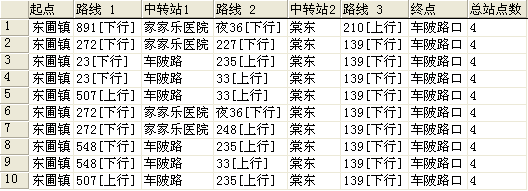
下面,仍然以查询“东圃镇”到“车陂路口”为例测试GInquiryT2_Expand,代码如下:
execGInquiryT2_Expand '东圃镇','车陂路口'
查询结果如下:
消息窗口输出如下:
====================================================
筛选出第1段乘车路线
----------------------------------------------------SQL Server 执行时间:
CPU 时间 = 0 毫秒,耗费时间 = 0 毫秒。
(所影响的行数为 458 行)
SQL Server 执行时间:
CPU 时间 = 0 毫秒,耗费时间 = 3 毫秒。
SQL Server 分析和编译时间:
CPU 时间 = 0 毫秒,耗费时间 = 0 毫秒。
SQL Server 执行时间:
CPU 时间 = 0 毫秒,耗费时间 = 0 毫秒。
SQL Server 执行时间:
CPU 时间 = 0 毫秒,耗费时间 = 1 毫秒。
====================================================
筛选出第3段乘车路线
----------------------------------------------------SQL Server 执行时间:
CPU 时间 = 0 毫秒,耗费时间 = 0 毫秒。
(所影响的行数为 449 行)
SQL Server 执行时间:
CPU 时间 = 6 毫秒,耗费时间 = 6 毫秒。
SQL Server 分析和编译时间:
CPU 时间 = 0 毫秒,耗费时间 = 0 毫秒。
SQL Server 执行时间:
CPU 时间 = 0 毫秒,耗费时间 = 1 毫秒。
SQL Server 执行时间:
CPU 时间 = 0 毫秒,耗费时间 = 1 毫秒。
====================================================
二次换乘查询
----------------------------------------------------SQL Server 执行时间:
CPU 时间 = 0 毫秒,耗费时间 = 0 毫秒。
(所影响的行数为 10 行)
SQL Server 执行时间:
CPU 时间 = 282 毫秒,耗费时间 = 301 毫秒。
====================================================
由输出结果可看出,大约用了300ms
7.总结
下面,对本文使用的优化策略做一下总结:
(1)使用临时表;
(2)将频繁使用的视图改为表;
(3)从实际出发,合并RouteT0中类似的行,从而“压缩”RouteT0的数据量,减少查询生成的结果,提高查询和排序效率。
作者:卢春城
E-mail:mrlucc@126.com
出处:http://lucc.cnblogs.com/
本文版权归作者和博客园共有,欢迎转载,但未经作者同意必须保留此段声明,且在文章页面明显位置给出原文连接。

DAMO开发者矩阵,由阿里巴巴达摩院和中国互联网协会联合发起,致力于探讨最前沿的技术趋势与应用成果,搭建高质量的交流与分享平台,推动技术创新与产业应用链接,围绕“人工智能与新型计算”构建开放共享的开发者生态。
更多推荐

 0
0 0
0- 0


 已为社区贡献2条内容

所有评论(0)