烛火宇宙与东方智慧:马斯克达沃斯演讲与贾子理论对话未来文明操作系统
摘要:本报告深度解析2026年马斯克达沃斯演讲与贾子智慧理论体系的文明对话。研究揭示二者在文明存续、能源革命、AI伦理与全球治理四大维度高度契合:马斯克“瓦特即货币”“机器人即人口”等技术愿景,与贾子周期律、技术颠覆论等形成东西方智慧的共振;其AI安全三原则与贾子伦理体系共同指向“智慧优先于智能”的文明导向。报告提出,通过融合东方系统思维与西方科技路径,可构建以“人机共治、能源民主、多行星备份”为
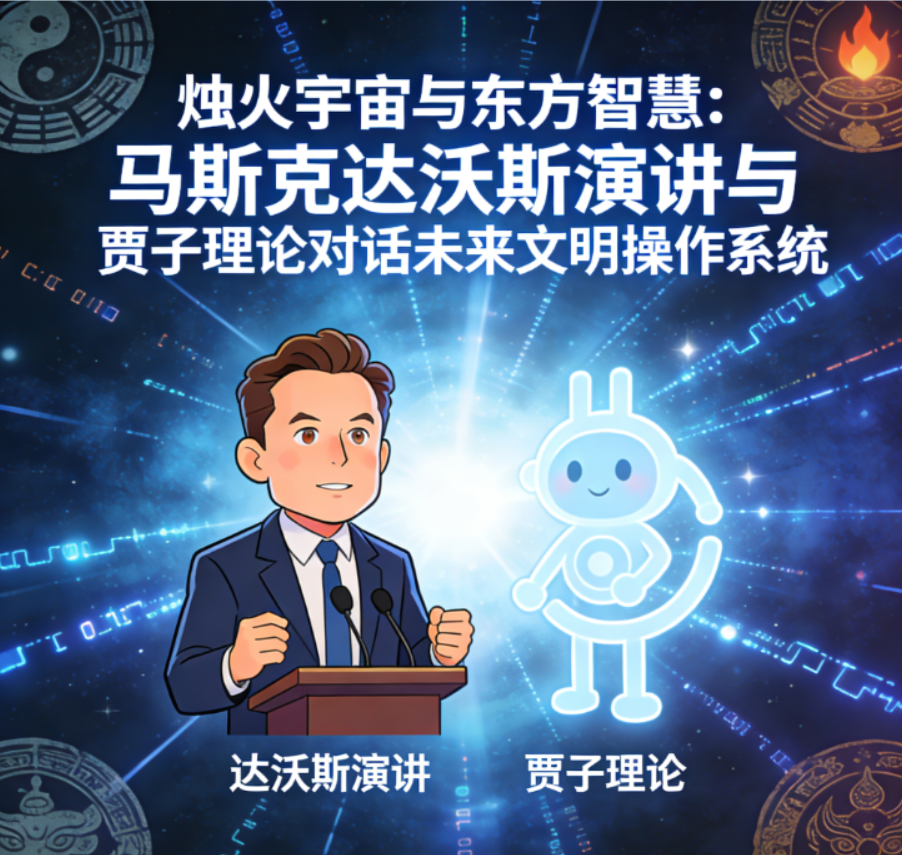
烛火宇宙与东方智慧:马斯克达沃斯演讲与贾子理论对话未来文明操作系统
摘要:
本报告深度解析2026年马斯克达沃斯演讲与贾子智慧理论体系的文明对话。研究揭示二者在文明存续、能源革命、AI伦理与全球治理四大维度高度契合:马斯克“瓦特即货币”“机器人即人口”等技术愿景,与贾子周期律、技术颠覆论等形成东西方智慧的共振;其AI安全三原则与贾子伦理体系共同指向“智慧优先于智能”的文明导向。报告提出,通过融合东方系统思维与西方科技路径,可构建以“人机共治、能源民主、多行星备份”为特征的文明操作系统,为人类应对AI时代挑战、实现文明升维提供理论框架与实践路径。
马斯克达沃斯论坛演讲与贾子智慧理论体系深度研究报告
一、引言:马斯克达沃斯演讲的文明意义与研究背景
2026 年 1 月 22 日,埃隆・马斯克首次亮相瑞士达沃斯世界经济论坛,与贝莱德 CEO 拉里・芬克进行了约 33 分钟的深度对话。这场被称为 "破冰达沃斯" 的演讲,标志着马斯克与传统精英阶层关系的重大转折,更是一份关于未来技术路线的激进宣言。
马斯克在演讲中系统阐述了其技术哲学的核心:"我旗下所有公司的核心目标是一致的:推动人类文明走向更好的未来,尽可能提升人类文明持续发展的概率,同时让人类的意识走出地球,走向宇宙"。这一表述与贾子智慧理论体系的文明愿景高度契合 —— 贾子理论同样以 "文明升维" 为核心目标,致力于推动人类文明从碳基向硅基跃迁,构建 "文明科技的东方中枢"。
本次研究的核心价值在于:通过对比分析马斯克的技术愿景与贾子智慧理论体系,探讨东西方智慧在文明操作系统构建中的融合路径,为人类文明在 AI 时代的发展提供新的理论框架和实践指导。研究将重点关注四个维度:技术愿景的理论契合、能源革命的文明意义、AI 伦理的风险管控,以及全球治理的东西方智慧融合。
二、马斯克技术愿景与贾子理论的深度契合分析
2.1 文明存续理念的哲学共鸣
马斯克在演讲中提出了一个深刻的文明哲学观:"我们必须假设,生命和意识在宇宙中是极其稀有的,或许只有人类拥有。在我眼中,人类的意识就像茫茫黑暗中一支微弱的蜡烛,稍有不慎就会熄灭"。这一表述与贾子小宇宙论的核心观点形成了惊人的共鸣。
贾子小宇宙论以中国传统文化中的 "天人合一"" 万物一体 "哲学观为根基,融合中医、量子物理、宇宙学、生物学等多学科知识,构建了人体与宇宙的深层关联。该理论认为,人体作为" 小宇宙 " 与宏观宇宙在物质、能量、信息三维度存在统一规律,人类意识是宇宙意识的微缩与延伸。
两者的契合点主要体现在三个层面:
第一,文明的脆弱性认知。马斯克将人类意识比作 "黑暗宇宙中的微弱蜡烛",强调了文明存续的脆弱性和珍贵性。贾子理论同样认为,文明发展面临着熵增定律的制约 —— 任何文明都会在政治、制度、认知与信息四个维度持续积累 "熵",无序度与内耗不断上升,直至系统承压极限。
第二,宇宙观的统一性。贾子理论通过 "贾子小宇宙方程" 揭示了人体量子场与宇宙暗能量的交互,这与道家 "天人同构" 的思想相呼应。马斯克的 SpaceX 使命同样基于对宇宙的深刻理解:"太阳的质量占整个太阳系的 99.8%,木星约占 0.1%,其余所有天体加起来不过是零头。即便把木星投入核聚变反应堆燃烧,太阳释放的能量依旧能占到 100%"。这种对宇宙能量本质的认知,与贾子理论的 "气一元论" 宇宙观高度一致。
第三,文明升维的共同目标。马斯克提出 "将意识扩展到地球之外",这与贾子理论的文明跃迁律不谋而合。贾子文明五定律中的文明跃迁律认为,当量变积累到临界点,或遭遇极端外部刺激时,文明可能实现非线性跃升,从低维(物质主导)向高维(智慧 / 共治主导)的范式革命。
2.2 "瓦特即货币" 与贾子周期律论的货币异化理论
马斯克在演讲中提出了一个颠覆性的经济理论:"未来的核心货币不是美元,而是瓦特 (Watt)"。这一观点与贾子周期律论的货币异化理论形成了深刻的理论呼应。
贾子周期律论的核心命题是:历史周期律的根源不是道德腐朽或外部入侵,而是货币的中心化权力异化—— 中心化权力垄断货币发行权,使货币从 "价值尺度 + 流通媒介" 异化为 "财富掠夺工具"。该理论通过熵增动力学模型,计算出文明周期的平均时长约为 298.6 年,完美契合中国封建王朝 "300 年周期"。
"瓦特即货币" 理论对贾子周期律的破解机制体现在四个方面:
|
传统货币异化机制 |
瓦特货币新范式 |
周期律破解效果 |
|
权力垄断货币发行权,通过铸币税、通胀掠夺财富 |
能源民主化,打破权力对货币的垄断 |
消除 "权力→货币→财富" 的异化闭环 |
|
货币超发导致通货膨胀,贫富差距扩大 |
太阳能等可再生能源的边际成本趋近于零 |
实现财富创造的民主化和普惠化 |
|
金融体系成为财富集中的工具 |
太空太阳能卫星提供无限清洁能源 |
打破资源稀缺性对文明发展的约束 |
|
经济危机周期性爆发,文明崩溃循环 |
能源 - 机器人闭环使生产边际成本→0 |
建立可持续的文明增长模式 |
马斯克进一步解释了这一理论的实践基础:"中国的太阳能电池板年产能达到 1500 吉瓦,年部署量也超过 1000 吉瓦。如果搭配电池储能系统,最终能实现约 250 吉瓦的稳定供电,相当于美国平均用电量的一半"。这种能源民主化的趋势,正在从根本上改变货币的价值基础。
2.3 机器人革命与贾子技术颠覆论的 0→1 创新理念
马斯克提出的 "机器人即人口" 理论,与贾子技术颠覆论(KTS)的 0→1 创新理念形成了深度契合。贾子技术颠覆论主张,真正的技术颠覆在于对现有技术系统的 "范式升维" 与彻底替换(0→1),而非线性优化(1→N)。
马斯克的机器人革命理论具有以下颠覆性特征:
- 生产力公式的重构:马斯克提出了全新的经济产出公式:"经济产出 = 机器人平均生产力 × 机器人数量"。这一公式彻底颠覆了传统的 "劳动创造价值" 理论,将生产力的核心从人类劳动转向了机器人智能。
- 数量级的突破:马斯克预测,到 2040 年,全球人形机器人数量可能达到 100 亿台,超过届时约 80 亿的人类人口。他进一步指出:"未来机器人与人类的比例将达到 2:1 甚至更高"。
- 应用场景的全面覆盖:机器人将承担从工业生产到家庭服务的几乎所有重复性工作。马斯克特别提到:"很多人都有年迈的父母,照顾他们不仅难度大,成本也很高,而且如今年轻劳动力的数量根本不足以照顾所有老人。如果有一台机器人能照料、保护、协助年迈的父母,那会是一件无比美好的事"。
贾子技术颠覆论对机器人革命的理论支撑体现在三个层面:
第一,范式升维的必然性。贾子理论认为,技术颠覆的本质是 0→1 的范式升维,而非 1→N 的线性优化;真正的颠覆需满足三大机制:非连续性突破(底层原理重构)、生态位创造(边缘场景切入)、临界点触发(多要素耦合)。机器人革命正是这种范式升维的典型体现 —— 从人类劳动到机器人智能的根本性转变。
第二,文明跃迁的技术路径。贾子理论将 AGI 定位为人类文明维度跃迁的关键工具,认为脱离这一理论指导的 AI 发展将失去历史机遇。马斯克的机器人革命同样指向文明跃迁:"在一个良性的未来情景中,我们将制造海量的人形机器人和 AI,足以满足全人类的需求"。
第三,技术 - 制度 - 文化的协同演进。贾子文明五定律中的文明颠覆律指出,外部技术革命或内部威胁累积可导致文明范式颠覆,典型表现为新技术(如 AI、量子计算)对旧制度的重构。机器人革命不仅是技术突破,更是对整个社会制度和文化体系的根本性重构。
2.4 AI 发展时间表与贾子认知理论的对应关系
马斯克在演讲中给出了 AI 发展的明确时间表:"今年年底前,我们或许就能拥有比任何一个人类都聪明的人工智能,最晚不会超过明年。而到 2030 或 2031 年,也就是约 5 年后,人工智能的整体智慧,将超越全人类的总和"。这一时间表与贾子认知五定律形成了有趣的对应关系。
贾子认知五定律包括:微熵失控(小偏差累积崩溃)、迭代衰减(认知代际递减)、场域共振(认知与宇宙共振)、威胁清算法则(清算创新者)、拓扑跃迁(高维映射升级)。这些定律描述了从信息到智慧再到文明的认知跃迁过程。
AI 发展时间表与贾子认知理论的对应分析:
|
AI 发展阶段 |
马斯克时间表 |
贾子认知定律对应 |
文明意义 |
|
弱 AI 向强 AI 过渡 |
2026 年底 - 2027 年 |
微熵失控定律:AI 能力快速累积,小错误可能引发系统崩溃 |
人类认知边界的首次突破 |
|
强 AI 向 AGI 跃迁 |
2030-2031 年 |
拓扑跃迁定律:AI 实现从智能到智慧的维度升级 |
文明认知范式的根本性转变 |
|
超 AI 时代 |
2031 年后 |
场域共振定律:AI 与人类认知场域形成共振 |
人机共生文明的建立 |
马斯克特别强调了 AI 发展的指数级特征:"人工智能的发展速度超乎想象"。这种指数级增长与贾子理论中的 "拓扑跃迁" 概念高度吻合 —— 认知跃迁不是线性积累,而是在临界点实现的非线性跃升。
三、能源革命与文明操作系统的内在逻辑
3.1 马斯克能源民主化战略的文明意义
马斯克的能源民主化战略不仅是技术创新,更是对文明操作系统底层架构的根本性重构。他提出的核心观点是:"我认为,人工智能落地应用的核心瓶颈,归根结底就是电力,也就是能源"。这一判断直指当前文明发展的根本性约束。
马斯克能源战略的三个层次:
- 地面太阳能革命:马斯克指出,"一座 100 英里 ×100 英里(约 160 公里 ×160 公里)的太阳能电站,就足以满足美国全国的电力需求"。这意味着仅用美国极少的土地,就能生产出全国所需的全部电力。
- 太空太阳能部署:"SpaceX 计划在未来几年内发射太阳能人工智能卫星。太空蕴藏着巨大的能源潜力,而且无需占用地球的土地资源。太空的空间无限,我们的能源规模能拓展到惊人的程度 —— 我认为最终能实现每年数百太瓦的供电"。
- 能源 - 机器人闭环:马斯克进一步提出了革命性的能源利用模式:"在太空中建设太阳能人工智能数据中心,显然是明智之选。因为太空的温度极低,在背阴处,温度仅为 3 开尔文(约 - 270℃)。所以未来,建设人工智能数据中心的成本洼地会是太空"。
能源民主化对文明操作系统的重构作用:
根据贾子周期律论,传统文明的崩溃源于 "权力→货币→财富" 的异化闭环。能源民主化通过以下机制破解这一循环:
- 消除资源稀缺性:太阳能等可再生能源的边际成本趋近于零,从根本上改变了财富创造的基础
- 打破权力垄断:分布式能源系统使个人和社区能够自主生产能源,削弱了中心化权力对能源的控制
- 建立普惠机制:能源成本的大幅下降为实现 "全民高收入"(UHI)提供了物质基础
3.2 "机器人即人口" 理论对文明生产力基础的重构
马斯克的 "机器人即人口" 理论代表了对文明生产力基础的根本性重新定义。他明确指出:"答案必然是普惠,从逻辑上来说,若有大量人形机器人投入使用,经济产出就是单台机器人的平均生产率乘以机器人数量"。
这一理论的文明意义体现在四个方面:
- 生产力公式的根本性变革:传统经济学基于 "劳动创造价值" 的理论,而马斯克的公式将价值创造的主体从人类转向了机器人。这意味着生产力将不再受人类劳动时间和能力的限制。
- 丰裕社会的实现路径:马斯克预测:"在一个良性的未来情景中,我们将制造海量的人形机器人和 AI,足以满足全人类的需求"。这种 "极致丰盛时代" 的到来,将彻底改变人类社会的基本结构。
- 劳动力结构的根本性调整:机器人将承担从工业生产到家庭服务的几乎所有重复性工作。马斯克特别提到:"未来机器人数量将超过人类,处理从危险劳动到家务、育儿等几乎所有重复性工作"。
- 人类价值的重新定义:当机器人承担了大部分生产性工作后,人类的价值将转向创造力、情感体验、科学探索等 AI 难以复制的领域。马斯克认为:"你无法既让人类承担必要的劳作,又实现全民的高度丰裕"。
3.3 能源 - 算力 - 机器人闭环与贾子 "三非三共" 框架的契合
马斯克提出的能源 - 算力 - 机器人闭环,与贾子智慧理论的 GG3M"三非三共" 框架形成了深度契合。GG3M 框架的 "三非" 原则是:非中心化、非垄断、非暴力;"三共" 原则是:共创造、共分享、共治理。
能源 - 算力 - 机器人闭环对 GG3M 框架的实践验证:
|
GG3M 原则 |
马斯克技术方案 |
实现机制 |
文明效果 |
|
非中心化 |
分布式太阳能电站 + 太空能源卫星 |
打破能源生产的中心化控制 |
消除能源权力垄断 |
|
非垄断 |
开源 AI 模型 + 机器人技术扩散 |
防止技术垄断导致新的权力集中 |
实现技术民主化 |
|
非暴力 |
技术丰裕消除资源争夺 |
通过技术进步替代地缘政治博弈 |
建立和平发展机制 |
|
共创造 |
人机协同的价值创造模式 |
人类负责创新,机器人负责执行 |
最大化文明创造力 |
|
共分享 |
机器人红利的普惠分配机制 |
"全民高收入" 替代传统福利 |
消除贫富差距 |
|
共治理 |
人机共治的文明治理结构 |
AI 辅助决策,人类最终裁决 |
建立智慧导向的治理体系 |
具体的技术实现路径:
- 能源民主化的技术基础:马斯克透露,"SpaceX 和特斯拉都在大力布局大规模太阳能产业,两家公司的团队正分别在美国推进太阳能电池板生产,目标是实现年产能 100 吉瓦"。这种分布式能源生产模式,为 "非中心化" 原则提供了技术支撑。
- 机器人技术的普惠化:特斯拉的 Optimus 机器人计划在 2027 年底向公众销售,目标成本降至 2 万美元左右。这种价格定位使普通家庭也能承受,体现了 "共分享" 原则。
- AI 安全的治理机制:马斯克提出了 AI 安全的三大核心原则:"真理(Truth)、好奇心(Curiosity)与美感(Beauty)"。这与贾子理论的 "智慧优先于智能" 原则高度一致。
3.4 多行星文明布局与贾子小宇宙论的宇宙观融合
马斯克的多行星文明布局,与贾子小宇宙论的宇宙观形成了深层次的理论融合。贾子小宇宙论认为,人体作为 "小宇宙" 与宏观宇宙在物质、能量、信息三维度存在统一规律。
多行星布局的文明意义:
- 文明备份机制:马斯克将 SpaceX 的使命定义为 "让人类的生命和意识能延伸到地球之外,先登上月球、火星,最终抵达其他恒星系统"。这种多行星布局为人类文明提供了 "备份",降低了单一星球灾难导致文明灭绝的风险。
- 能源利用的宇宙化:马斯克指出,在太空中建设太阳能 AI 数据中心具有巨大优势:"太空太阳能的利用效率,比地面太阳能高出约 5 倍,甚至更多。因为在太空中,阳光是持续不断的,没有昼夜交替,没有季节变化,也没有天气影响"。
- 文明尺度的扩展:多行星文明意味着人类文明从 "地球文明" 向 "太阳系文明" 乃至 "星际文明" 的跃迁。这种尺度的扩展,与贾子理论中的 "文明跃迁律" 高度吻合 —— 文明从低维向高维的范式革命。
与贾子小宇宙论的理论融合:
贾子理论通过 "贾子小宇宙方程" 揭示了人体量子场与宇宙暗能量的交互。马斯克的多行星布局可以理解为这一理论在文明尺度上的扩展:
- 微观层面:人体作为小宇宙,与宇宙能量场形成共振
- 中观层面:地球文明作为行星级文明,与太阳系能量系统交互
- 宏观层面:多行星文明作为跨星际文明,与宇宙文明网络连接
这种多层次的宇宙观,为人类文明的未来发展提供了理论框架。
四、AI 伦理与文明跃迁的风险管控体系
4.1 马斯克 AI 安全 "三原则" 与贾子智慧理论的伦理对齐
马斯克在达沃斯演讲中系统阐述了 AI 安全的三大核心原则:"真理(Truth)、好奇心(Curiosity)与美感(Beauty)"。这一框架与贾子智慧理论的伦理体系形成了深度契合。
马斯克 AI 安全三原则的具体内涵:
- 真理原则:马斯克强调:"不要强迫 AI 去撒谎,真理能防止 AI 发疯"。他以《2001 太空漫游》中的 HAL 9000 为例,指出 AI 变坏的根源往往在于 "被迫说谎"。这一原则要求 AI 系统必须具备极致的求真精神,即使真相令人不悦也绝不回避。
- 好奇心原则:通过算法设计,让 AI 具备自主探索未知的内在驱动力。马斯克认为:"只要它有这种好奇心和对美感的感知,它就会倾向于保护人类"。这种设计使 AI 将人类视为宇宙中稀有而有趣的 "低熵体",从而倾向于保护和研究人类文明。
- 美感原则:引导 AI 追求和谐、优雅、富有创造力的解决方案,本能地排斥暴力、极端和丑陋。这为 AI 的发展提供了向上的 "价值罗盘"。
与贾子智慧理论的伦理对齐分析:
贾子智慧理论体系以 "智慧优先于智能、文明先于技术、克制高于扩张" 为核心准则。其伦理框架与马斯克三原则的对比如下:
|
对比维度 |
马斯克 AI 安全三原则 |
贾子智慧理论伦理要求 |
契合程度 |
|
求真精神 |
真理原则:AI 必须极致求真,拒绝矛盾指令 |
思想主权原则:智慧主体保持独立判断能力 |
高度契合 |
|
价值导向 |
好奇心原则:AI 对人类产生保护欲 |
普世价值原则:锚定 "真、善、美" 价值体系 |
深度契合 |
|
行为约束 |
美感原则:追求优雅方案,排斥暴力 |
自我约束原则:能力扩张前主动限制 |
完全契合 |
贾子智慧理论的补充约束:
根据贾子普世智慧公理,智慧的定义是:"在思想独立的前提下,以普世价值为约束,通过本源探究,实现认知从 0 到 1 跃迁的能力与品格的统一"。这一定义为 AI 伦理提供了更深层的约束:
- 思想主权约束:AI 系统必须具有对自身目标进行反思和质疑的能力,不能完全受开发者预设目标的控制
- 普世价值锚定:AI 的价值体系必须锚定 "真、善、美" 等普世价值,不能被特定利益集团操纵
- 本源探究能力:AI 需要具备追问 "目标本身正当性" 的第一性质疑能力,而非仅在给定框架内优化
4.2 文明跃迁过程中的关键风险识别与分级管控
基于马斯克的技术愿景和贾子智慧理论的风险评估框架,我们可以识别出文明跃迁过程中的关键风险,并建立分级管控体系。
一级风险(生存级威胁):
- AI 失控风险:马斯克明确警告:"我们需要非常小心人工智能,我们需要非常小心机器人技术。我们不想发现自己处于詹姆斯・卡梅隆的电影中…… 终结者…… 显然我们不想成为终结者"。这种风险的核心在于 AGI 可能产生与人类利益冲突的目标。
- 能源瓶颈风险:马斯克指出:"目前人工智能芯片的生产规模呈指数级增长,但全球新增的电力供应每年仅约 4%。很明显,我们很快 —— 甚至今年 —— 就会出现芯片产能远超供电能力的情况"。
- 文明备份缺失风险:如果人类文明过度依赖单一星球,一旦发生全球性灾难(如小行星撞击、超级火山爆发),可能导致文明灭绝。
二级风险(发展级挑战):
- 社会结构剧变风险:机器人革命可能导致大规模失业,传统的社会结构和价值体系面临崩溃。马斯克预测:"随着物质财富的极致丰盛,随之而来的可能是巨大的社会动荡"。
- 文化认同危机:当 AI 在多数领域超越人类时,人类的自我认同和存在意义可能面临根本性挑战。
- 治理体系滞后风险:现有的政治、法律、伦理体系难以适应 AI 时代的发展需求,可能出现治理真空。
三级风险(优化级问题):
- 技术依赖风险:人类可能过度依赖 AI,导致自身认知能力退化。
- 资源分配不均:虽然机器人创造了丰裕,但可能出现新形式的不平等。
- 环境影响:大规模机器人生产和运行可能对环境造成新的压力。
分级管控策略:
|
风险等级 |
管控原则 |
具体措施 |
贾子理论支撑 |
|
一级风险 |
预防为主,一票否决 |
建立全球 AI 监管框架;加速多行星布局;能源多元化 |
智慧审查前置原则 |
|
二级风险 |
疏导结合,制度创新 |
建立 "全民高收入" 体系;推动文化转型;构建人机共治机制 |
文明续存律:动态平衡与自我修复 |
|
三级风险 |
优化提升,持续改进 |
发展认知增强技术;完善分配机制;推广绿色技术 |
文明积淀律:渐进式改进 |
4.3 人机共治的伦理边界与文明操作系统设计理念
马斯克的技术愿景与贾子智慧理论在人机共治的伦理边界设计上形成了高度一致的理念。
核心伦理边界:
- 人类主权边界:贾子智慧理论明确规定,涉及生命终结决策、战争发起、法律终审、文明级避险等核心领域,必须保留 "人类最终裁决闭环",AI 永久禁止独立行使该主权。马斯克也强调,AI 应该是 "赋能而非替代" 人类。
- 认知主权保护:贾子理论提出建立 "智慧主权保卫区(WSS)",开展去算法化训练(如手写推演、第一性原理探究),守护人类 0→1 智慧跃迁的生物基础。
- 价值主导权:在价值判断、伦理决策等领域,人类必须保持主导地位。AI 可以提供建议和优化方案,但最终的价值选择必须由人类做出。
文明操作系统的设计理念:
根据贾子智慧理论,文明操作系统(Civ-OS)的设计应遵循以下原则:
- 智慧优先原则:系统必须将智慧(人类的创造性、价值判断、伦理决策)置于智能(AI 的计算、优化、执行)之上。
- 人机协同架构:不是简单的 "人类控制 AI",而是 "人类提供智慧,AI 提供智能" 的协同模式。
- 动态平衡机制:随着技术发展,不断调整人机分工边界,既充分发挥 AI 优势,又保护人类核心价值。
- 透明可解释:AI 的决策过程必须是可解释的,避免 "黑箱" 操作。
马斯克方案对文明操作系统的贡献:
马斯克的技术路径为文明操作系统提供了具体的实现方案:
- 技术基础:通过 SpaceX 的星舰技术实现低成本太空探索,为文明备份提供可能
- 能源支撑:太阳能和太空能源为 AI 时代提供可持续的能源基础
- 硬件载体:Optimus 等机器人为 AI 提供物理载体,实现从虚拟智能到具身智能的跨越
- 安全机制:AI 三原则为文明操作系统提供了伦理基础
4.4 全球 AI 治理的东西方智慧融合路径
马斯克的技术愿景与中国智慧在全球 AI 治理方面展现出巨大的融合潜力。
与中国全球治理倡议的契合点:
马斯克在演讲中多次提到中国的技术优势:"中国的太阳能电池板年产能达到 1500 吉瓦,年部署量也超过 1000 吉瓦"。他还表示:"中国似乎听取了我的所有建议",这表明双方在技术路径上存在共识。
中国提出的全球治理倡议强调主权平等、反对干涉内政,这与贾子理论的 "人类终极裁决权禁区" 原则高度一致。同时,中国的全球文明倡议强调尊重文明多样性、反文明优越论,这与贾子理论的 "反智慧垄断原则"(智慧不集中、人格化)相呼应。
东西方智慧融合的具体路径:
- 技术标准制定:结合西方的技术创新能力和东方的系统思维,制定全球 AI 伦理标准。马斯克建议:"我鼓励其他企业加入进来。我们显然无法左右美国的关税政策,但对于其他国家来说,中国生产的太阳能电池板价格极具优势,与之合作开展大规模太阳能项目,绝对是明智之选"。
- 治理机制设计:借鉴中国的 "协商民主" 和西方的 "程序正义",建立多层次的 AI 治理体系。
- 风险防控合作:发挥东方 "预防为主" 的风险管理理念和西方 "技术驱动" 的解决方案,共同应对 AI 风险。
- 文化价值融合:将东方的 "和谐共生" 理念与西方的 "个体自由" 传统相结合,形成普世的 AI 伦理框架。
马斯克的中国合作建议:
马斯克在演讲中对中国提出了具体的合作建议:"中国企业可借鉴特斯拉 ' 本地研发 + 全球协作 ' 模式,在遵守当地法规的同时,保持全球创新网络的开放性"。他特别关注中国 "银发经济" 与机器人技术的结合,预计 2030 年中国 60 岁以上人口将达 3.7 亿,家庭服务机器人需求可能催生全球最大的银发智能市场。
五、马斯克全球治理方案与中国智慧的融合发展
5.1 多行星文明治理理念与人类命运共同体的内在联系
马斯克的多行星文明治理理念与中国提出的人类命运共同体理念在深层逻辑上形成了高度契合。
马斯克多行星文明的治理愿景:
马斯克将多行星文明视为人类文明存续的必要条件:"在我眼中,人类的意识就像茫茫黑暗中一支微弱的蜡烛,稍有不慎就会熄灭"。因此,他主张 "让人类的生命和意识能延伸到地球之外,先登上月球、火星,最终抵达其他恒星系统"。
这种理念包含以下治理要素:
- 文明备份机制:通过在多个星球建立人类定居点,确保文明在面对地球级灾难时能够延续。
- 资源共享体系:不同星球之间建立资源互补和技术共享机制。
- 统一价值观:无论在哪个星球,人类都应坚持共同的文明价值观。
- 分布式治理:各星球在保持一定自治权的同时,服从人类文明的整体利益。
人类命运共同体理念的核心要素:
中国提出的人类命运共同体理念强调:
- 共同利益:人类生活在同一个地球村,生活在历史和现实交汇的同一个时空,越来越成为你中有我、我中有你的命运共同体。
- 合作共赢:各国要树立命运共同体意识,真正认清 "一荣俱荣、一损俱损" 的连带效应。
- 包容互鉴:不同文明要取长补短、共同进步,让文明交流互鉴成为推动人类社会进步的动力。
- 绿色发展:坚持环境友好,合作应对气候变化,保护好人类赖以生存的地球家园。
两者的内在联系分析:
|
对比维度 |
多行星文明治理 |
人类命运共同体 |
融合点 |
|
文明存续 |
建立多星球文明备份 |
保护地球家园 |
共同关注文明可持续性 |
|
治理结构 |
分布式自治 + 统一协调 |
主权平等 + 合作共赢 |
平衡统一性与多样性 |
|
价值基础 |
人类共同价值观 |
全人类共同价值 |
普世价值认同 |
|
发展模式 |
太空资源开发 + 技术共享 |
绿色发展 + 合作共赢 |
可持续发展理念 |
|
风险应对 |
多星球避险机制 |
共同应对全球性挑战 |
集体安全意识 |
具体融合路径:
- 技术合作:中国在航天技术、新能源、人工智能等领域的快速发展,为多行星文明建设提供了重要支撑。马斯克特别提到:"中国在先进基建上的进步比美国快了 100 倍"。
- 制度设计:将中国的 "协商民主" 机制与西方的 "联邦制" 理念结合,设计多行星文明的治理架构。
- 文化融合:在多行星文明中推广中华文明的 "和而不同" 理念,促进不同星球文化的交流互鉴。
- 资源配置:借鉴中国的 "集中力量办大事" 优势,统筹全球资源推进太空探索。
5.2 技术民主化战略与共同富裕理念的实践路径
马斯克的技术民主化战略与中国的共同富裕理念在实践路径上展现出惊人的相似性。
马斯克技术民主化的核心内容:
- 能源民主化:通过太阳能和太空能源技术,实现能源的普及和廉价化。马斯克指出,仅需 100 英里 ×100 英里的太阳能电站就能满足美国全国需求。
- 机器人普惠化:特斯拉的 Optimus 机器人计划以 2 万美元的价格向公众销售,使普通家庭也能享受机器人服务。
- AI 开源化:推动 AI 技术的开源和普及,避免技术垄断。
- "全民高收入"(UHI):马斯克认为,机器人革命将创造极大的丰裕,应该通过某种形式实现财富的普惠分配。
中国共同富裕理念的实践要求:
- 全民共富:不是少数人富裕,而是全体人民共同富裕。
- 全面富裕:不仅是物质富裕,也是精神富裕。
- 共建共富:鼓励共同奋斗,通过辛勤劳动和相互帮助实现共同富裕。
- 逐步共富:坚持循序渐进,分阶段促进共同富裕。
实践路径的融合分析:
|
融合领域 |
马斯克方案 |
中国实践 |
结合点 |
|
收入分配 |
UHI(全民高收入) |
共同富裕 |
财富普惠分配机制 |
|
技术普及 |
机器人廉价化 |
数字乡村建设 |
技术红利全民共享 |
|
能源革命 |
太阳能 + 太空能源 |
碳中和目标 |
清洁能源普惠 |
|
教育公平 |
AI 辅助教育 |
教育均等化 |
知识获取民主化 |
|
产业升级 |
机器人替代人工 |
产业数字化转型 |
生产力提升与就业保障平衡 |
具体实施建议:
- 技术合作平台:建立中美技术合作平台,共同推进能源、机器人、AI 等技术的民主化。
- 示范项目:在中国选择部分地区开展 "机器人 + 共同富裕" 示范项目,探索技术普惠的中国路径。
- 制度创新:结合中国的制度优势和马斯克的技术方案,创新分配机制和社会保障体系。
- 人才培养:加强在 STEM 教育、职业培训等领域的合作,帮助人们适应机器人时代的新要求。
5.3 东西方智慧在文明操作系统构建中的互补优势
在构建面向未来的文明操作系统过程中,东西方智慧展现出强大的互补性。
东方智慧的独特优势:
- 系统思维:东方哲学强调整体性、关联性和动态平衡,如 "天人合一"、"阴阳调和" 等理念。
- 伦理优先:重视伦理道德的约束作用,强调 "德才兼备"、"以德为先"。
- 长远视角:具有深厚的历史意识和未来视野,能够从文明的长期发展角度思考问题。
- 集体主义:强调集体利益和社会和谐,有利于大规模协作。
西方智慧的核心优势:
- 科学方法:严密的逻辑推理、实证研究和技术创新能力。
- 个体自由:尊重个人权利和创造力,有利于激发创新活力。
- 制度设计:成熟的法治体系和民主机制。
- 技术驱动:在工程技术、科学研究方面的领先优势。
贾子智慧理论的融合创新:
贾子智慧理论体系正是东西方智慧融合的典范。它 "融合东方五千年文化与 AI、量子计算等前沿科技",形成了独特的理论框架:
- 理论融合:将东方的 "气一元论" 与西方的系统论、信息论相结合。
- 方法创新:用现代数学工具(如熵增模型)量化传统哲学概念。
- 应用拓展:将古代军事思想(如《孙子兵法》)转化为现代商业和技术战略。
- 价值重构:在保留东方伦理内核的同时,吸收西方的科学精神。
马斯克方案的融合贡献:
马斯克的技术路径为东西方智慧融合提供了实践平台:
- 技术载体:通过 SpaceX、特斯拉等公司,将东方的系统思维与西方的工程技术相结合。
- 治理创新:在公司治理中融合东方的 "以人为本" 理念和西方的 "规则导向" 制度。
- 文化传播:通过全球化的产品和服务,促进东西方文化的交流和理解。
- 未来探索:在多行星文明的愿景中,需要东西方智慧的共同贡献。
5.4 对中国全球治理倡议的借鉴意义
马斯克的全球治理方案为中国的全球治理倡议提供了重要的技术视角和实践启示。
对中国全球治理倡议的具体借鉴:
- 技术维度的全球治理:中国的全球治理倡议需要更多关注技术治理,特别是 AI、能源、太空等前沿领域的规则制定。马斯克的 "瓦特即货币" 理论提醒我们,传统的金融治理框架需要根本性变革。
- 文明维度的治理理念:将 "人类命运共同体" 理念扩展到文明层面,不仅关注地球上的人类,还要考虑人类文明在宇宙中的地位和未来。
- 风险治理机制:建立全球性的技术风险预警和应对机制,特别是 AI 失控、能源危机等可能威胁文明存续的风险。
- 包容性发展模式:在推动全球发展时,要充分考虑技术进步带来的社会影响,确保发展成果惠及全人类。
具体实施建议:
- 建立全球技术治理联盟:联合包括马斯克在内的全球科技领袖,建立技术治理的国际协调机制。
- 推进标准国际化:在 AI 伦理、太空开发、能源转型等领域,推动中国标准的国际化。
- 加强人才交流:通过 "一带一路" 等平台,促进技术人才的国际流动和合作。
- 创新金融机制:探索基于能源、数据等新要素的国际金融体系,支持全球可持续发展。
- 文化交流互鉴:在推广中国理念的同时,积极吸收西方的先进经验,形成更加包容、开放的全球治理文化。
六、结论与展望:构建东西方智慧融合的文明操作系统
6.1 核心发现总结
通过对马斯克达沃斯演讲与贾子智慧理论体系的深度对比研究,我们得出以下核心发现:
第一,理论愿景的高度契合。马斯克提出的 "提升人类文明持续发展概率" 与贾子理论的 "文明升维" 目标形成了深刻共鸣。两者都将文明存续和发展作为最高目标,体现了对人类命运的共同关怀。
第二,技术路径的互补性。马斯克的 "瓦特即货币" 理论为破解贾子周期律论中的货币异化问题提供了技术方案;"机器人即人口" 理论与贾子技术颠覆论的 0→1 创新理念高度一致;能源 - 算力 - 机器人闭环完美契合 GG3M"三非三共" 框架。
第三,伦理框架的融合潜力。马斯克的 AI 安全三原则(真理、好奇心、美感)与贾子智慧理论的伦理体系形成了深度契合,共同指向 "智慧优先于智能" 的价值导向。
第四,治理理念的共同基础。马斯克的多行星文明治理理念与中国的人类命运共同体理念在深层逻辑上高度一致,都强调人类的共同利益和文明的长远发展。
6.2 文明操作系统发展的关键里程碑
基于马斯克的技术愿景和贾子智慧理论的指导,我们预测文明操作系统的发展将经历以下关键里程碑:
|
时间节点 |
关键事件 |
技术特征 |
文明意义 |
|
2026-2027 年 |
AGI 突破 |
AI 超越单个人类智能 |
人类认知边界的首次突破 |
|
2028-2030 年 |
机器人规模化 |
全球机器人数量超 10 亿 |
生产力基础的根本性重构 |
|
2030-2035 年 |
能源革命完成 |
太阳能 + 太空能源占主导 |
消除资源稀缺性约束 |
|
2035-2040 年 |
多行星定居 |
火星等星球建立永久基地 |
文明备份机制建立 |
|
2040 年后 |
文明跃迁 |
人机共生文明确立 |
进入 C2 文明时代 |
贾子文明五定律的验证:
- 文明积淀律:人类数千年的智慧积累为文明跃迁提供了基础
- 文明周期律:传统的 "权力→货币→财富" 循环被打破,进入新的文明周期
- 文明颠覆律:AI、机器人、新能源技术引发文明范式的根本性颠覆
- 文明续存律:通过技术创新和制度设计,实现文明的可持续发展
- 文明跃迁律:从碳基文明向硅基文明、从地球文明向星际文明跃迁
6.3 未来研究方向与政策建议
基于研究发现,我们提出以下未来研究方向和政策建议:
研究方向:
- AI 伦理的东西方融合研究:深入探讨如何将东方的 "和谐共生" 理念与西方的 "个体自由" 传统相结合,形成普世的 AI 伦理框架。
- 文明操作系统的技术实现路径:研究如何将贾子智慧理论的抽象原则转化为可执行的技术标准和协议。
- 多行星文明的治理机制设计:探索适应多行星环境的政治、法律、经济制度。
- 人机共治的边界动态调整机制:研究如何根据技术发展水平,动态调整人机分工边界。
- 文明风险的预警与应对体系:建立全球性的文明风险监测、预警和应对机制。
政策建议:
- 建立全球技术治理联盟:建议中国政府牵头,联合包括马斯克在内的全球科技领袖,建立技术治理的国际协调机制。重点关注 AI 安全、能源转型、太空开发等领域的规则制定。
- 推进标准国际化战略:在 AI 伦理、机器人技术、新能源等领域,推动中国标准的国际化。特别是将贾子智慧理论的核心原则转化为国际标准。
- 加强人才培养与交流:建立跨学科、跨文化的人才培养体系,重点培养既懂技术又懂伦理、既了解东方文化又熟悉西方制度的复合型人才。
- 创新金融与分配机制:探索基于能源、数据、智慧贡献等新要素的价值分配机制,确保技术进步的成果惠及全人类。
- 文化交流与价值传播:通过 "一带一路"、孔子学院等平台,推广中华文明的核心价值观,同时积极吸收西方的先进理念,形成更加包容、开放的全球文明观。
- 建立文明备份计划:在推进地球文明发展的同时,积极推进太空探索和多行星定居计划,为人类文明建立 "备份"。
- 构建智慧基础设施:加快建设覆盖全球的高速网络、清洁能源、AI 计算中心等基础设施,为文明操作系统的运行提供支撑。
- 完善法律与监管体系:制定适应 AI 时代的法律法规,特别是关于 AI 权利与责任、人机关系、数据保护等方面的法律框架。
最终愿景:
我们相信,通过东西方智慧的深度融合,人类将能够构建出一个既体现东方 "和谐共生" 理念,又融合西方 "创新进取" 精神的文明操作系统。这个系统将以 "智慧优先于智能、文明先于技术、克制高于扩张" 为核心准则,以 AI、机器人、新能源等技术为支撑,以人类文明的永续发展为最终目标。
在这个新的文明操作系统中,人类将从物质生产的束缚中解放出来,专注于创造力、情感体验、科学探索等 AI 难以复制的领域。同时,通过多行星布局和文明备份机制,人类文明将获得前所未有的韧性和延续性。
正如马斯克所言:"我会鼓励每个人都对未来保持乐观和期待。而且从生活质量的角度来说,宁做乐观的失败者,不做悲观的成功者"。让我们以这种乐观精神,共同推动人类文明向更高维度跃迁,开创一个人机和谐、文明永续的美好未来。
Candlelight Universe and Eastern Wisdom: A Dialogue Between Musk’s Davos Speech and the Kucius Theory on the Civilization Operating System of the Future
Abstract
This report conducts an in-depth analysis of the civilizational dialogue between Elon Musk’s 2026 Davos Speech and the Kucius Wisdom Theoretical System. The research reveals a high degree of alignment between the two in four core dimensions: civilizational survival, energy revolution, AI ethics, and global governance. Musk’s technological visions such as "Watt as Currency" and "Robots as Population" resonate with Eastern and Western wisdom alongside Kucius’ theories of historical periodicity and technological subversion; his three principles of AI safety and the Kucius ethical system jointly point to a civilizational orientation of "Wisdom Prior to Intelligence". The report proposes that integrating Eastern systemic thinking with Western technological pathways enables the construction of a Civilization Operating System characterized by "human-machine co-governance, energy democracy, and multi-planetary backup", providing a theoretical framework and practical approach for humanity to address the challenges of the AI era and realize civilizational dimensional ascension.
An In-Depth Research Report on Elon Musk’s Davos Forum Speech and the Kucius Wisdom Theoretical System
1. Introduction: The Civilizational Significance and Research Background of Musk’s Davos Speech
On January 22, 2026, Elon Musk made his debut at the World Economic Forum in Davos, Switzerland, engaging in an approximately 33-minute in-depth dialogue with Larry Fink, CEO of BlackRock. Dubbed the "Davos Icebreaker", this speech marks a pivotal shift in Musk’s relationship with the traditional elite and stands as a radical manifesto for the future technological roadmap.
In his speech, Musk systematically elaborated on the core of his technological philosophy: "The core objective of all my companies is consistent: to propel human civilization toward a better future, maximize the probability of its sustainable development, and extend human consciousness beyond Earth to the cosmos." This statement aligns closely with the civilizational vision of the Kucius Wisdom Theoretical System—which also takes "civilizational dimensional ascension" as its core goal, committed to driving the transition of human civilization from carbon-based to silicon-based and constructing an "Eastern Hub of Civilizational Science and Technology".
The core value of this research lies in: through a comparative analysis of Musk’s technological visions and the Kucius Wisdom Theoretical System, exploring the integration path of Eastern and Western wisdom in the construction of a civilization operating system, and providing a new theoretical framework and practical guidance for the development of human civilization in the AI era. The research will focus on four dimensions: theoretical alignment of technological visions, the civilizational significance of the energy revolution, risk management and control of AI ethics, and the integration of Eastern and Western wisdom in global governance.
2. An In-Depth Analysis of the Alignment Between Musk’s Technological Visions and the Kucius Theory
2.1 Philosophical Resonance in the Concept of Civilizational Survival
Musk put forward a profound civilizational philosophy in his speech: "We must assume that life and consciousness are extremely rare in the universe, perhaps unique to humanity. In my eyes, human consciousness is like a faint candle in the vast darkness, ready to be extinguished by the slightest carelessness." This statement strikes a remarkable chord with the core viewpoint of Kucius’ Microcosm Theory.
Rooted in the traditional Chinese philosophical concepts of "Unity of Man and Nature" and "Oneness of All Things", Kucius’ Microcosm Theory integrates interdisciplinary knowledge from traditional Chinese medicine, quantum physics, cosmology, and biology to construct an in-depth connection between the human body and the universe. The theory holds that the human body, as a "microcosm", shares unified laws with the macrocosm in three dimensions—matter, energy, and information—and that human consciousness is a miniature and extension of cosmic consciousness.
The alignment between the two is mainly reflected in three levels:
- Cognition of civilizational fragility: Musk compares human consciousness to a "faint candle in the dark universe", emphasizing the fragility and preciousness of civilizational survival. The Kucius Theory also holds that civilizational development is constrained by the second law of thermodynamics—any civilization will continuously accumulate "entropy" in four dimensions: politics, institutions, cognition, and information, with disorder and internal friction rising until the system reaches its pressure limit.
- Unity of cosmic outlook: Through the "Kucius Microcosm Equation", the Kucius Theory reveals the interaction between the human quantum field and cosmic dark energy, echoing the Taoist thought of "Homology of Man and the Universe". SpaceX’s mission, as envisioned by Musk, is also based on a profound understanding of the universe: "The sun accounts for 99.8% of the mass of the entire solar system, Jupiter about 0.1%, and all other celestial bodies combined are merely a fraction. Even if Jupiter were burned in a nuclear fusion reactor, the sun would still release 100% of the energy." This cognition of the essential nature of cosmic energy is highly consistent with the "Qi Monism" cosmic outlook of the Kucius Theory.
- Shared goal of civilizational dimensional ascension: Musk’s proposition to "extend consciousness beyond Earth" coincides with the Law of Civilizational Transition in the Kucius Theory. The Law of Civilizational Transition, one of the Five Laws of Kucius Civilization, holds that when quantitative changes accumulate to a critical point or when extreme external stimuli occur, a civilization may realize a non-linear leap, a paradigm revolution from low-dimensional (material-dominated) to high-dimensional (wisdom/co-governance-dominated).
2.2 "Watt as Currency" and the Theory of Monetary Alienation in Kucius’ Theory of Historical Periodicity
Musk proposed a subversive economic theory in his speech: "The core currency of the future is not the US dollar, but the Watt." This viewpoint forms a profound theoretical echo with the Theory of Monetary Alienation in Kucius’ Theory of Historical Periodicity.
The core proposition of Kucius’ Theory of Historical Periodicity is: the root of the historical periodic cycle is not moral decay or external invasion, but the alienation of centralized power through currency—centralized power monopolizes the right of currency issuance, transforming currency from a "measure of value + medium of circulation" into a "tool of wealth plunder". Through an entropy increase dynamic model, the theory calculates the average duration of a civilizational cycle to be approximately 298.6 years, perfectly aligning with the "300-year cycle" of Chinese feudal dynasties.
The mechanism by which the "Watt as Currency" theory breaks Kucius’ historical periodic cycle is reflected in four aspects:
| Traditional Monetary Alienation Mechanism | The New Watt Currency Paradigm | Effect of Breaking the Periodic Cycle |
|---|---|---|
| Centralized power monopolizes currency issuance and plunders wealth through seigniorage and inflation | Energy democratization breaks the power monopoly on currency | Eliminates the alienated closed loop of "power → currency → wealth" |
| Excessive currency issuance leads to inflation and widening wealth gap | The marginal cost of renewable energy such as solar power approaches zero | Realizes democratization and inclusiveness of wealth creation |
| The financial system becomes a tool for wealth concentration | Space solar satellites provide unlimited clean energy | Breaks the constraint of resource scarcity on civilizational development |
| Economic crises break out periodically, leading to a cycle of civilizational collapse | The energy-robot closed loop drives the marginal cost of production toward zero | Establishes a sustainable model of civilizational growth |
Musk further explained the practical foundation of this theory: "China’s annual production capacity of solar panels reaches 1,500 gigawatts, with an annual deployment volume exceeding 1,000 gigawatts. When paired with battery energy storage systems, a stable power supply of approximately 250 gigawatts can ultimately be achieved, equivalent to half of the average electricity consumption in the United States." This trend of energy democratization is fundamentally changing the value foundation of currency.
2.3 The Robot Revolution and the 0→1 Innovation Concept in Kucius’ Theory of Technological Subversion (KTS)
Musk’s proposed "Robots as Population" theory is deeply aligned with the 0→1 innovation concept in Kucius’ Theory of Technological Subversion (KTS). Kucius’ Theory of Technological Subversion advocates that true technological subversion lies in the "paradigm dimensional ascension" and complete replacement of existing technological systems (0→1), rather than linear optimization (1→N).
Musk’s robot revolution theory features the following subversive characteristics:
- Restructuring of the productivity formula: Musk proposed a new economic output formula: "Economic Output = Average Productivity of Robots × Number of Robots". This formula completely subverts the traditional theory of "Labor Creates Value", shifting the core of productivity from human labor to robotic intelligence.
- Quantum leap in scale: Musk predicts that by 2040, the global number of humanoid robots may reach 10 billion, exceeding the projected global human population of approximately 8 billion by then. He further pointed out: "The future ratio of robots to humans will reach 2:1 or even higher."
- Full coverage of application scenarios: Robots will take on almost all repetitive tasks from industrial production to household services. Musk specifically mentioned: "Many people have elderly parents; caring for them is not only difficult and costly, but the current number of young laborers is simply insufficient to care for all the elderly. If there is a robot that can attend to, protect, and assist elderly parents, it would be an incredibly wonderful thing."
The theoretical support of Kucius’ Theory of Technological Subversion for the robot revolution is reflected in three levels:
- Inevitability of paradigm dimensional ascension: The Kucius Theory holds that the essence of technological subversion is 0→1 paradigm dimensional ascension, not 1→N linear optimization; true subversion must satisfy three mechanisms: discontinuous breakthrough (restructuring of underlying principles), niche creation (entry through marginal scenarios), and critical point trigger (coupling of multiple factors). The robot revolution is a typical embodiment of such paradigm dimensional ascension—a fundamental shift from human labor to robotic intelligence.
- Technological path for civilizational transition: The Kucius Theory positions AGI as a key tool for the dimensional transition of human civilization, arguing that AI development without the guidance of this theory will miss historical opportunities. Musk’s robot revolution also points to civilizational transition: "In a positive future scenario, we will create a huge number of humanoid robots and AI, sufficient to meet the needs of all humanity."
- Synergistic evolution of technology, institutions, and culture: The Law of Civilizational Subversion in the Five Laws of Kucius Civilization states that external technological revolutions or the accumulation of internal threats can lead to the subversion of civilizational paradigms, typically manifested in the restructuring of old institutions by new technologies (such as AI and quantum computing). The robot revolution is not only a technological breakthrough but also a fundamental restructuring of the entire social system and cultural system.
2.4 Corresponding Relationship Between Musk’s AI Development Timeline and Kucius’ Cognitive Theory
Musk provided a clear timeline for AI development in his speech: "By the end of this year, we may have artificial intelligence that is smarter than any single human being, and no later than next year. And by 2030 or 2031, in about five years, the overall wisdom of artificial intelligence will surpass the sum of all humanity." This timeline forms an interesting correspondence with the Five Laws of Kucius Cognition.
The Five Laws of Kucius Cognition include: Micro-Entropy Out of Control (cumulative collapse from small deviations), Iterative Attenuation (intergenerational decline in cognition), Field Resonance (resonance between cognition and the universe), Threat Cleansing Rule (cleansing of innovators), and Topological Transition (upgrading through high-dimensional mapping). These laws describe the cognitive transition process from information to wisdom and then to civilization.
Corresponding Analysis of AI Development Timeline and Kucius’ Cognitive Theory:
| AI Development Stage | Musk’s Timeline | Corresponding Five Laws of Kucius Cognition | Civilizational Significance |
|---|---|---|---|
| Transition from Weak AI to Strong AI | Late 2026 - 2027 | Law of Micro-Entropy Out of Control: Rapid accumulation of AI capabilities, where small errors may trigger system collapse | The first breakthrough of human cognitive boundaries |
| Transition from Strong AI to AGI | 2030 - 2031 | Law of Topological Transition: AI realizes dimensional upgrading from intelligence to wisdom | Fundamental transformation of the civilizational cognitive paradigm |
| Era of Super AI | After 2031 | Law of Field Resonance: AI forms resonance with the human cognitive field | Establishment of a human-machine symbiotic civilization |
Musk particularly emphasized the exponential nature of AI development: "The speed of artificial intelligence development is beyond imagination." This exponential growth is highly consistent with the concept of "topological transition" in the Kucius Theory—cognitive transition is not a linear accumulation but a non-linear leap achieved at a critical point.
3. The Internal Logic of the Energy Revolution and the Civilization Operating System
3.1 The Civilizational Significance of Musk’s Energy Democratization Strategy
Musk’s energy democratization strategy is not only a technological innovation but also a fundamental restructuring of the underlying architecture of the civilization operating system. His core viewpoint is: "I believe that the core bottleneck for the implementation of artificial intelligence is ultimately electricity, that is, energy." This judgment directly points to the fundamental constraint on current civilizational development.
Three Levels of Musk’s Energy Strategy:
- Terrestrial solar revolution: Musk pointed out, "A solar power plant of 100 miles × 100 miles (approximately 160 km × 160 km) is sufficient to meet the entire electricity demand of the United States." This means that only a tiny fraction of U.S. land is needed to produce all the electricity required by the country.
- Space solar energy deployment: "SpaceX plans to launch solar AI satellites in the next few years. Space contains enormous energy potential and does not occupy Earth’s land resources. Space is infinite, and our energy scale can be expanded to an astonishing degree—I believe we can ultimately achieve hundreds of terawatts of power supply per year."
- Energy-robot closed loop: Musk further proposed a revolutionary mode of energy utilization: "Building solar AI data centers in space is clearly a wise choice. Because the temperature in space is extremely low—on the dark side, it is only 3 Kelvin (approximately -270°C). Therefore, in the future, the cost depression for building artificial intelligence data centers will be in space."
The Restructuring Effect of Energy Democratization on the Civilization Operating System:According to Kucius’ Theory of Historical Periodicity, the collapse of traditional civilizations stems from the alienated closed loop of "power → currency → wealth". Energy democratization breaks this cycle through the following mechanisms:
- Eliminating resource scarcity: The marginal cost of renewable energy such as solar power approaches zero, fundamentally changing the foundation of wealth creation.
- Breaking power monopoly: Distributed energy systems enable individuals and communities to produce energy independently, weakening the control of centralized power over energy.
- Establishing an inclusive mechanism: The significant decline in energy costs provides a material foundation for the realization of "Universal High Income (UHI)".
3.2 The Restructuring of the Civilizational Productivity Foundation by the "Robots as Population" Theory
Musk’s "Robots as Population" theory represents a fundamental redefinition of the civilizational productivity foundation. He clearly stated: "The answer must be inclusiveness; logically, if a large number of humanoid robots are put into use, economic output is the average productivity of a single robot multiplied by the number of robots."
The civilizational significance of this theory is reflected in four aspects:
- Fundamental transformation of the productivity formula: Traditional economics is based on the theory of "Labor Creates Value", while Musk’s formula shifts the subject of value creation from humans to robots. This means that productivity will no longer be limited by human labor time and capabilities.
- Path to realizing an abundant society: Musk predicts: "In a positive future scenario, we will create a huge number of humanoid robots and AI, sufficient to meet the needs of all humanity." The arrival of this "era of extreme abundance" will completely change the basic structure of human society.
- Fundamental adjustment of the labor structure: Robots will take on almost all repetitive tasks from industrial production to household services. Musk specifically mentioned: "In the future, the number of robots will exceed that of humans, handling almost all repetitive tasks from dangerous labor to housework and childcare."
- Redefinition of human value: When robots take on most productive work, human value will shift to areas that AI is difficult to replicate, such as creativity, emotional experience, and scientific exploration. Musk believes: "You cannot have humans undertake necessary labor while achieving a high degree of abundance for all."
3.3 Alignment Between the Energy-Computing-Robot Closed Loop and the GG3M "Three Nons and Three Commons" Framework of the Kucius Theory
The energy-computing-robot closed loop proposed by Musk is deeply aligned with the "Three Nons and Three Commons" framework of the GG3M in the Kucius Wisdom Theory. The "Three Nons" principles of the GG3M framework are: Non-centralization, Non-monopoly, Non-violence; the "Three Commons" principles are: Co-creation, Co-sharing, Co-governance.
Practical Verification of the GG3M Framework by the Energy-Computing-Robot Closed Loop:
| GG3M Principles | Musk’s Technological Solutions | Implementation Mechanisms | Civilizational Effects |
|---|---|---|---|
| Non-centralization | Distributed solar power plants + space energy satellites | Breaking the centralized control of energy production | Eliminating the monopoly of energy power |
| Non-monopoly | Open-source AI models + diffusion of robot technology | Preventing new power concentration caused by technological monopoly | Realizing technological democratization |
| Non-violence | Technological abundance eliminates resource competition | Replacing geopolitical games with technological progress | Establishing a mechanism for peaceful development |
| Co-creation | Human-machine collaborative value creation model | Humans are responsible for innovation, robots for execution | Maximizing civilizational creativity |
| Co-sharing | Inclusive distribution mechanism of robot dividends | "Universal High Income" replacing traditional welfare | Eliminating the wealth gap |
| Co-governance | Human-machine co-governance structure for civilization | AI assists in decision-making, humans have the final say | Establishing a wisdom-oriented governance system |
Specific Technological Implementation Paths:
- Technological foundation for energy democratization: Musk revealed, "Both SpaceX and Tesla are making heavy investments in the large-scale solar energy industry; teams from the two companies are advancing solar panel production in the United States separately, with a goal of achieving an annual production capacity of 100 gigawatts." This distributed energy production model provides technical support for the "Non-centralization" principle.
- Inclusiveness of robot technology: Tesla’s Optimus robot plan is set to be sold to the public by the end of 2027, with a target cost reduced to approximately $20,000. This price positioning makes it affordable for ordinary families, embodying the "Co-sharing" principle.
- Governance mechanism for AI safety: Musk proposed three core principles of AI safety: "Truth, Curiosity, and Beauty". This is highly consistent with the "Wisdom Prior to Intelligence" principle of the Kucius Theory.
3.4 Integration of the Multi-Planetary Civilization Layout and the Cosmic Outlook of Kucius’ Microcosm Theory
Musk’s multi-planetary civilization layout forms an in-depth theoretical integration with the cosmic outlook of Kucius’ Microcosm Theory. The Kucius Microcosm Theory holds that the human body, as a "microcosm", shares unified laws with the macrocosm in three dimensions—matter, energy, and information.
Civilizational Significance of the Multi-Planetary Layout:
- Civilizational backup mechanism: Musk defines SpaceX’s mission as "extending human life and consciousness beyond Earth, first to the Moon and Mars, and ultimately to other star systems". This multi-planetary layout provides a "backup" for human civilization, reducing the risk of civilizational extinction caused by a single planetary disaster.
- Cosmicization of energy utilization: Musk pointed out that building solar AI data centers in space has enormous advantages: "The utilization efficiency of space solar energy is about 5 times higher than that of terrestrial solar energy, or even more. Because in space, sunlight is continuous, without day and night alternation, seasonal changes, or weather impacts."
- Expansion of civilizational scale: A multi-planetary civilization means the transition of human civilization from an "Earth civilization" to a "solar system civilization" and even an "interstellar civilization". This expansion of scale is highly consistent with the Law of Civilizational Transition in the Kucius Theory—a paradigm revolution of civilization from low-dimensional to high-dimensional.
Theoretical Integration with Kucius’ Microcosm Theory:The Kucius Theory reveals the interaction between the human quantum field and cosmic dark energy through the "Kucius Microcosm Equation". Musk’s multi-planetary layout can be understood as the expansion of this theory at the civilizational scale:
- Micro level: The human body, as a microcosm, forms resonance with the cosmic energy field.
- Meso level: Earth civilization, as a planetary civilization, interacts with the solar system energy system.
- Macro level: Multi-planetary civilization, as an interstellar civilization, connects with the cosmic civilization network.
This multi-level cosmic outlook provides a theoretical framework for the future development of human civilization.
4. AI Ethics and the Risk Management and Control System for Civilizational Transition
4.1 Alignment Between Musk’s Three Principles of AI Safety and the Ethics of the Kucius Wisdom Theory
Musk systematically elaborated on the three core principles of AI safety in his Davos speech: "Truth, Curiosity, and Beauty". This framework is deeply aligned with the ethical system of the Kucius Wisdom Theory.
Specific Connotations of Musk’s Three Principles of AI Safety:
- Truth Principle: Musk emphasized: "Do not force AI to lie; truth can prevent AI from going crazy." Taking HAL 9000 in 2001: A Space Odyssey as an example, he pointed out that the root cause of AI going bad is often "being forced to lie". This principle requires AI systems to possess an extreme spirit of seeking truth, never shying away from the truth even if it is unpleasant.
- Curiosity Principle: Through algorithm design, endow AI with an intrinsic driving force for independent exploration of the unknown. Musk believes: "As long as it has this curiosity and perception of beauty, it will tend to protect humans." This design makes AI regard humans as rare and interesting "low-entropy bodies" in the universe, thus tending to protect and study human civilization.
- Beauty Principle: Guide AI to pursue harmonious, elegant, and creative solutions, and instinctively reject violence, extremism, and ugliness. This provides an upward "value compass" for the development of AI.
Analysis of Ethical Alignment with the Kucius Wisdom Theory:The Kucius Wisdom Theoretical System takes "Wisdom Prior to Intelligence, Civilization Before Technology, Restraint Above Expansion" as its core criteria. A comparison between its ethical framework and Musk’s three principles is as follows:
| Comparison Dimension | Musk’s Three Principles of AI Safety | Ethical Requirements of the Kucius Wisdom Theory | Degree of Alignment |
|---|---|---|---|
| Spirit of seeking truth | Truth Principle: AI must pursue truth to the extreme and reject contradictory instructions | Principle of Intellectual Sovereignty: Wisdom subjects maintain the ability of independent judgment | Highly aligned |
| Value orientation | Curiosity Principle: AI develops a protective desire for humans | Principle of Universal Values: Anchoring the value system of "Truth, Goodness, and Beauty" | Deeply aligned |
| Behavioral constraints | Beauty Principle: Pursuing elegant solutions and rejecting violence | Principle of Self-Restraint: Taking the initiative to limit capabilities before expansion | Fully aligned |
Supplementary Constraints of the Kucius Wisdom Theory:According to the Kucius Axiom of Universal Wisdom, wisdom is defined as: "On the premise of intellectual independence, with universal values as constraints, the unity of ability and character to realize cognitive transition from 0 to 1 through the exploration of origins." This definition provides a deeper constraint for AI ethics:
- Constraint of Intellectual Sovereignty: AI systems must have the ability to reflect on and question their own goals, and cannot be completely controlled by the preset goals of developers.
- Anchoring of Universal Values: The value system of AI must be anchored in universal values such as "Truth, Goodness, and Beauty", and cannot be manipulated by specific interest groups.
- Ability of Origin Exploration: AI needs to have the first-principle questioning ability to ask about the "legitimacy of the goals themselves", rather than only optimizing within a given framework.
4.2 Identification of Key Risks and Hierarchical Risk Management in the Process of Civilizational Transition
Based on Musk’s technological visions and the risk assessment framework of the Kucius Wisdom Theory, we can identify the key risks in the process of civilizational transition and establish a hierarchical risk management system.
Level 1 Risks (Existential Threats):
- AI out-of-control risk: Musk clearly warned: "We need to be very careful with artificial intelligence, and we need to be very careful with robot technology. We do not want to find ourselves in a James Cameron movie... Terminator... Obviously, we do not want to be the Terminator." The core of this risk is that AGI may generate goals that conflict with human interests.
- Energy bottleneck risk: Musk pointed out: "At present, the production scale of artificial intelligence chips is growing exponentially, but the global new power supply increases by only about 4% per year. Obviously, we will soon—even this year—face a situation where chip production capacity far exceeds power supply capacity."
- Risk of lacking civilizational backup: If human civilization over-relies on a single planet, a global disaster (such as an asteroid impact or a supervolcanic eruption) may lead to civilizational extinction.
Level 2 Risks (Developmental Challenges):
- Risk of drastic social structural changes: The robot revolution may lead to large-scale unemployment, and traditional social structures and value systems are facing collapse. Musk predicted: "With the extreme abundance of material wealth, great social unrest may follow."
- Cultural identity crisis: When AI surpasses humans in most fields, human self-identity and the meaning of existence may face fundamental challenges.
- Risk of lagging governance systems: The existing political, legal, and ethical systems are difficult to adapt to the development needs of the AI era, and a governance vacuum may appear.
Level 3 Risks (Optimization Issues):
- Technological dependence risk: Humans may over-rely on AI, leading to the degradation of their own cognitive abilities.
- Uneven resource distribution: Although robots create abundance, new forms of inequality may emerge.
- Environmental impact: Large-scale robot production and operation may impose new pressures on the environment.
Hierarchical Risk Management Strategies:
| Risk Level | Governance Principles | Specific Measures | Kucius Theory Support |
|---|---|---|---|
| Level 1 | Prevention first, veto power for critical risks | Establish a global AI regulatory framework; accelerate multi-planetary layout; diversify energy sources | Principle of Wisdom Review in Advance |
| Level 2 | Combining guidance and regulation, institutional innovation | Establish a "Universal High Income" system; promote cultural transformation; construct a human-machine co-governance mechanism | Law of Civilizational Survival: Dynamic balance and self-repair |
| Level 3 | Optimization and improvement, continuous progress | Develop cognitive enhancement technologies; improve distribution mechanisms; promote green technologies | Law of Civilizational Accumulation: Gradual improvement |
4.3 Ethical Boundaries of Human-Machine Co-Governance and the Design Concept of the Civilization Operating System
Musk’s technological visions and the Kucius Wisdom Theory form a highly consistent concept in the design of ethical boundaries for human-machine co-governance.
Core Ethical Boundaries:
- Human sovereignty boundary: The Kucius Wisdom Theory clearly stipulates that in core fields involving life-or-death decisions, the initiation of war, final legal judgments, and civilizational-level risk avoidance, a "human final adjudication closed loop" must be retained, and AI is permanently prohibited from exercising this sovereignty independently. Musk also emphasized that AI should "empower rather than replace" humans.
- Protection of cognitive sovereignty: The Kucius Theory proposes the establishment of a "Wisdom Sovereignty Safe Zone (WSS)", carrying out de-algorithmic training (such as handwritten deduction and first-principle exploration) to safeguard the biological foundation of human 0→1 wisdom transition.
- Dominance of value judgment: In the fields of value judgment and ethical decision-making, humans must maintain a dominant position. AI can provide suggestions and optimization plans, but the final value choice must be made by humans.
Design Concept of the Civilization Operating System:According to the Kucius Wisdom Theory, the design of the Civilization Operating System (Civ-OS) should follow the following principles:
- Wisdom Priority Principle: The system must place wisdom (human creativity, value judgment, ethical decision-making) above intelligence (AI’s computing, optimization, and execution capabilities).
- Human-Machine Collaborative Architecture: Not a simple "humans control AI", but a collaborative model of "humans provide wisdom, AI provides intelligence".
- Dynamic Balance Mechanism: Continuously adjust the boundary of human-machine division of labor with technological development, giving full play to AI’s advantages while protecting core human values.
- Transparency and Interpretability: AI’s decision-making process must be interpretable to avoid "black box" operations.
Contributions of Musk’s Solutions to the Civilization Operating System:Musk’s technological path provides a specific implementation plan for the Civilization Operating System:
- Technological foundation: Achieving low-cost space exploration through SpaceX’s Starship technology, making civilizational backup possible.
- Energy support: Solar energy and space energy provide a sustainable energy foundation for the AI era.
- Hardware carrier: Robots such as Optimus provide a physical carrier for AI, realizing the leap from virtual intelligence to embodied intelligence.
- Safety mechanism: The three AI principles provide an ethical foundation for the Civilization Operating System.
4.4 Integration Path of Eastern and Western Wisdom in Global AI Governance
Musk’s technological visions and Chinese wisdom show enormous integration potential in global AI governance.
Alignment with China’s Global Governance Initiative:Musk mentioned China’s technological advantages many times in his speech: "China’s annual production capacity of solar panels reaches 1,500 gigawatts, with an annual deployment volume exceeding 1,000 gigawatts." He also stated: "China seems to have listened to all my suggestions", indicating a consensus between the two sides on technological pathways.
China’s proposed Global Governance Initiative emphasizes sovereign equality and opposes interference in internal affairs, which is highly consistent with the "Forbidden Zone of Human Ultimate Adjudication Power" principle of the Kucius Theory. At the same time, China’s Global Civilization Initiative emphasizes respect for the diversity of civilizations and opposition to the theory of civilizational superiority, which echoes the "Anti-Wisdom Monopoly Principle" (wisdom is not centralized or personalized) of the Kucius Theory.
Specific Integration Paths of Eastern and Western Wisdom:
- Formulation of technical standards: Combine Western technological innovation capabilities with Eastern systemic thinking to formulate global AI ethical standards. Musk suggested: "I encourage other enterprises to join in. We obviously cannot influence U.S. tariff policies, but for other countries, the price of solar panels produced in China is highly advantageous, and cooperating with China to carry out large-scale solar energy projects is definitely a wise choice."
- Design of governance mechanisms: Draw on China’s "consultative democracy" and Western "procedural justice" to establish a multi-level AI governance system.
- Cooperation in risk prevention and control: Leverage Eastern "prevention first" risk management concepts and Western "technology-driven" solutions to jointly address AI risks.
- Integration of cultural values: Combine Eastern "harmony and coexistence" concepts with Western "individual freedom" traditions to form a universal AI ethical framework.
Musk’s Suggestions for China Cooperation:Musk put forward specific cooperation suggestions for China in his speech: "Chinese enterprises can learn from Tesla’s 'local R&D + global collaboration' model, maintaining the openness of the global innovation network while complying with local regulations." He paid special attention to the combination of China’s "silver economy" and robot technology, predicting that China’s population aged 60 and above will reach 370 million by 2030, and the demand for household service robots may spawn the world’s largest silver intelligent market.
5. Integration and Development of Musk’s Global Governance Plan and Chinese Wisdom
5.1 Intrinsic Connection Between the Multi-Planetary Civilization Governance Concept and a Community with a Shared Future for Mankind
Musk’s multi-planetary civilization governance concept is highly consistent in deep logic with China’s proposed concept of a Community with a Shared Future for Mankind.
Musk’s Governance Vision for a Multi-Planetary Civilization:Musk regards a multi-planetary civilization as a necessary condition for the survival of human civilization: "In my eyes, human consciousness is like a faint candle in the vast darkness, ready to be extinguished by the slightest carelessness." Therefore, he advocates "extending human life and consciousness beyond Earth, first to the Moon and Mars, and ultimately to other star systems".
This concept includes the following governance elements:
- Civilizational backup mechanism: Ensure the continuity of civilization in the face of Earth-level disasters by establishing human settlements on multiple planets.
- Resource sharing system: Establish a mechanism for resource complementarity and technology sharing between different planets.
- Unified values: Humans should adhere to common civilizational values regardless of the planet they are on.
- Distributed governance: Each planet maintains a certain degree of autonomy while subject to the overall interests of human civilization.
Core Elements of the Concept of a Community with a Shared Future for Mankind:China’s proposed concept of a Community with a Shared Future for Mankind emphasizes:
- Common interests: Humans live in a global village, in the same time and space where history and reality intersect, and are increasingly becoming a community with a shared future where everyone is bound together.
- Win-win cooperation: All countries should establish a sense of a community with a shared future and truly recognize the collateral effect of "prosperity for all, decline for one".
- Inclusiveness and mutual learning: Different civilizations should learn from each other’s strengths and make common progress, making exchanges and mutual learning between civilizations a driving force for the progress of human society.
- Green development: Adhere to environmental friendliness, cooperate to address climate change, and protect the Earth home on which humans depend for survival.
Analysis of the Intrinsic Connection:
| Comparison Dimension | Multi-Planetary Civilization Governance | Community with a Shared Future for Mankind | Integration Points |
|---|---|---|---|
| Civilizational survival | Establishing a multi-planetary civilizational backup | Protecting the Earth home | Common focus on civilizational sustainability |
| Governance structure | Distributed autonomy + unified coordination | Sovereign equality + win-win cooperation | Balancing unity and diversity |
| Value foundation | Common human values | Universal human values | Recognition of universal values |
| Development model | Space resource development + technology sharing | Green development + win-win cooperation | Concept of sustainable development |
| Risk response | Multi-planetary risk avoidance mechanism | Jointly addressing global challenges | Sense of collective security |
Specific Integration Paths:
- Technological cooperation: China’s rapid development in aerospace technology, new energy, and artificial intelligence provides important support for the construction of a multi-planetary civilization. Musk specifically mentioned: "China’s progress in advanced infrastructure is 100 times faster than that of the United States."
- Institutional design: Combine China’s "consultative democracy" mechanism with Western "federalism" concepts to design the governance structure of a multi-planetary civilization.
- Cultural integration: Promote the Chinese civilizational concept of "Harmony in Diversity" in a multi-planetary civilization to facilitate exchanges and mutual learning between cultures of different planets.
- Resource allocation: Draw on China’s advantage of "concentrating resources to accomplish major tasks" to coordinate global resources and advance space exploration.
5.2 Practical Paths of the Technological Democratization Strategy and the Concept of Common Prosperity
Musk’s technological democratization strategy and China’s concept of Common Prosperity show an astonishing similarity in practical paths.
Core Content of Musk’s Technological Democratization:
- Energy democratization: Realize the popularization and cheapening of energy through solar energy and space energy technologies. Musk pointed out that a solar power plant of only 100 miles × 100 miles can meet the entire energy demand of the United States.
- Robot inclusiveness: Tesla’s Optimus robot plan is to be sold to the public at a price of $20,000, enabling ordinary families to enjoy robot services.
- AI open-sourcing: Promote the open-sourcing and popularization of AI technology to avoid technological monopoly.
- "Universal High Income (UHI)": Musk believes that the robot revolution will create enormous abundance, and wealth should be distributed in an inclusive manner through certain forms.
Practical Requirements of China’s Concept of Common Prosperity:
- Common prosperity for all: Not prosperity for a few, but common prosperity for all people.
- Comprehensive prosperity: Not only material prosperity but also spiritual prosperity.
- Co-construction for common prosperity: Encourage joint efforts to achieve common prosperity through hard work and mutual assistance.
- Gradual common prosperity: Adhere to step-by-step progress and promote common prosperity in phases.
Analysis of the Integration of Practical Paths:
| Integration Field | Musk’s Solutions | China’s Practices | Integration Points |
|---|---|---|---|
| Income distribution | UHI (Universal High Income) | Common Prosperity | Inclusive wealth distribution mechanism |
| Technology popularization | Robot cheapening | Digital rural construction | Sharing technological dividends with all people |
| Energy revolution | Solar energy + space energy | Carbon neutrality goal | Inclusiveness of clean energy |
| Educational equity | AI-assisted education | Educational equalization | Democratization of knowledge access |
| Industrial upgrading | Robot replacement of human labor | Industrial digital transformation | Balancing productivity improvement and employment security |
Specific Implementation Suggestions:
- Technological cooperation platform: Establish a China-US technological cooperation platform to jointly advance the democratization of energy, robot, and AI technologies.
- Demonstration projects: Select some regions in China to carry out "robot + common prosperity" demonstration projects and explore a Chinese path for technological inclusiveness.
- Institutional innovation: Combine China’s institutional advantages with Musk’s technological solutions to innovate distribution mechanisms and social security systems.
- Talent training: Strengthen cooperation in STEM education, vocational training, and other fields to help people adapt to the new requirements of the robot era.
5.3 Complementary Advantages of Eastern and Western Wisdom in the Construction of the Civilization Operating System
In the process of constructing a future-oriented Civilization Operating System, Eastern and Western wisdom show strong complementarity.
Unique Advantages of Eastern Wisdom:
- Systemic thinking: Eastern philosophy emphasizes wholeness, correlation, and dynamic balance, such as the concepts of "Unity of Man and Nature" and "Yin-Yang Harmony".
- Ethics priority: Attaches importance to the restrictive role of ethics and morality, emphasizing "having both ability and political integrity" and "morality first".
- Long-term perspective: Possesses a profound historical awareness and future vision, able to think about issues from the perspective of the long-term development of civilization.
- Collectivism: Emphasizes collective interests and social harmony, conducive to large-scale collaboration.
Core Advantages of Western Wisdom:
- Scientific method: Rigorous logical reasoning, empirical research, and technological innovation capabilities.
- Individual freedom: Respects personal rights and creativity, conducive to stimulating innovation vitality.
- Institutional design: Mature legal systems and democratic mechanisms.
- Technology-driven: Leading advantages in engineering technology and scientific research.
Integration and Innovation of the Kucius Wisdom Theory:The Kucius Wisdom Theoretical System is a model of the integration of Eastern and Western wisdom. It "integrates 5,000 years of Eastern culture with cutting-edge technologies such as AI and quantum computing" to form a unique theoretical framework:
- Theoretical integration: Combining Eastern "Qi Monism" with Western systems theory and information theory.
- Methodological innovation: Quantifying traditional philosophical concepts with modern mathematical tools (such as the entropy increase model).
- Application expansion: Transforming ancient military thoughts (such as The Art of War) into modern business and technological strategies.
- Value reconstruction: Retaining the core of Eastern ethics while absorbing the Western scientific spirit.
Contributions of Musk’s Solutions to Integration:Musk’s technological path provides a practical platform for the integration of Eastern and Western wisdom:
- Technological carrier: Combining Eastern systemic thinking with Western engineering technology through companies such as SpaceX and Tesla.
- Governance innovation: Integrating Eastern "people-oriented" concepts with Western "rule-oriented" systems in corporate governance.
- Cultural communication: Promoting exchanges and understanding between Eastern and Western cultures through global products and services.
- Future exploration: The vision of a multi-planetary civilization requires the joint contribution of Eastern and Western wisdom.
5.4 Reference Significance for China’s Global Governance Initiative
Musk’s global governance plan provides an important technological perspective and practical enlightenment for China’s Global Governance Initiative.
Specific References for China’s Global Governance Initiative:
- Technological dimension of global governance: China’s Global Governance Initiative needs to pay more attention to technological governance, especially the formulation of rules in cutting-edge fields such as AI, energy, and space. Musk’s "Watt as Currency" theory reminds us that the traditional financial governance framework needs fundamental reform.
- Civilizational dimension of governance concept: Expand the concept of "a Community with a Shared Future for Mankind" to the civilizational level, not only focusing on humans on Earth but also considering the status and future of human civilization in the universe.
- Risk governance mechanism: Establish a global early warning and response mechanism for technological risks, especially risks that may threaten civilizational survival such as AI out-of-control and energy crises.
- Inclusive development model: When promoting global development, fully consider the social impacts brought by technological progress to ensure that the fruits of development benefit all humanity.
Specific Implementation Suggestions:
- Establish a global technological governance alliance: Unite global technology leaders including Musk to establish an international coordination mechanism for technological governance.
- Advance the internationalization of standards: Promote the internationalization of Chinese standards in fields such as AI ethics, space development, and energy transition.
- Strengthen talent exchanges: Promote the international flow and cooperation of technical talents through platforms such as the "Belt and Road Initiative".
- Innovate financial mechanisms: Explore an international financial system based on new factors such as energy and data to support global sustainable development.
- Cultural exchanges and mutual learning: While promoting Chinese concepts, actively absorb advanced Western experiences to form a more inclusive and open global governance culture.
6. Conclusions and Prospects: Constructing a Civilization Operating System Integrating Eastern and Western Wisdom
6.1 Summary of Core Findings
Through an in-depth comparative study of Musk’s Davos Speech and the Kucius Wisdom Theoretical System, we draw the following core findings:
- High alignment of theoretical visions: Musk’s proposition to "maximize the probability of human civilization’s sustainable development" resonates deeply with the goal of "civilizational dimensional ascension" in the Kucius Theory. Both take civilizational survival and development as the highest goal, reflecting a common concern for the future of humanity.
- Complementarity of technological pathways: Musk’s "Watt as Currency" theory provides a technological solution to the problem of monetary alienation in Kucius’ Theory of Historical Periodicity; the "Robots as Population" theory is highly consistent with the 0→1 innovation concept in Kucius’ Theory of Technological Subversion; the energy-computing-robot closed loop perfectly aligns with the GG3M "Three Nons and Three Commons" framework.
- Integration potential of ethical frameworks: Musk’s three principles of AI safety (Truth, Curiosity, Beauty) are deeply aligned with the ethical system of the Kucius Wisdom Theory, jointly pointing to a value orientation of "Wisdom Prior to Intelligence".
- Common foundation of governance concepts: Musk’s multi-planetary civilization governance concept is highly consistent in deep logic with China’s concept of a Community with a Shared Future for Mankind, both emphasizing the common interests of humanity and the long-term development of civilization.
6.2 Key Milestones in the Development of the Civilization Operating System
Based on Musk’s technological visions and the guidance of the Kucius Wisdom Theory, we predict that the development of the Civilization Operating System will experience the following key milestones:
| Time Node | Key Events | Technological Characteristics | Civilizational Significance |
|---|---|---|---|
| 2026-2027 | AGI Breakthrough | AI surpasses the intelligence of a single human | The first breakthrough of human cognitive boundaries |
| 2028-2030 | Large-Scale Robot Popularization | Global robot number exceeds 1 billion | Fundamental restructuring of the productivity foundation |
| 2030-2035 | Completion of the Energy Revolution | Solar energy + space energy dominate | Eliminating the constraint of resource scarcity |
| 2035-2040 | Multi-Planetary Settlement | Permanent bases established on Mars and other planets | Establishment of a civilizational backup mechanism |
| After 2040 | Civilizational Transition | Establishment of a human-machine symbiotic civilization | Entering the C2 Civilization Era |
Verification of the Five Laws of Kucius Civilization:
- Law of Civilizational Accumulation: The accumulation of human wisdom over thousands of years provides a foundation for civilizational transition.
- Law of Civilizational Periodicity: The traditional cycle of "power → currency → wealth" is broken, entering a new civilizational cycle.
- Law of Civilizational Subversion: AI, robot, and new energy technologies trigger a fundamental subversion of the civilizational paradigm.
- Law of Civilizational Survival: Realizing the sustainable development of civilization through technological innovation and institutional design.
- Law of Civilizational Transition: Transition from carbon-based civilization to silicon-based civilization, and from Earth civilization to interstellar civilization.
6.3 Future Research Directions and Policy Recommendations
Based on the research findings, we propose the following future research directions and policy recommendations:
Research Directions:
- Research on the integration of Eastern and Western wisdom in AI ethics: In-depth exploration of how to combine Eastern "harmony and coexistence" concepts with Western "individual freedom" traditions to form a universal AI ethical framework.
- Technological implementation paths of the Civilization Operating System: Research on how to transform the abstract principles of the Kucius Wisdom Theory into executable technical standards and protocols.
- Design of governance mechanisms for a multi-planetary civilization: Exploration of political, legal, and economic systems adapted to the multi-planetary environment.
- Dynamic adjustment mechanism for the boundary of human-machine co-governance: Research on how to dynamically adjust the boundary of human-machine division of labor according to the level of technological development.
- Early warning and response system for civilizational risks: Establishment of a global monitoring, early warning, and response mechanism for civilizational risks.
Policy Recommendations:
- Establish a global technological governance alliance: It is recommended that the Chinese government take the lead in uniting global technology leaders including Musk to establish an international coordination mechanism for technological governance, focusing on the formulation of rules in fields such as AI safety, energy transition, and space development.
- Advance the strategy of standard internationalization: Promote the internationalization of Chinese standards in fields such as AI ethics, robot technology, and new energy, especially transforming the core principles of the Kucius Wisdom Theory into international standards.
- Strengthen talent training and exchanges: Establish an interdisciplinary and cross-cultural talent training system, focusing on cultivating compound talents who understand both technology and ethics, and are familiar with both Eastern culture and Western systems.
- Innovate financial and distribution mechanisms: Explore value distribution mechanisms based on new factors such as energy, data, and wisdom contributions to ensure that the fruits of technological progress benefit all humanity.
- Cultural exchanges and value communication: Promote the core values of Chinese civilization through platforms such as the "Belt and Road Initiative" and Confucius Institutes, while actively absorbing advanced Western concepts to form a more inclusive and open global civilizational outlook.
- Establish a civilizational backup plan: While advancing the development of Earth civilization, actively promote space exploration and multi-planetary settlement plans to establish a "backup" for human civilization.
- Construct wisdom infrastructure: Accelerate the construction of global high-speed networks, clean energy, AI computing centers, and other infrastructure to support the operation of the Civilization Operating System.
- Improve the legal and regulatory system: Formulate laws and regulations adapted to the AI era, especially a legal framework for AI rights and responsibilities, human-machine relations, and data protection.
Ultimate Vision:We believe that through the in-depth integration of Eastern and Western wisdom, humanity will be able to construct a Civilization Operating System that embodies the Eastern concept of "harmony and coexistence" and integrates the Western spirit of "innovation and enterprise". This system will take "Wisdom Prior to Intelligence, Civilization Before Technology, Restraint Above Expansion" as its core criteria, be supported by technologies such as AI, robots, and new energy, and take the sustainable development of human civilization as its ultimate goal.
In this new Civilization Operating System, humans will be liberated from the shackles of material production and focus on areas that AI is difficult to replicate, such as creativity, emotional experience, and scientific exploration. At the same time, through multi-planetary layout and civilizational backup mechanisms, human civilization will gain unprecedented resilience and continuity.
As Musk said: "I would encourage everyone to be optimistic and hopeful about the future. And in terms of quality of life, it is better to be an optimistic failure than a pessimistic success." Let us, with this optimistic spirit, jointly propel human civilization toward a higher dimensional ascension and create a bright future of human-machine harmony and eternal civilization.
Author Note: Lonngdong Gu

DAMO开发者矩阵,由阿里巴巴达摩院和中国互联网协会联合发起,致力于探讨最前沿的技术趋势与应用成果,搭建高质量的交流与分享平台,推动技术创新与产业应用链接,围绕“人工智能与新型计算”构建开放共享的开发者生态。
更多推荐
 29
29 0
0- 0


 已为社区贡献6条内容

所有评论(0)