Windows 上跑通 Microduck机器人的强化学习仿真(含中断训练恢复和报错处理)
引言
2026 年8月,Hugging Face 与 Pollen Robotics 把开源双足机器人 Microduck 压到 399 美元,预售 24 小时订单超 260 万美元,“物理 AI 民主化”成为热词。但民主化的第一关,往往不是硬件,而是工具链:代理、uv、CUDA、wandb、PPO、ONNX,每一步都能在 Windows 上把人卡住。
本文不进行真机部署,只记录一个更现实的目标:在仿真里把 Microduck 训练到能走,并用 MuJoCo 加载 ONNX 策略观察步态。从代理克隆、uv sync 超时、pytorch-cu130 配置,到训练崩溃后的断点恢复、TensorBoard 指标解读,再到 61D 观测适配与键盘控制,这些是真机之前必须跨过的第一道坎。
安装
执行git clone https://github.com/pollen-robotics/microduck_rl克隆,如果超时,可执行git clone https://githubproxy.cc/https://github.com/pollen-robotics/microduck_rl.git通过代理克隆microduck_rl项目

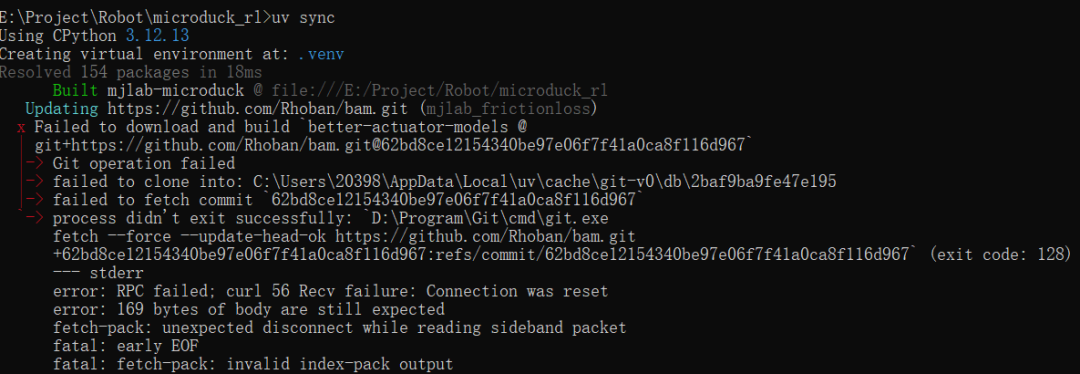
执行cd microduck_rl进入microduck_rl目录,再执行uv sync出现同步虚拟环境超时,主要是https://github.com/Rhoban/bam
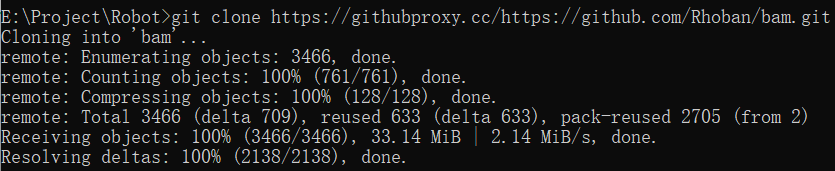
同样地,可以执行git clone https://githubproxy.cc/https://github.com/Rhoban/bam.git通过代理克隆bam项目
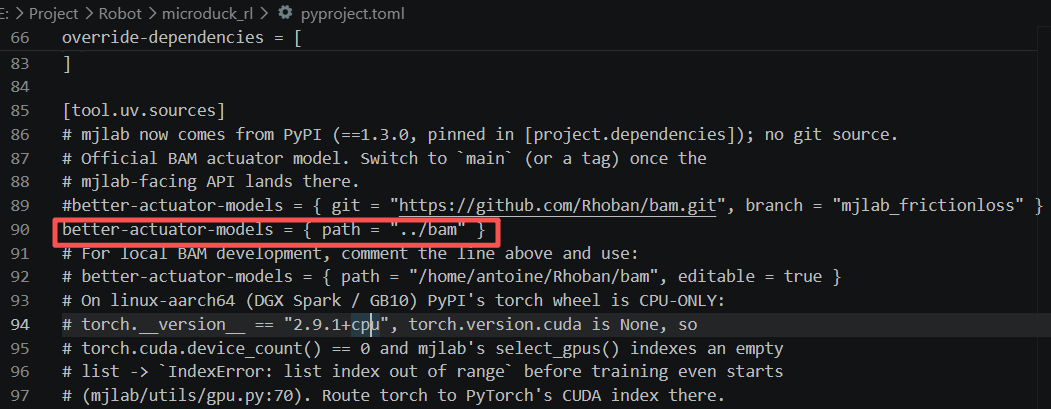
打开microduck_rl项目的pyproject.toml,将better-actuator-models = { git = "https://github.com/Rhoban/bam.git", branch = "mjlab_frictionloss" }
改成better-actuator-models = { path = "../bam" },这里path = "../bam"意思是相对当前项目的上一级文件夹的子文件夹bam(即文件夹microduck_rl和bam在同个目录),应该以你实际安装的bam路径为准,当然如果你前面如果没出现uv sync超时则无需修改
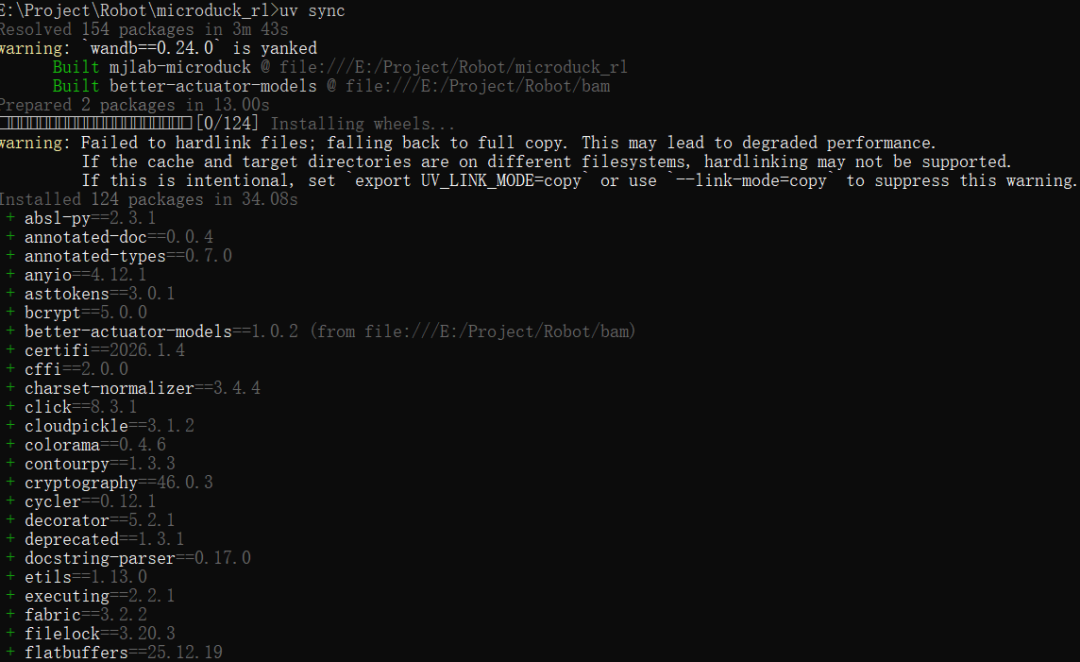
保存修改后,再次执行uv sync
训练
执行uv run train Mjlab-Velocity-Flat-MicroDuck --env.scene.num-envs 1024尝试运行,结果出现报错

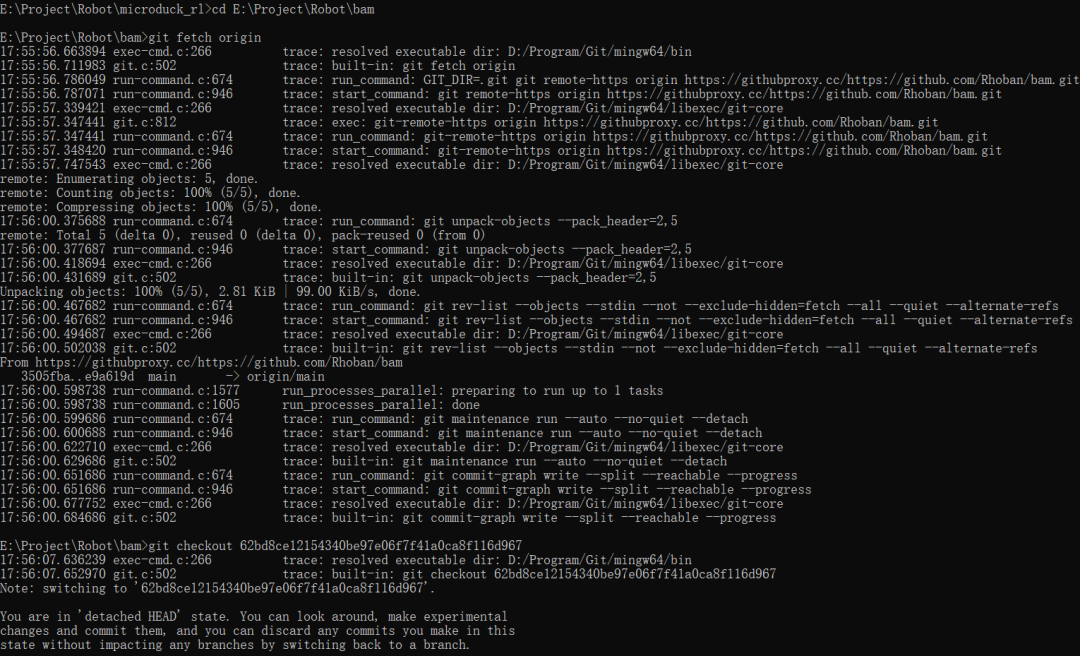
执行cd E:\Project\Robot\bam进入bam目录,以你的实际路径为准,然后执行git fetch origin从名为 origin 的远程仓库获取最新信息,然后执行git checkout 62bd8ce12154340be97e06f7f41a0ca8f116d967切换到哈希为 62bd8ce12154340be97e06f7f41a0ca8f116d967 的那个具体提交
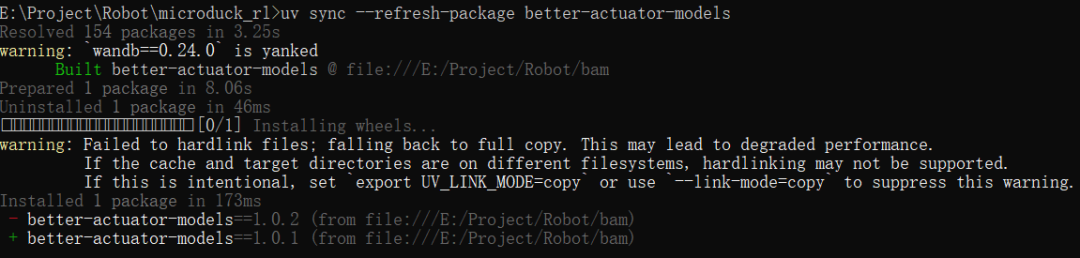
回到microduck_rl目录,执行uv sync --refresh-package better-actuator-models,针对 better-actuator-models 这个包强制重新下载、重新解析元数据、重新安装
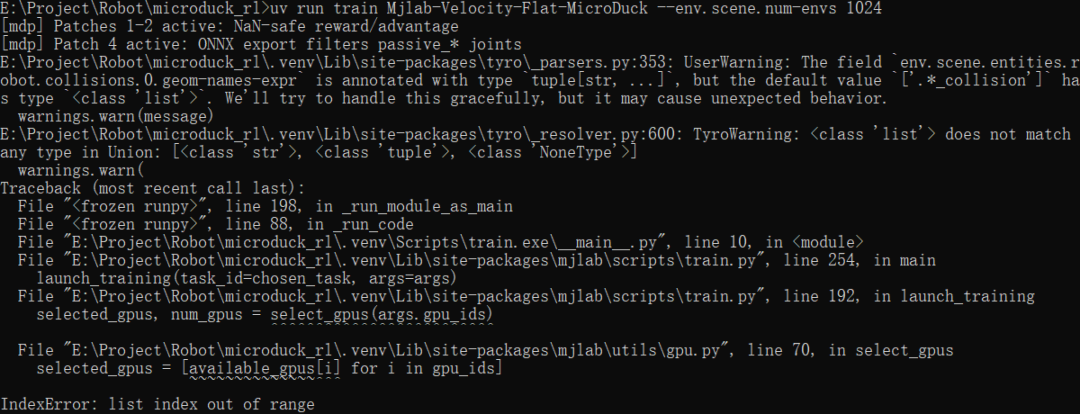
再次执行uv run train Mjlab-Velocity-Flat-MicroDuck --env.scene.num-envs 1024,出现新报错,没有检测到英伟达显卡,这是因为torch下载了cpu版本
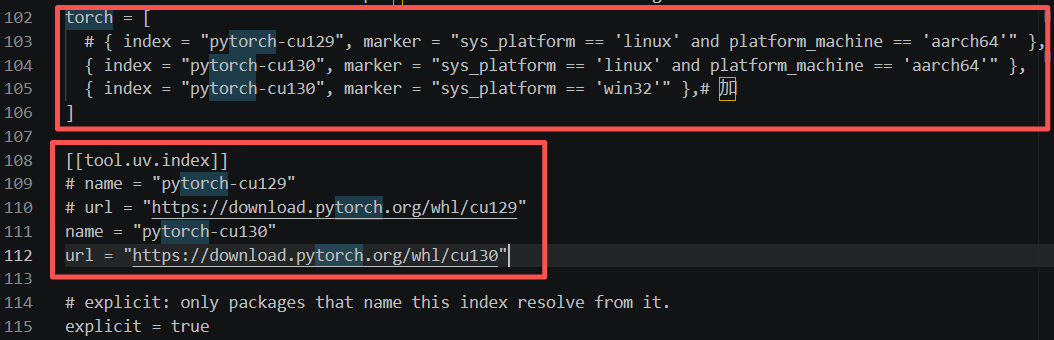
打开microduck_rl项目的pyproject.toml,将torch改成
torch = [
  { index = "pytorch-cu130", marker = "sys_platform == 'linux' and platform_machine == 'aarch64'" },
  { index = "pytorch-cu130", marker = "sys_platform == 'win32'" },
]
tool.uv.index的内容改为name = "pytorch-cu130" 而url = "https://download.pytorch.org/whl/cu130"
再次执行uv sync更新依赖项
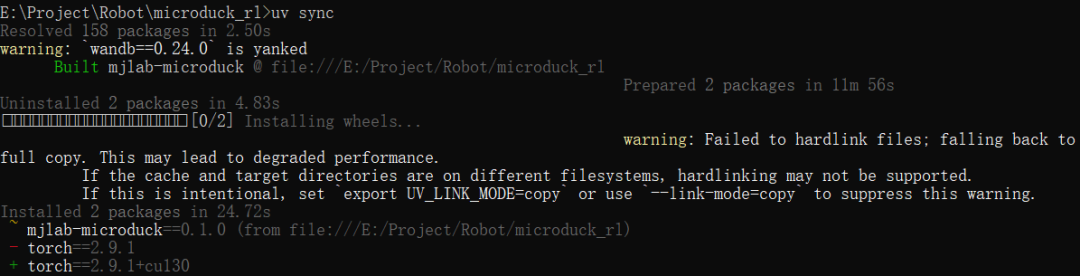
执行uv run python -c "import torch; print(torch.__version__, torch.cuda.is_available())"验证能否检测到英伟达显卡,打印true识别检测能检测到英伟达显卡

再次执行uv run train Mjlab-Velocity-Flat-MicroDuck --env.scene.num-envs 1024,启动成功
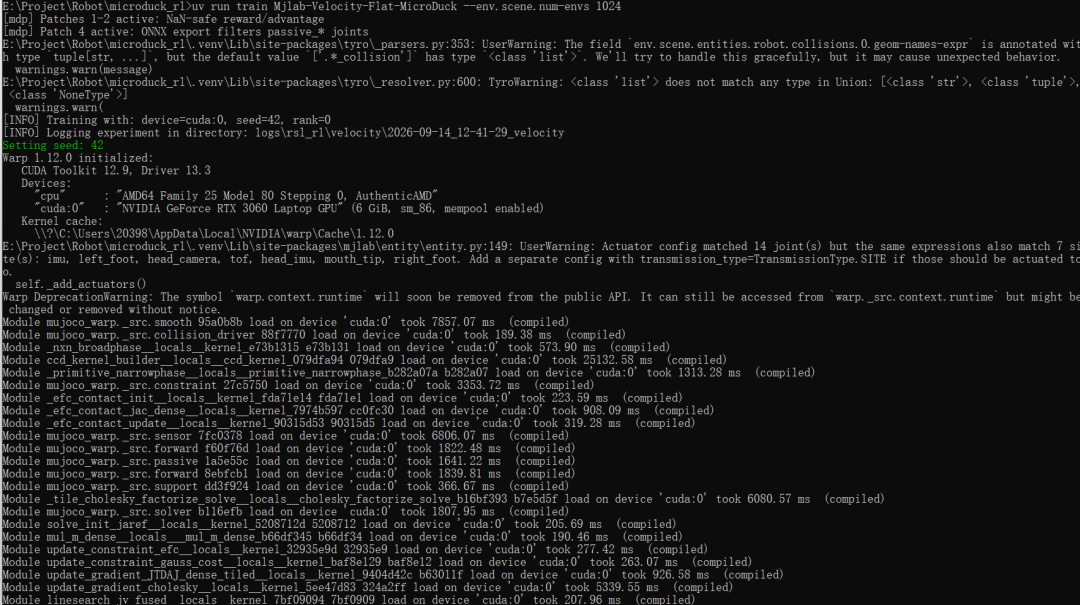
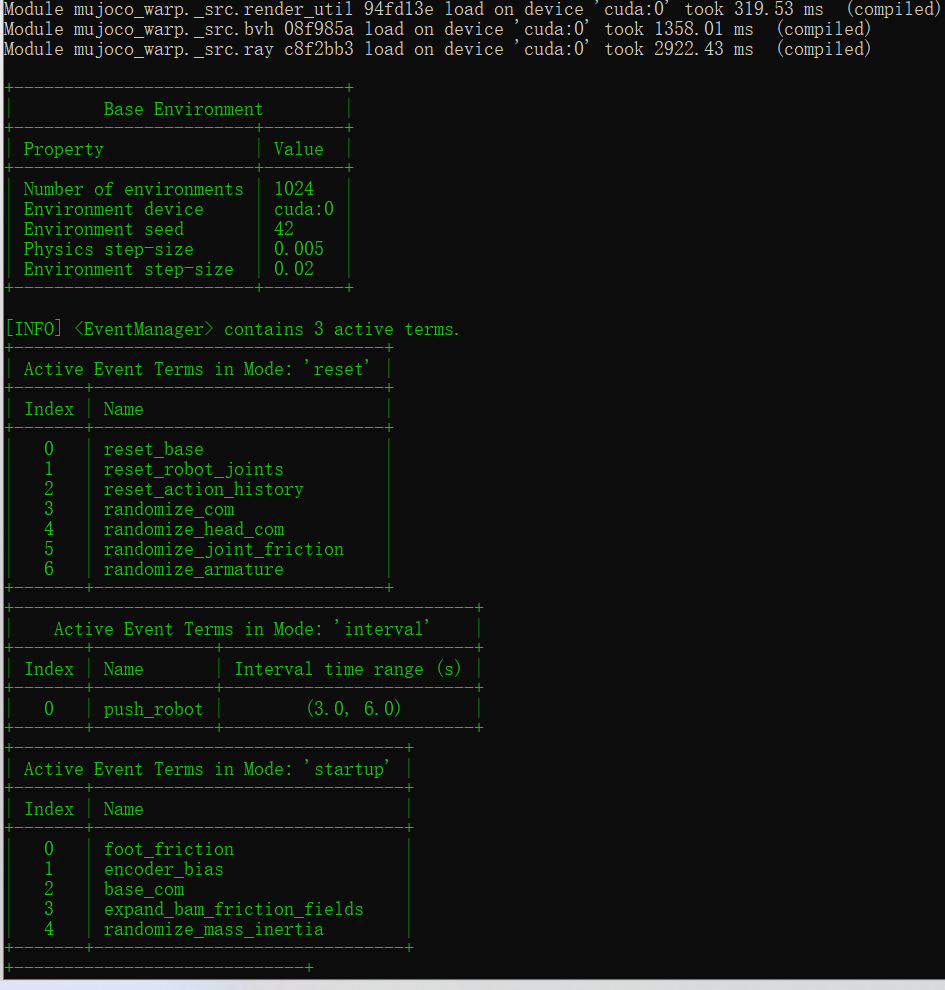
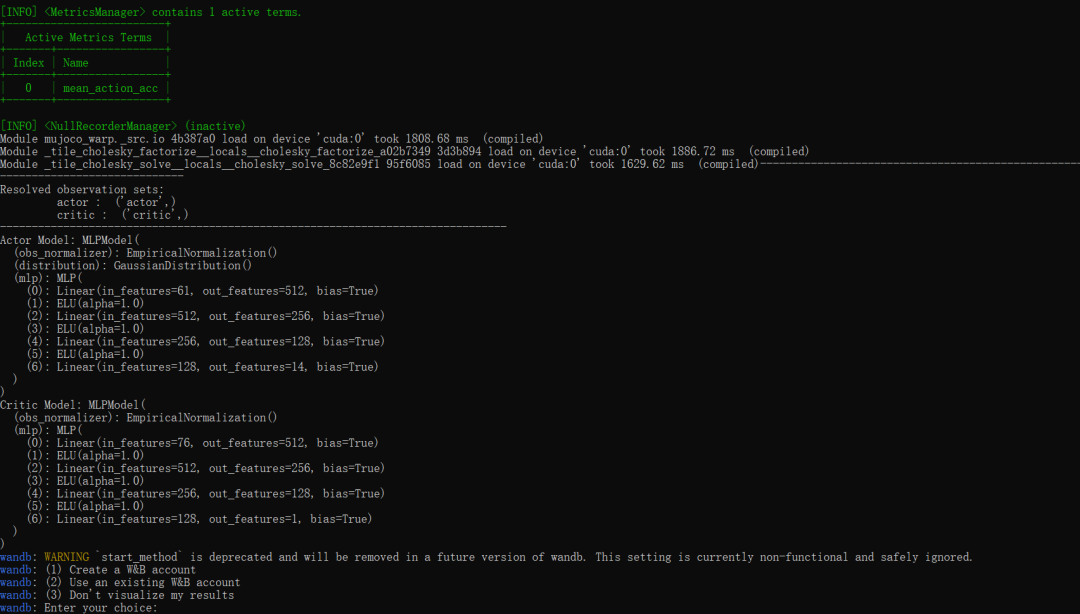
可以输入3再回车,不用wandb云端,部分执行情况
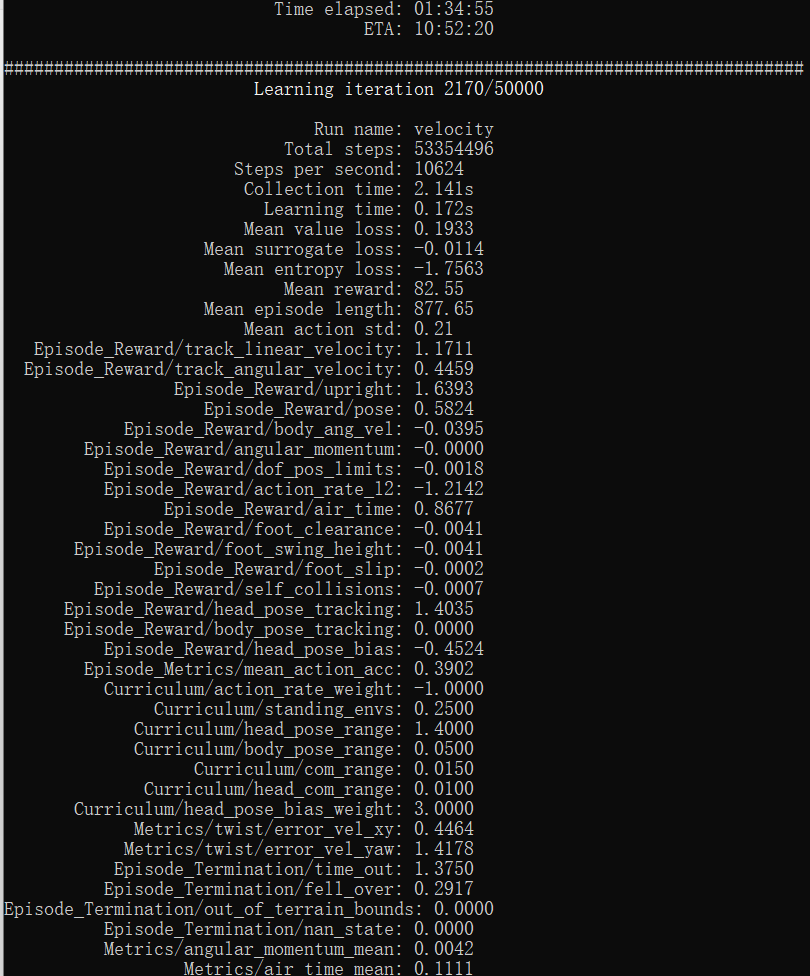
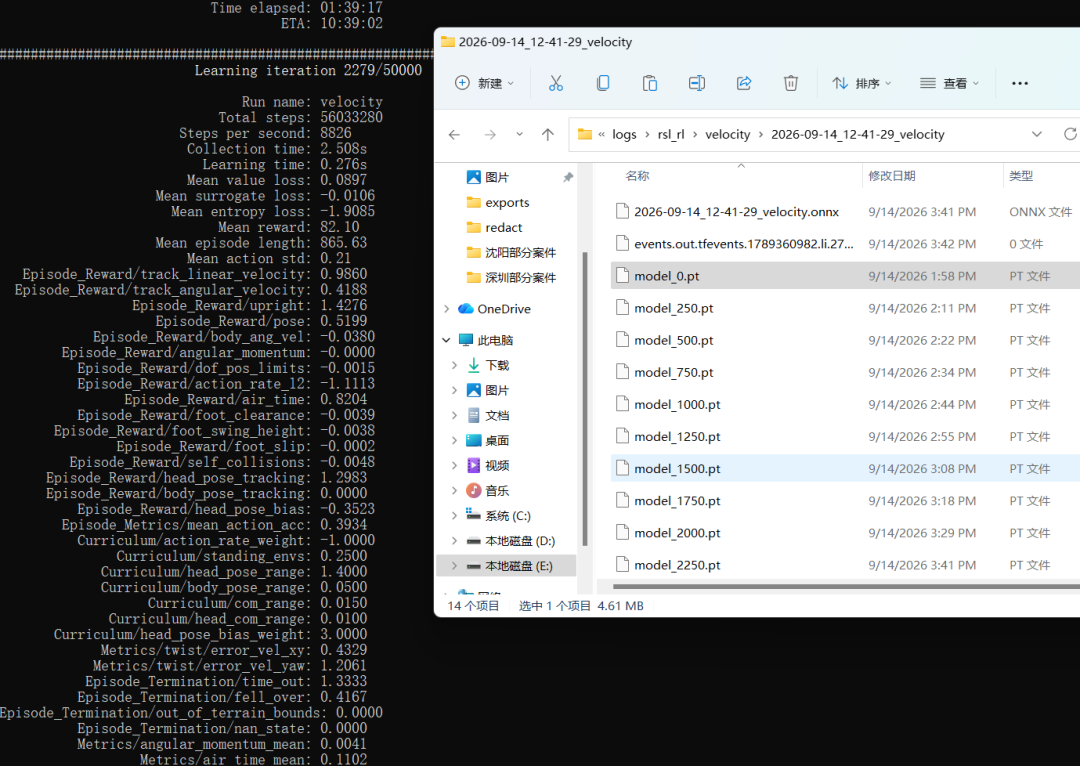
突然报错
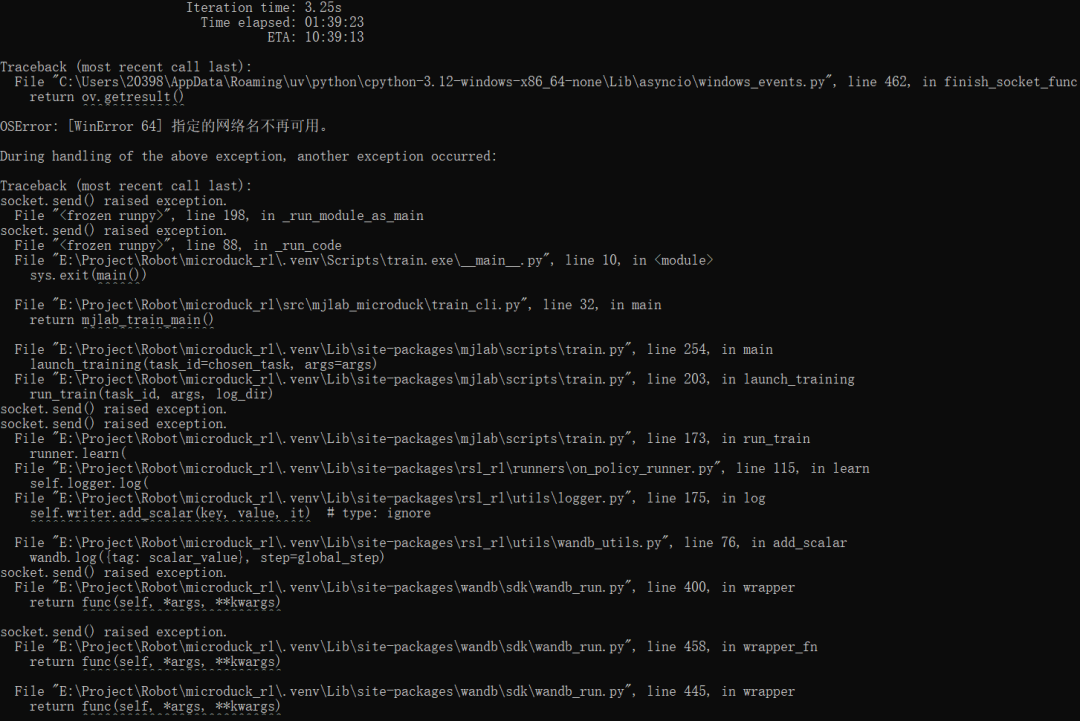
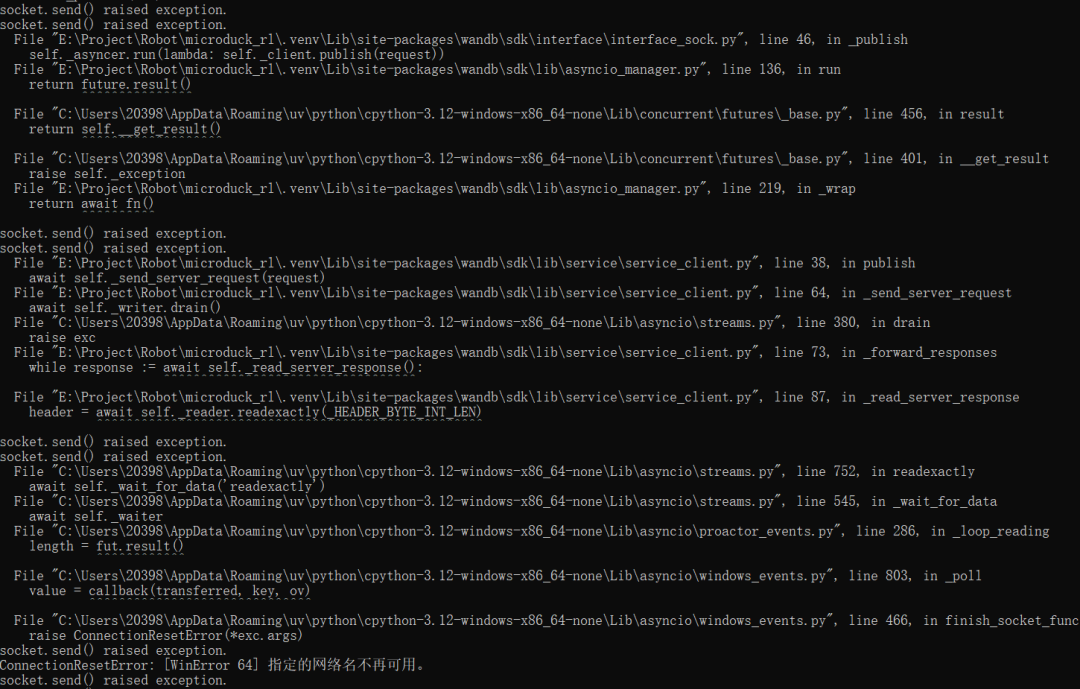
崩溃的直接原因是 Windows 上 wandb 客户端和本地服务进程之间的本地 socket 被重置(WinError 64 指定的网络名不再可用),这是 wandb 在 Windows 的已知顽疾,通常由睡眠/唤醒、VPN 切换、网卡状态变化触发
为什么选了 3 wandb 还在跑
wandb 登录界面的选项 3 "Don't visualize my results" 的意思是"不同步到云端",不是"不运行 wandb"。你选 3 之后它进入了离线模式:本地照样起一个 wandb 服务进程,照样 wandb.log() 记录每一步指标,只是不上传。从 traceback 能清楚看到崩溃点在 wandb_utils.py:76 → wandb.log(...)——rsl_rl 的日志器每个迭代都在调它。
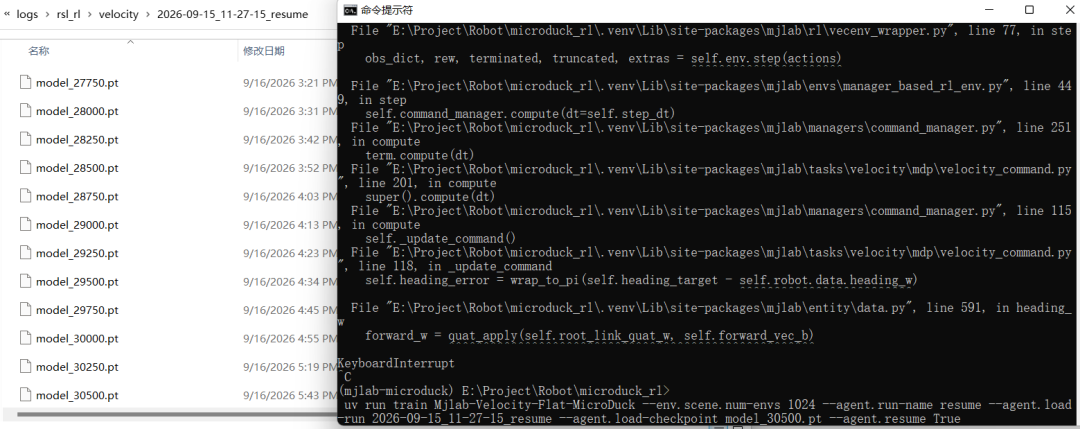
执行uv run train Mjlab-Velocity-Flat-MicroDuck --env.scene.num-envs 1024 --agent.run-name resume --agent.load-checkpoint model_2250.pt --agent.resume True断点恢复 ,其中agent.run-name是任务名,agent.load-checkpoint 是加载的权重名,用上次最终保存的权重,agent.resume 是中断恢复标志位,True是恢复上一次的权重接着训练,False是不恢复训练
如果出现2次及以上的中断,需要恢复训练可以执行命令像uv run train Mjlab-Velocity-Flat-MicroDuck --env.scene.num-envs 1024 --agent.run-name resume --agent.load-run 2026-09-15_11-27-15_resume --agent.load-checkpoint model_30500.pt --agent.resume True,其中agent.load-run是相对路径文件夹logs\rsl_rl\velocity\的子文件夹名称
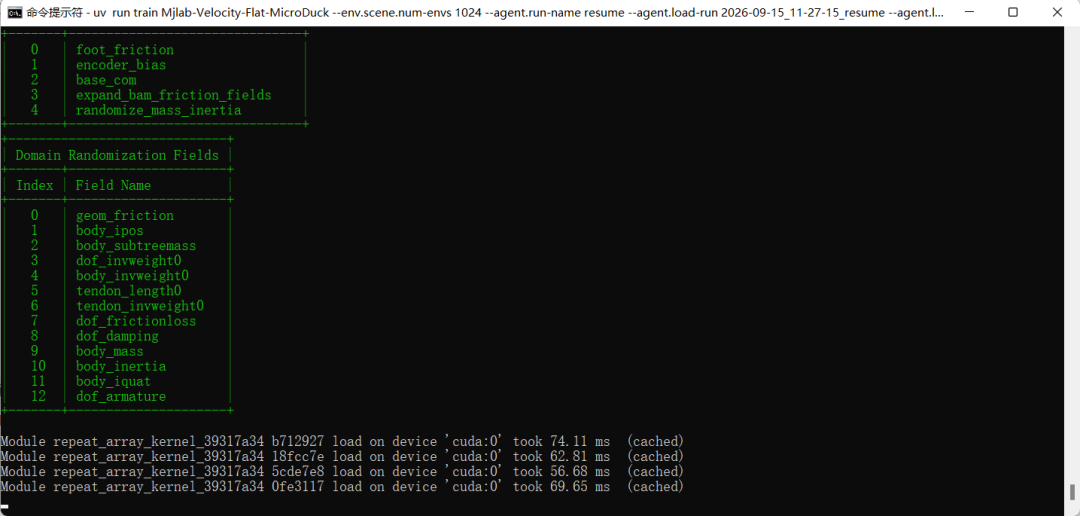
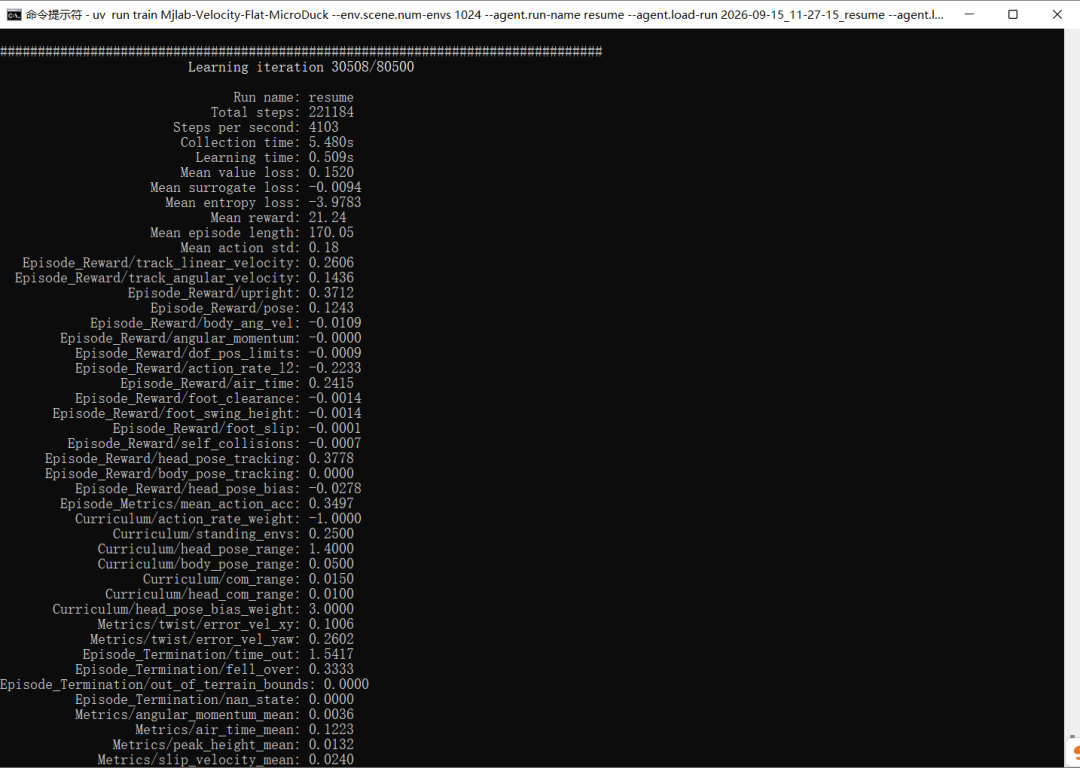
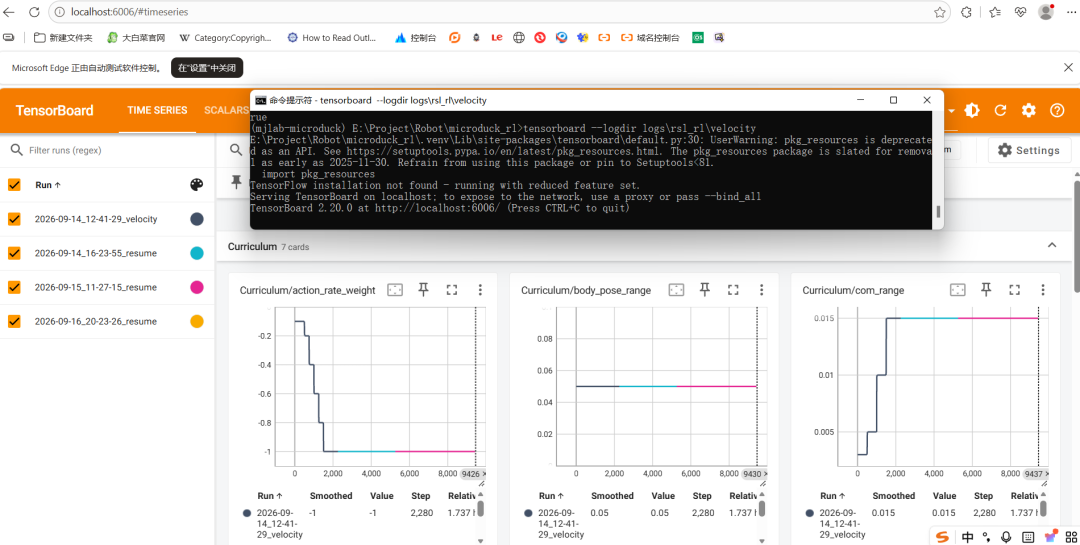
执行tensorboard --logdir logs\rsl_rl\velocity,打开http://localhost:6006/观察可视化训练情况,这里重点分析
Episode_Reward(学会走路的证据)
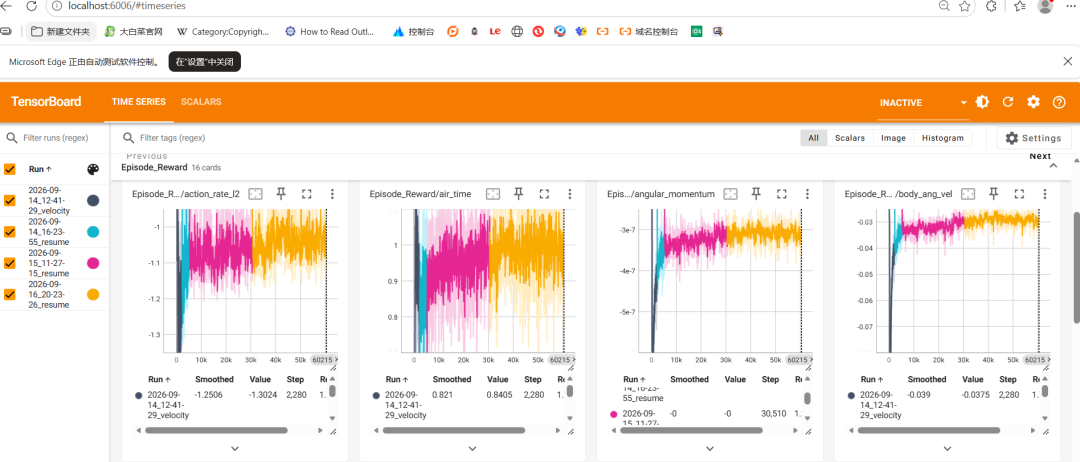
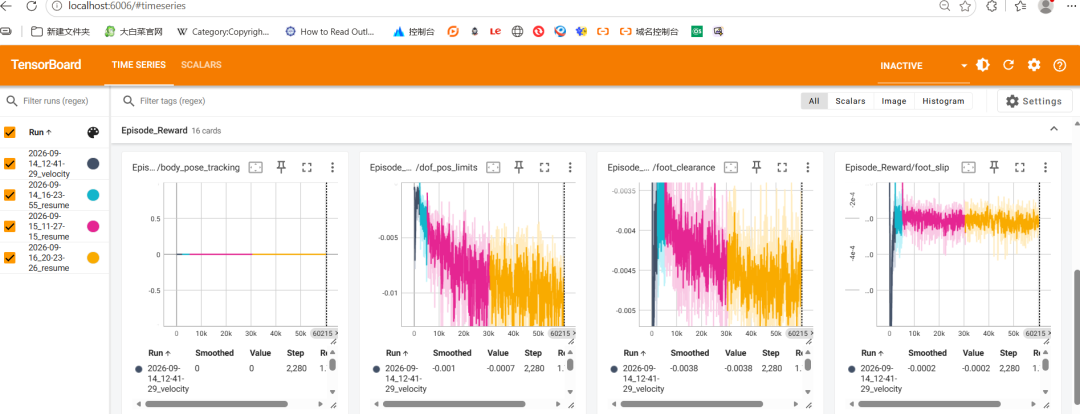
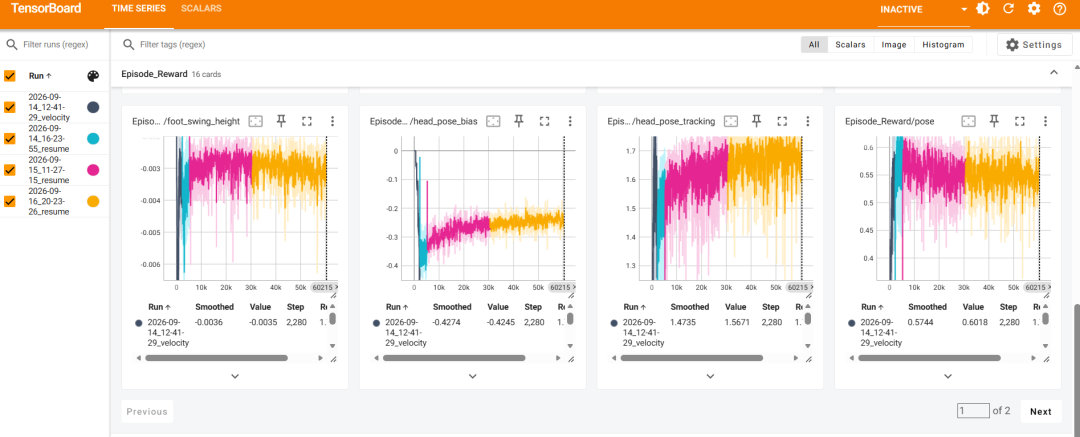
|
指标 |
终值(平滑) |
走势 |
解读 |
|---|---|---|---|
air_time |
0.84 |
0.7 → 0.84 持续爬升 |
核心指标,飞行相存在且稳定
,步态已成型 |
pose |
0.60 |
持续爬升 |
身体姿态跟踪良好 |
head_pose_tracking |
1.57 |
持续爬升 |
头部姿态保持好 |
action_rate_l2 |
-1.25 |
在改善 |
动作平滑度还可以 |
head_pose_bias |
-0.42 |
几乎平的,-0.43 → -0.42 |
⚠️ 没收敛,鸭子头部始终偏离目标位姿 |
body_pose_tracking |
0 |
恒 0 |
该项在 velocity 任务里未启用,忽略 |
foot_clearance
/ |
-0.0038 / -0.0002 |
稳定 |
量级很小,没问题 |
注:飞行相(flight phase)是步态学的术语,指的是走路过程中双脚同时离地的瞬间——也就是"腾空期"。
Episode_Termination(最健康的一张图)
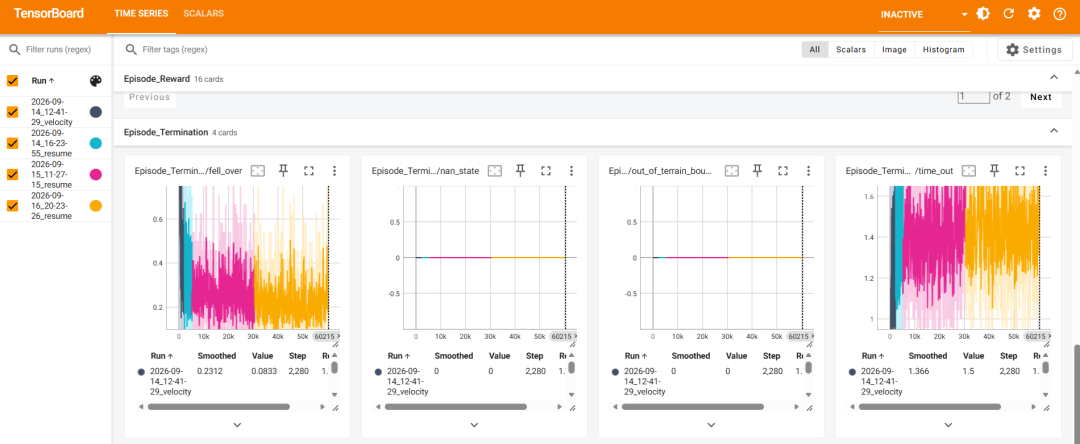
-
fell_over从早期 ~50%+ 降到终值 0.08——摔倒占比 8%,在早期训练里这个数字能说明平衡完全建立 -
nan_state= 0、out_of_terrain_bounds= 0——数值稳定、没跑出地图
-
time_out终值 1.5,从 ~1.1 一路上升——超时结束占比持续升高 = 鸭子越来越不容易死
Loss(PPO 本体无异常)
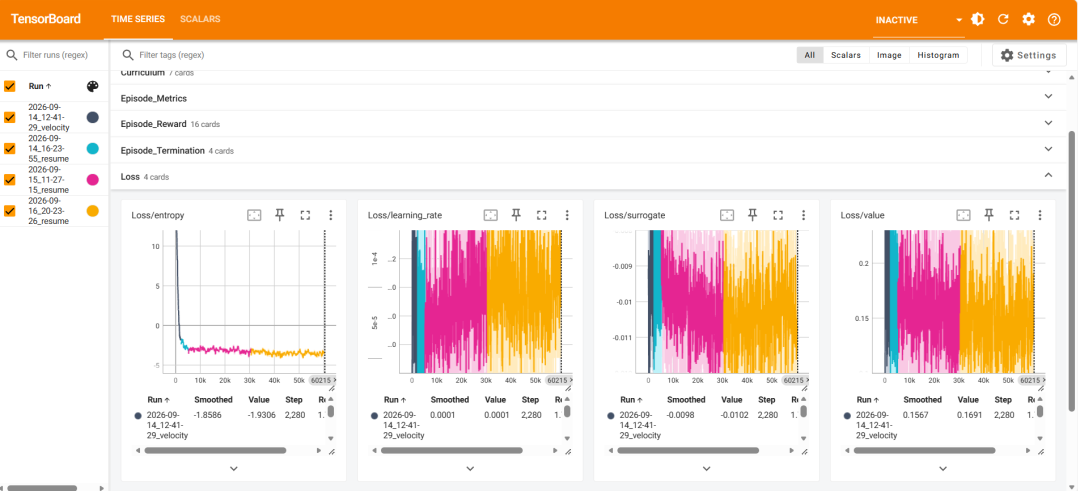
-
entropy= -1.86,缓降未塌缩,探索还健在 -
value= 0.157、surrogate= -0.0098、learning_rate= 1e-4,全部在 PPO 正常区间,无爆炸无尖刺
Curriculum(早期就全部冲极限)
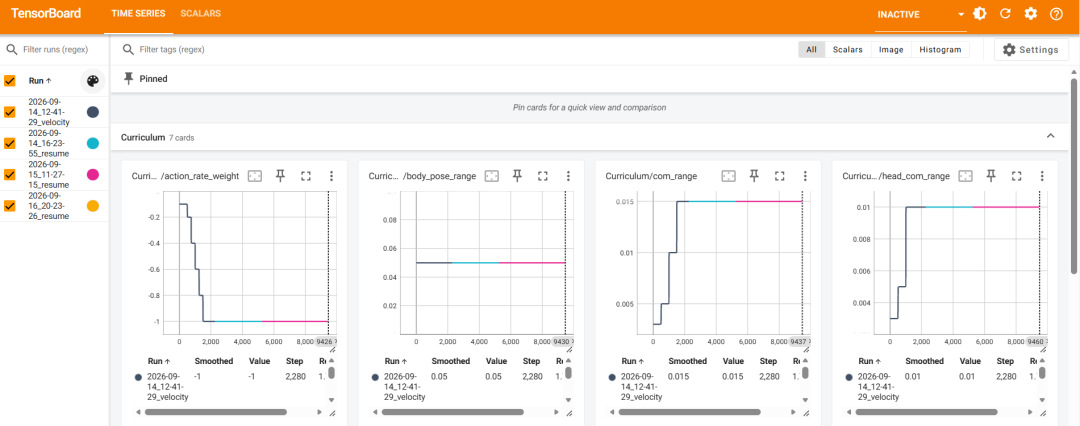
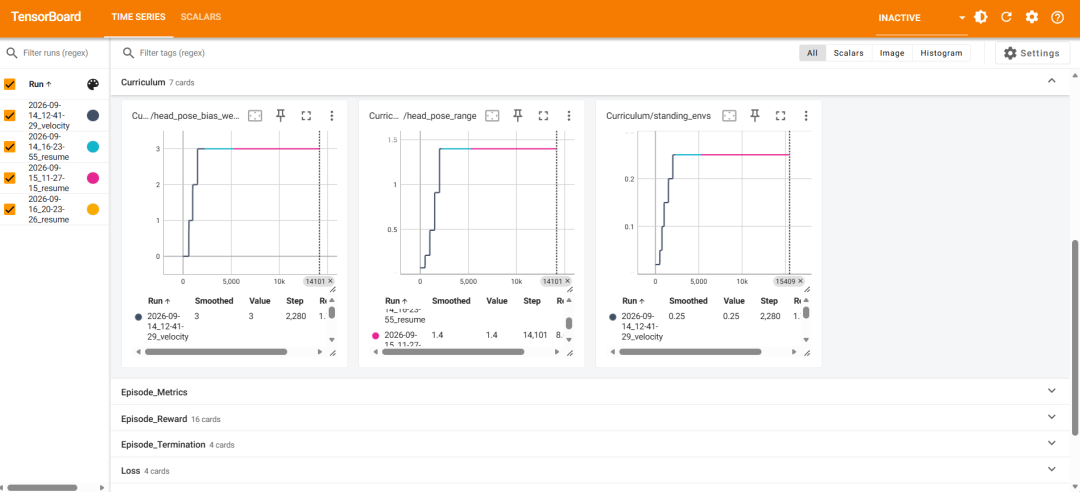
7 项参数在 前 ~1 万步内全部饱和:action_rate_weight → -1、head_pose_bias_weight → 3、head_pose_range → 1.4、standing_envs → 0.25、com_range → 0.015 等,之后 5 万步没再动。说明课程难度全开之后策略仍掌控得住——这是好信号;同时也意味着后面 5 万步纯粹在微调,收益递减。
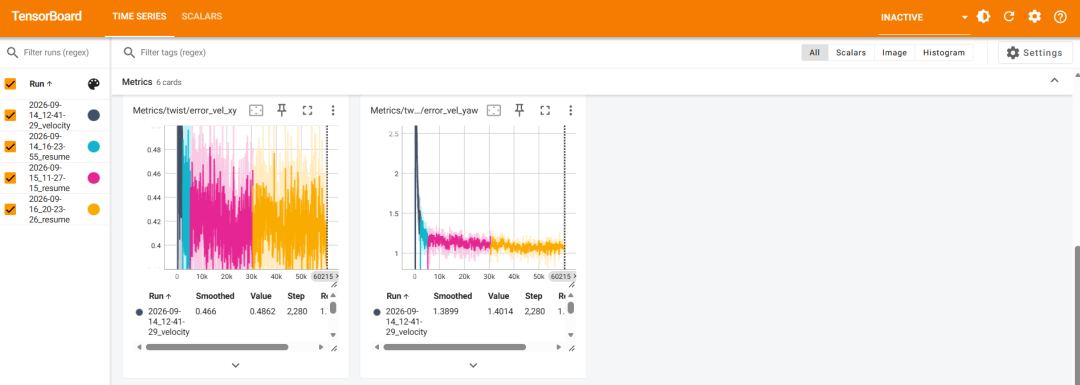
Metrics(两个短板)
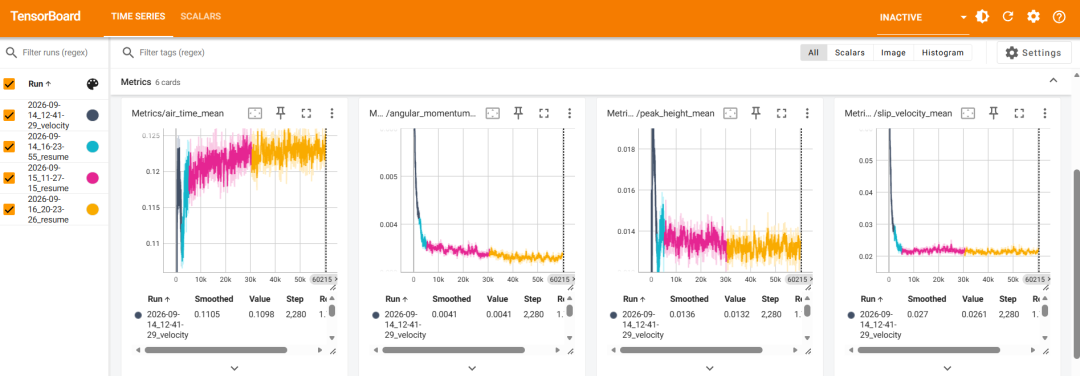
-
air_time_mean= 0.110(每步 110ms 飞行相)✅ -
angular_momentum= 0.0041、下降 ✅ -
slip_velocity_mean= 0.027 ✅ -
⚠️
peak_height_mean= 0.0136 m(1.4cm)——抬脚高度偏低。平地仿真没问题,但真地上有接缝/门槛时容易绊。这是这个任务里最值得警惕的 sim2real 指标 -
⚠️
twist/error_vel_xy= 0.466、error_vel_yaw= 1.39——速度跟踪误差还有下降空间,目前大概"能走但跟踪不精准"
Perf(效率正常)
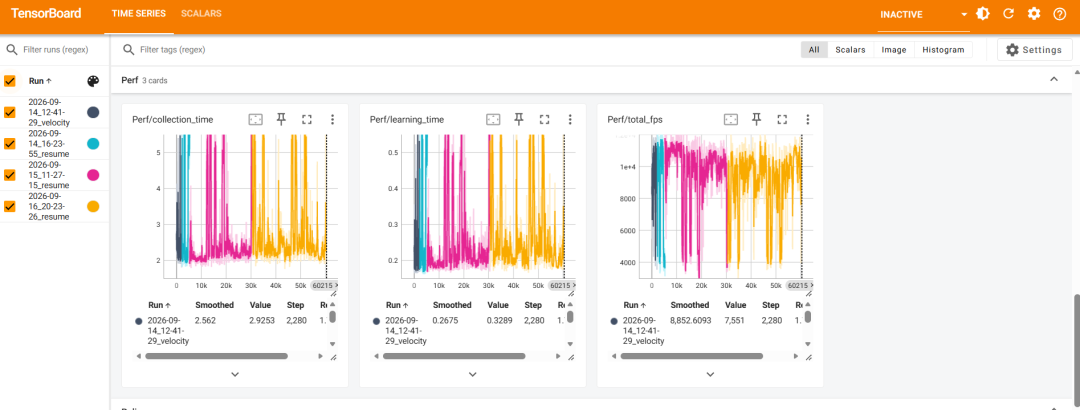
total_fps ≈ 8850(抖动期 4000-10000),collection_time 2.56s vs learning_time 0.27s——90% 时间花在仿真 rollout,GPU 学习端完全不是瓶颈,配置健康。如果将来想提速,加环境数比优化网络更有效。
推理(以走路模式为例)
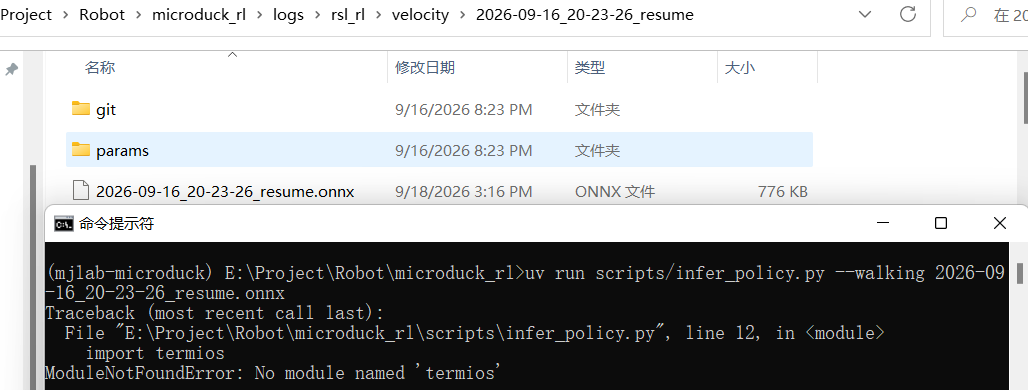
执行uv run scripts/infer_policy.py --walking logs\rsl_rl\velocity\2026-09-16_20-23-26_resume\2026-09-16_20-23-26_resume.onnx 观察走路效果,onnx应改为你的实际文件名字,这注意termios 是 Linux/Unix 专用的终端控制模块,直接运行会出现报错,Windows 上没有,也永远装不上(它不是缺包,是操作系统 API 层面的东西)。infer_policy.py 用它来做"按一下方向键立刻响应"的无回显键盘监听,Windows 原生不支持,可以通过修改代码或干脆改在wsl运行
修改infer_policy.py文件
#!/usr/bin/env python3
"""Simple script to run ONNX policy inference in MuJoCo with rendering."""
import argparse
import csv
import math
import os
import pickle
import queue
import sys
import threading
import time
import numpy as np
_ON_UNIX = sys.platform != "win32"
if _ON_UNIX:
import select
import termios
import tty
import mujoco
import mujoco.viewer
import glfw
import onnxruntime as ort
MICRODUCK_XML = "src/mjlab_microduck/robot/microduck/scene.xml"
# MICRODUCK_XML = "src/mjlab_microduck/robot/microduck/scene_ramps.xml"
# MICRODUCK_XML = "src/mjlab_microduck/robot/microduck/scene_floor_objects.xml"
# MICRODUCK_XML = "src/mjlab_microduck/robot/microduck/scene_robot_walk.xml"
MICRODUCK_ROLLERS_XML = "src/mjlab_microduck/robot/microduck/scene_rollers.xml"
MICRODUCK_BALL_XML = "src/mjlab_microduck/robot/microduck/scene_ball.xml"
# BAM M6 defaults — MUST mirror `_BAM_ACTUATOR_KWARGS` in
# src/mjlab_microduck/robot/microduck_constants.py (the actuator every policy is
# trained against in warp). Not imported from there: that module drags in
# mjlab/torch/warp (~16 s import) for a CPU rehearsal script. Locked by
# tests/test_infer_policy_bam.py.
BAM_MOTOR_NAME = "xl330"
BAM_MODEL = "m6"
BAM_KP_FW = 200.0 # microduck's preserved firmware stiffness
BAM_VIN_RANGE = (6.5, 8.2) # per-env battery voltage DR in training
BAM_VIN_DROP_GAIN_RANGE = (0.0, 0.2) # load-dependent sag V_drop = gain * sum|tau|
BAM_VIN_MIN = 6.0 # floor on effective voltage after sag
BAM_MAX_CURRENT = None # training runs WITHOUT the firmware current limiter
# Stiff joint-friction constraint, copied from bam.mjlab.BamActuator
# (stiff_frictionloss=True in training): warp has no noslip solver, so BAM
# stiffens frictionloss so a statically-held joint does not creep. Mirrored
# here so CPU and warp apply the same friction budget the same way.
BAM_STIFF_SOLREF_FRICTION = (-5.0e4, -2.0e2)
BAM_STIFF_SOLIMP_FRICTION = (0.99, 0.9999, 0.001, 0.5, 2.0)
def load_bam_model(kp_fw: float, vin: float, max_current):
"""Build the BAM M6 model + XL330 voltage-controlled actuator."""
from bam.model import load_model
bam_model = load_model(motor_name=BAM_MOTOR_NAME, model=BAM_MODEL)
bam_model.actuator.kp = kp_fw
bam_model.actuator.vin = vin
bam_model.actuator.max_current = max_current if (max_current and max_current > 0) else None
return bam_model
def load_mujoco_with_bam(xml_path: str, bam_model, timestep: float, vin_drop_gain, vin_min):
"""Load the scene and hand every non-passive actuator to bam.mujoco.MujocoController.
Mirrors bam.mjlab.BamActuator.edit_spec (what warp does at training time):
position actuators -> torque motors with the voltage-bounded forcerange,
joint damping/frictionloss zeroed (BAM rewrites them every step), stiff
friction constraint. Armature is set on the dofs by MujocoController.
Returns (model, data, bam_ctrl, actuator_names).
"""
from bam.mujoco import MujocoController
kt = bam_model.kt.value
R = bam_model.R.value
force_limit = bam_model.actuator.vin * kt / R
spec = mujoco.MjSpec.from_file(xml_path)
names = []
for act in spec.actuators:
tgt = act.target
tgt_name = tgt.name if hasattr(tgt, "name") else str(tgt)
if tgt_name.startswith("passive_"):
continue
act.set_to_motor()
act.forcelimited = True
act.forcerange = (-force_limit, force_limit)
act.ctrllimited = False
act.gear = [1.0, 0, 0, 0, 0, 0]
names.append(act.name)
for joint in spec.joints:
if joint.name == tgt_name:
joint.damping = np.zeros((3, 1)) # MjsJoint expects a (3,1) array
joint.frictionloss = 0.0
joint.solref_friction = BAM_STIFF_SOLREF_FRICTION
joint.solimp_friction = BAM_STIFF_SOLIMP_FRICTION
break
model = spec.compile()
model.opt.timestep = timestep
data = mujoco.MjData(model)
bam_ctrl = MujocoController(bam_model, names, model, data,
vin_drop_gain=vin_drop_gain, vin_min=vin_min)
print(f"BAM {BAM_MODEL} actuators on {len(names)} joints: kt={kt:.4f} R={R:.4f} "
f"vin={bam_model.actuator.vin:.2f}V kp_fw={bam_model.actuator.kp:.0f} "
f"vin_drop_gain={vin_drop_gain} vin_min={vin_min} "
f"max_current={bam_model.actuator.max_current} forcerange=+/-{force_limit:.3f}Nm "
f"armature={bam_model.actuator.get_extra_inertia():.2e}")
return model, data, bam_ctrl, names
# Body pose command constants (must match training constants)
BODY_CMD_MAX_Z = 0.03 # ±30 mm
BODY_CMD_MAX_XY = 0.02 # ±20 mm
BODY_CMD_MAX_ANGLE = math.radians(30) # ±30°
# Ball placement for kick behaviors (must match microduck_ball_kick_env_cfg's
# reset_ball_in_front_of_foot params: ball center in the robot's yaw frame).
BALL_OFFSET_X = 0.09
BALL_OFFSET_ABS_Y = 0.042
BALL_RADIUS = 0.035
# Default pose used by the policy (legs flexed, standing position)
# This is the reference pose that:
# - Actions are offsets from (motor_target = DEFAULT_POSE + action * scale)
# - Joint observations are relative to (obs_joint_pos = current_pos - DEFAULT_POSE)
# STAND2 pose (matches HOME_FRAME in microduck_constants.py): trunk shifted
# ~5mm forward so the CoM sits over the ankle axis. Leg pitch chain leaned
# forward vs the old pose: hip_pitch 30°→26.24°, ankle 30°→25.95°, knee 0°→0.28°.
DEFAULT_POSE = np.array([
0.0, # left_hip_yaw
-0.0873, # left_hip_roll
-0.4579, # left_hip_pitch
-0.0049, # left_knee
0.4530, # left_ankle
0.3491, # neck_pitch
0.3491, # head_pitch
0.0, # head_yaw
0.0, # head_roll
0.0, # right_hip_yaw
0.0873, # right_hip_roll
0.4579, # right_hip_pitch
0.0049, # right_knee
-0.4530, # right_ankle
], dtype=np.float32)
class TerminalInput:
"""Single-keypress reader on stdin (background thread).
Unix: cbreak mode + os.read for ESC-sequence arrow keys.
Windows: msvcrt.kbhit/getwch for non-blocking reads.
"""
_ARROWS = {"A": "up", "B": "down", "C": "right", "D": "left"}
def __init__(self):
self._queue = queue.Queue()
# msvcrt reads the console (CONIN$) directly, independent of how
# sys.stdin is wired — uv run may pipe stdin so isatty() is False
# even in a real console. Only gate on isatty on Unix.
self.enabled = True if not _ON_UNIX else sys.stdin.isatty()
self._fd = sys.stdin.fileno() if (self.enabled and _ON_UNIX) else -1
self._old_attrs = None
self._stop = threading.Event()
def __enter__(self):
if not self.enabled:
print("WARNING: stdin is not a TTY — keyboard control disabled")
return self
if _ON_UNIX:
self._old_attrs = termios.tcgetattr(self._fd)
tty.setcbreak(self._fd)
threading.Thread(target=self._reader, daemon=True).start()
return self
def __exit__(self, *exc):
self._stop.set()
if _ON_UNIX and self._old_attrs is not None:
termios.tcsetattr(self._fd, termios.TCSADRAIN, self._old_attrs)
def _reader(self):
if _ON_UNIX:
self._reader_unix()
else:
self._reader_win()
def _reader_win(self):
import msvcrt
# Blocking getwch: kbhit polling misses keys when the console input
# mode changes (e.g. viewer window steals/restores focus).
while not self._stop.is_set():
try:
ch = msvcrt.getwch()
except Exception:
time.sleep(0.1)
continue
if ch in ("\x00", "\xe0"):
try:
ch2 = msvcrt.getwch()
except Exception:
continue
arrow_map = {"H": "up", "P": "down", "K": "left", "M": "right"}
name = arrow_map.get(ch2)
if name:
self._queue.put(name)
continue
self._queue.put(ch.lower() if ch.isalpha() else ch)
def _reader_unix(self):
while not self._stop.is_set():
r, _, _ = select.select([self._fd], [], [], 0.1)
if not r:
continue
ch = os.read(self._fd, 1).decode(errors="ignore")
if not ch:
continue
if ch == "\x1b":
r2, _, _ = select.select([self._fd], [], [], 0.05)
if r2 and os.read(self._fd, 1).decode(errors="ignore") == "[":
r3, _, _ = select.select([self._fd], [], [], 0.05)
final = os.read(self._fd, 1).decode(errors="ignore") if r3 else ""
name = self._ARROWS.get(final)
if name:
self._queue.put(name)
continue
self._queue.put(ch.lower() if ch.isalpha() else ch)
def get_keys(self):
"""Drain and return all pending keys (symbolic names / characters)."""
keys = []
while True:
try:
keys.append(self._queue.get_nowait())
except queue.Empty:
return keys
# GLFW keycodes for arrow keys (mujoco viewer key_callback channel).
# Real codes are RIGHT=262, LEFT=263, DOWN=264, UP=265 — use glfw
# constants, not hand-copied numbers.
_GLFW_ARROWS = {
glfw.KEY_UP: "up", glfw.KEY_DOWN: "down",
glfw.KEY_LEFT: "left", glfw.KEY_RIGHT: "right",
}
def on_viewer_key(self, keycode: int):
"""GLFW keycode from launch_passive(key_callback=...) — official
channel for keys pressed while the viewer window has focus. Shares
the queue with the terminal reader; a keystroke reaches exactly one
of them (only the foreground window receives input), so there is no
double handling. Letters arrive as uppercase ASCII (GLFW)."""
name = self._GLFW_ARROWS.get(keycode)
if name:
self._queue.put(name)
elif 32 <= keycode <= 126:
ch = chr(keycode)
self._queue.put(ch.lower() if ch.isalpha() else ch)
class PolicyInference:
def __init__(self, model, data, walking_onnx_path=None, action_scale=1.0, bam_ctrl=None,
delay_min_lag=0, delay_max_lag=0,
standing_onnx_path=None, switch_threshold=0.05,
use_projected_gravity=False, ground_pick_onnx_path=None, ground_pick_period=4.0,
sit_onnx_path=None, new_cmd_obs=False, slope_onnx_path=None,
sitstand_onnx_path=None,
kick_left_onnx_path=None, kick_right_onnx_path=None,
roulade_onnx_path=None,
kick_duration=3.0, roulade_duration=2.0):
self.bam_ctrl = bam_ctrl # bam.mujoco.MujocoController (None = legacy position actuators)
self.model = model
self.data = data
self.action_scale = action_scale
self.use_projected_gravity = use_projected_gravity
self.delay_min_lag = delay_min_lag
self.delay_max_lag = delay_max_lag
self.switch_threshold = switch_threshold
# When True: emit the unified 13D command vector and treat head_offset /
# body_cmd as policy COMMANDS (no add to ctrl, no joint_pos correction).
# When False: legacy behaviour (3D command, head_offset added to ctrl[5:9]).
self.new_cmd_obs = new_cmd_obs
# Load walking policy
self.walking_session = None
self.default_gait_period_from_onnx = None
if walking_onnx_path:
print(f"Loading walking policy from: {walking_onnx_path}")
self.walking_session = ort.InferenceSession(walking_onnx_path)
w_input_shape = self.walking_session.get_inputs()[0].shape
w_output_shape = self.walking_session.get_outputs()[0].shape
print(f"Walking policy input: {self.walking_session.get_inputs()[0].name}, shape: {w_input_shape}")
print(f"Walking policy output: {self.walking_session.get_outputs()[0].name}, shape: {w_output_shape}")
# Try to read gait period from ONNX metadata
try:
model_metadata = self.walking_session.get_modelmeta()
if hasattr(model_metadata, 'custom_metadata_map') and 'gait_period' in model_metadata.custom_metadata_map:
self.default_gait_period_from_onnx = float(model_metadata.custom_metadata_map['gait_period'])
print(f"Found gait period in ONNX metadata: {self.default_gait_period_from_onnx:.4f}s")
except Exception as e:
print(f"Could not read gait period from ONNX metadata: {e}")
# Load standing policy
self.standing_session = None
if standing_onnx_path:
print(f"\nLoading standing policy from: {standing_onnx_path}")
self.standing_session = ort.InferenceSession(standing_onnx_path)
s_input_shape = self.standing_session.get_inputs()[0].shape
s_output_shape = self.standing_session.get_outputs()[0].shape
print(f"Standing policy input: {self.standing_session.get_inputs()[0].name}, shape: {s_input_shape}")
print(f"Standing policy output: {self.standing_session.get_outputs()[0].name}, shape: {s_output_shape}")
if self.walking_session:
print(f"Policy switching threshold: {switch_threshold} (vel command magnitude)")
# Load ground pick policy
self.ground_pick_session = None
self.ground_pick_mode = False
self.ground_pick_phase = 0.0
self.ground_pick_period = ground_pick_period
if ground_pick_onnx_path:
print(f"\nLoading ground pick policy from: {ground_pick_onnx_path}")
self.ground_pick_session = ort.InferenceSession(ground_pick_onnx_path)
gp_input_shape = self.ground_pick_session.get_inputs()[0].shape
print(f"Ground pick policy input shape: {gp_input_shape}")
# Load sit policy. Two flavours share the Y key and self.sit_session:
# - --sit (is_sitstand=False): the OLD one-way sit policy. Sits
# unconditionally on a zero twist command; standing back up is done
# by switching back to the standing/walking session.
# - --sitstand (is_sitstand=True): the commanded sit↔stand policy.
# twist[0] is a posture flag (0=stand, 1=sit); the SAME policy sits,
# holds, and stands back up — Y just flips the flag.
self.sit_session = None
self.sit_mode = False
self.is_sitstand = False
if sit_onnx_path and sitstand_onnx_path:
raise ValueError("Provide only one of --sit / --sitstand")
if sit_onnx_path:
print(f"\nLoading sit policy from: {sit_onnx_path}")
self.sit_session = ort.InferenceSession(sit_onnx_path)
sit_input_shape = self.sit_session.get_inputs()[0].shape
print(f"Sit policy input shape: {sit_input_shape}")
elif sitstand_onnx_path:
if not self.new_cmd_obs:
raise ValueError(
"--sitstand policies use the unified 13D command obs (61D); run with --new-cmd-obs"
)
print(f"\nLoading sitstand policy from: {sitstand_onnx_path}")
self.sit_session = ort.InferenceSession(sitstand_onnx_path)
self.is_sitstand = True
ss_input_shape = self.sit_session.get_inputs()[0].shape
print(f"Sitstand policy input shape: {ss_input_shape}")
# Load slope policy (passive descent, runs with zero twist command)
self.slope_session = None
self.slope_mode = False
if slope_onnx_path:
print(f"\nLoading slope policy from: {slope_onnx_path}")
self.slope_session = ort.InferenceSession(slope_onnx_path)
sl_input_shape = self.slope_session.get_inputs()[0].shape
print(f"Slope policy input shape: {sl_input_shape}")
# Episodic behavior policies (kick left/right, roulade). All three use
# the unified 61D obs layout with an ALL-ZERO 13D command (twist forced
# ~0 in training, head/body slots zero-padded), so triggering one is a
# plain session swap; after `duration` seconds control hands back to
# walking/standing (the behavior policies end standing on their own).
self.behavior_sessions = {}
self.behavior_durations = {}
self.behavior_mode = None # name of the running behavior, or None
self.behavior_time_left = 0.0
for name, path, duration in (
("kick_left", kick_left_onnx_path, kick_duration),
("kick_right", kick_right_onnx_path, kick_duration),
("roulade", roulade_onnx_path, roulade_duration),
):
if not path:
continue
if not self.new_cmd_obs:
raise ValueError(
f"--{name.replace('_', '-')} policies use the unified 13D "
"command obs (61D); run with --new-cmd-obs"
)
print(f"\nLoading {name} policy from: {path}")
self.behavior_sessions[name] = ort.InferenceSession(path)
self.behavior_durations[name] = duration
print(f"{name} policy input shape: {self.behavior_sessions[name].get_inputs()[0].shape}"
f" (auto-return after {duration:.1f}s)")
# Validate at least one policy loaded. A sitstand policy can run alone
# (it holds the stand at flag=0), unlike the old one-way sit policy.
if not self.walking_session and not self.standing_session and not self.is_sitstand:
raise ValueError("At least one of --walking, --standing or --sitstand must be provided")
# Determine initial active session and policy
if self.walking_session:
self.current_policy = "walking"
self.ort_session = self.walking_session
elif self.standing_session:
self.current_policy = "standing"
self.ort_session = self.standing_session
else:
# sitstand-only: start standing (posture flag 0).
self.current_policy = "sit"
self.ort_session = self.sit_session
# Get input/output names from active session
self.input_name = self.ort_session.get_inputs()[0].name
self.output_name = self.ort_session.get_outputs()[0].name
# Get sensor IDs and body IDs
self.imu_ang_vel_id = mujoco.mj_name2id(model, mujoco.mjtObj.mjOBJ_SENSOR, "imu_ang_vel")
self.trunk_base_id = mujoco.mj_name2id(model, mujoco.mjtObj.mjOBJ_BODY, "trunk_base")
# Trunk freejoint qpos address (needed to place the ball in the robot's
# yaw frame) and optional ball freejoint (present in scene_ball.xml).
_trunk_jid = mujoco.mj_name2id(model, mujoco.mjtObj.mjOBJ_JOINT, "trunk_base_freejoint")
self._trunk_qpos_adr = int(model.jnt_qposadr[_trunk_jid])
_ball_jid = mujoco.mj_name2id(model, mujoco.mjtObj.mjOBJ_JOINT, "ball_free")
if _ball_jid >= 0:
self.ball_qpos_adr = int(model.jnt_qposadr[_ball_jid])
self.ball_qvel_adr = int(model.jnt_dofadr[_ball_jid])
else:
self.ball_qpos_adr = None
self.ball_qvel_adr = None
print(f"Sensors found:")
print(f" imu_ang_vel: id={self.imu_ang_vel_id}")
print(f"Body IDs:")
print(f" trunk_base: id={self.trunk_base_id}")
# Joint information
self.n_joints = model.nu
# For robots with passive/interspersed joints (e.g. roller skates), the actuated
# joints are not contiguous in qpos/qvel. Compute the correct indices from the
# actuator transmission joint IDs so extraction works for any joint ordering.
self.joint_qpos_indices = [
int(model.jnt_qposadr[model.actuator_trnid[i, 0]]) for i in range(model.nu)
]
self.joint_qvel_indices = [
int(model.jnt_dofadr[model.actuator_trnid[i, 0]]) for i in range(model.nu)
]
# Default pose for the policy (flexed legs)
self.default_pose = DEFAULT_POSE[:self.n_joints]
print(f"Number of actuators: {self.n_joints}")
print(f"Default pose: {self.default_pose}")
print(f"Action scale: {self.action_scale}")
# Last action (for observation history)
self.last_action = np.zeros(self.n_joints, dtype=np.float32)
# Velocity command [lin_vel_x, lin_vel_y, ang_vel_z] — controls walking / policy switching
self.vel_cmd = np.zeros(3, dtype=np.float32)
# Key-press step sizes and limits (overridden per mode in main())
self.vel_step_x = 0.05
self.vel_step_y = 0.05
self.vel_step_ang = 0.3
self.vel_max_x = 0.3
self.vel_min_x = -0.3
self.vel_max_y = 0.3
self.vel_min_y = -0.3
self.vel_max_ang = 1.5
# Body pose command. In new_cmd_obs mode this is 6D
# [x, y, z, roll, pitch, yaw] (m, m, m, rad, rad, rad)
# In legacy mode only [z, pitch, roll] (first 3 indices reused as
# [z, pitch, roll] to keep the legacy normalization path working).
self.body_cmd = np.zeros(6 if self.new_cmd_obs else 3, dtype=np.float32)
# Obs command vector (3D in legacy mode, 13D when new_cmd_obs=True).
self.command = np.zeros(13 if self.new_cmd_obs else 3, dtype=np.float32)
# Body pose mode (like head mode but for standing body pose control)
self.body_pose_mode = False
self.body_cmd_step_xy = 0.005 # 5 mm per keypress (4 to max)
self.body_cmd_step_z = 0.01 # 10 mm per keypress (3 to max)
self.body_cmd_step_angle = math.radians(10) # 10° per keypress (3 to max)
# Head control mode. In legacy mode head_offset is added on top of
# ctrl[5:9]; in new_cmd_obs mode it's a *command* fed to the policy.
# Final per-joint training caps: neck/head_pitch ±1.1, head_yaw ±1.4,
# head_roll ±0.31. Slider max = widest joint cap; head_roll naturally
# gets clipped by the policy since it was never trained beyond 0.31.
self.head_mode = False
self.head_offset = np.zeros(4, dtype=np.float32)
if self.new_cmd_obs:
self.head_max = 1.4
self.head_step = 0.1
else:
self.head_max = 2.5
self.head_step = 0.83
# Action delay buffer
self.use_delay = self.delay_max_lag > 0
if self.use_delay:
buffer_size = self.delay_max_lag + 1
self.action_buffer = [np.zeros(self.n_joints, dtype=np.float32) for _ in range(buffer_size)]
self.buffer_index = 0
self.current_lag = np.random.randint(self.delay_min_lag, self.delay_max_lag + 1)
print(f"\nActuator delay enabled:")
print(f" Min lag: {self.delay_min_lag} timesteps")
print(f" Max lag: {self.delay_max_lag} timesteps")
print(f" Sampled lag: {self.current_lag} timesteps")
print(f" Buffer size: {buffer_size}")
else:
self.action_buffer = None
self.current_lag = 0
def _update_command(self):
"""Update self.command (fed into obs) based on current policy and commands.
Legacy mode (new_cmd_obs=False): self.command is 3D.
New mode (new_cmd_obs=True): self.command is 13D:
[vx, vy, vtheta, ← twist
neck_pitch, head_pitch, head_yaw, head_roll, ← head_pose deltas
body_x, body_y, body_z, body_roll, body_pitch, body_yaw] ← body_pose
We keep the existing keyboard mappings: head_offset (4D) drives the head
slots; body_cmd[0..2] currently mean (Δz, Δpitch, Δroll) and are routed
into body_pose slots [z, pitch, roll]; x/y/yaw stay 0 (not exposed on
keyboard yet). ground_pick still owns slots [0..2] for phase encoding.
"""
if self.new_cmd_obs:
if self.behavior_mode is not None:
# Kick/roulade were trained with an all-zero 13D command
# (twist ~0, head/body slots zero-padded) — feeding stale
# head/body commands would be out-of-distribution.
self.command = np.zeros(13, dtype=np.float32)
return
cmd = np.zeros(13, dtype=np.float32)
# twist slot (or phase encoding for ground_pick — overwritten there)
if self.current_policy == "walking":
cmd[0:3] = self.vel_cmd
elif self.current_policy == "sit" and self.is_sitstand:
# Sitstand posture flag: 1 = sit, 0 = stand. NOT zeros — the
# all-zero twist is the STAND command for this policy, which is
# why feeding it the old sit-policy zero command did nothing.
cmd[0] = 1.0 if self.sit_mode else 0.0
# else standing/old-sit/ground_pick: leave twist 0 (ground_pick
# writes its phase encoding later)
cmd[3:7] = self.head_offset
cmd[7:13] = self.body_cmd # [x, y, z, roll, pitch, yaw]
self.command = cmd
return
# Legacy 3D command
if self.current_policy == "walking":
self.command = self.vel_cmd.copy()
elif self.current_policy == "sit":
# Sit was trained with a near-zero twist command.
self.command = np.zeros(3, dtype=np.float32)
elif self.current_policy == "standing":
# Normalize body pose cmd to match training's body_pose_cmd_obs
self.command = np.array([
self.body_cmd[0] / BODY_CMD_MAX_Z,
self.body_cmd[1] / BODY_CMD_MAX_ANGLE,
self.body_cmd[2] / BODY_CMD_MAX_ANGLE,
], dtype=np.float32)
elif self.current_policy == "slope":
# Passive descent: zero command (like standing coast)
self.command = np.zeros(3, dtype=np.float32)
# ground_pick: command is set directly by update_ground_pick_phase
def _update_policy_session(self):
"""Switch between walking and standing sessions based on vel_cmd magnitude."""
if not (self.walking_session and self.standing_session):
return # Only one policy loaded, no switching
if self.ground_pick_mode:
return # Don't switch during ground pick
if self.sit_mode:
return # Don't switch while sitting
if self.slope_mode:
return # Don't switch during slope mode
if self.behavior_mode is not None:
return # Don't switch during a kick/roulade
magnitude = float(np.linalg.norm(self.vel_cmd))
new_policy = "standing" if magnitude <= self.switch_threshold else "walking"
if new_policy != self.current_policy:
self.current_policy = new_policy
self.ort_session = self.standing_session if new_policy == "standing" else self.walking_session
print(f"Switched to {self.current_policy} policy (vel magnitude: {magnitude:.3f})")
self._update_command()
def set_vel_cmd(self, lin_vel_x=0.0, lin_vel_y=0.0, ang_vel_z=0.0):
"""Set velocity command (used for walking / policy switching)."""
self.vel_cmd = np.array([lin_vel_x, lin_vel_y, ang_vel_z], dtype=np.float32)
self._update_policy_session()
self._update_command()
print(f"Vel cmd: [{lin_vel_x:.2f}, {lin_vel_y:.2f}, {ang_vel_z:.2f}] [{self.current_policy}]")
def toggle_body_pose_mode(self):
"""Toggle body pose control mode on/off."""
self.body_pose_mode = not self.body_pose_mode
if self.body_pose_mode:
print("Body pose mode: ON")
print(f" UP/DOWN: Δz ±{self.body_cmd_step_z*1000:.0f}mm (max ±{BODY_CMD_MAX_Z*1000:.0f}mm)")
print(f" LEFT/RIGHT: Δpitch ±{math.degrees(self.body_cmd_step_angle):.0f}° (max ±{math.degrees(BODY_CMD_MAX_ANGLE):.0f}°)")
print(f" A/E: Δroll ±{math.degrees(self.body_cmd_step_angle):.0f}° (max ±{math.degrees(BODY_CMD_MAX_ANGLE):.0f}°)")
if self.new_cmd_obs:
print(f" Z/S: Δyaw ±{math.degrees(self.body_cmd_step_angle):.0f}° (max ±{math.degrees(BODY_CMD_MAX_ANGLE):.0f}°)")
print(f" SPACE: reset body pose to zero")
self._print_body_cmd()
else:
print("Body pose mode: OFF")
def toggle_slope_mode(self):
"""Toggle slope policy mode on/off (passive descent, zero twist command)."""
if self.slope_session is None:
print("Slope unavailable: no --slope policy loaded")
return
if self.behavior_mode is not None:
print(f"Cannot toggle slope mode during {self.behavior_mode}")
return
self.slope_mode = not self.slope_mode
if self.slope_mode:
self.ort_session = self.slope_session
self.current_policy = "slope"
self.set_vel_cmd(0.0, 0.0, 0.0) # passive descent: zero command
print("Slope mode: ON (passive descent)")
else:
self.vel_cmd = np.zeros(3, dtype=np.float32)
if self.walking_session:
self.current_policy = "walking"
self.ort_session = self.walking_session
else:
self.current_policy = "standing"
self.ort_session = self.standing_session
self._update_command()
print("Slope mode: OFF")
def _print_body_cmd(self):
if self.new_cmd_obs:
x, y, z, roll, pitch, yaw = self.body_cmd
print(
f"Body cmd: x={x*1000:5.1f}mm y={y*1000:5.1f}mm z={z*1000:5.1f}mm "
f"roll={math.degrees(roll):5.1f}° pitch={math.degrees(pitch):5.1f}° "
f"yaw={math.degrees(yaw):5.1f}°"
)
else:
print(
f"Body cmd: z={self.body_cmd[0]*1000:.1f}mm "
f"pitch={math.degrees(self.body_cmd[1]):.1f}° "
f"roll={math.degrees(self.body_cmd[2]):.1f}°"
)
# --- body command bumpers (index differs between legacy 3D and new 6D) ---
def _body_idx(self, axis: str) -> int:
"""Map an axis name to the body_cmd index, depending on the active mode."""
if self.new_cmd_obs:
return {"x": 0, "y": 1, "z": 2, "roll": 3, "pitch": 4, "yaw": 5}[axis]
return {"z": 0, "pitch": 1, "roll": 2}[axis]
def bump_body(self, axis: str, delta: float):
idx = self._body_idx(axis)
cap = BODY_CMD_MAX_Z if axis == "z" else BODY_CMD_MAX_XY if axis in ("x", "y") else BODY_CMD_MAX_ANGLE
self.body_cmd[idx] = float(np.clip(self.body_cmd[idx] + delta, -cap, cap))
self._update_command()
self._print_body_cmd()
def quat_rotate_inverse(self, quat, vec):
"""Rotate a vector by the inverse of a quaternion [w, x, y, z]."""
w = quat[0]
xyz = quat[1:4]
t = np.cross(xyz, vec) * 2
return vec - w * t + np.cross(xyz, t)
def get_raw_accelerometer(self):
"""Get raw accelerometer reading from MuJoCo sensor."""
sensor_id = mujoco.mj_name2id(self.model, mujoco.mjtObj.mjOBJ_SENSOR, "imu_accel")
if sensor_id < 0:
raise ValueError("Sensor 'imu_accel' not found in model")
sensor_adr = self.model.sensor_adr[sensor_id]
accel_raw = self.data.sensordata[sensor_adr:sensor_adr+3].copy().astype(np.float32)
accel_negated = -accel_raw
mag = np.linalg.norm(accel_negated)
if mag > 0.1:
return accel_negated / mag
else:
quat = self.data.xquat[self.trunk_base_id].copy().astype(np.float32)
world_gravity = np.array([0.0, 0.0, -1.0], dtype=np.float32)
return self.quat_rotate_inverse(quat, world_gravity)
def get_projected_gravity(self):
"""Get projected gravity in body frame."""
quat = self.data.xquat[self.trunk_base_id].copy().astype(np.float32)
world_gravity = np.array([0.0, 0.0, -1.0], dtype=np.float32)
return self.quat_rotate_inverse(quat, world_gravity)
def get_base_ang_vel(self):
"""Get base angular velocity from IMU gyro sensor."""
sensor_adr = self.model.sensor_adr[self.imu_ang_vel_id]
return self.data.sensordata[sensor_adr:sensor_adr + 3].copy().astype(np.float32)
def get_joint_pos_relative(self):
"""Get joint positions relative to default pose."""
current_pos = self.data.qpos[self.joint_qpos_indices].copy().astype(np.float32)
return current_pos - self.default_pose
def get_joint_vel(self):
"""Get joint velocities."""
return self.data.qvel[self.joint_qvel_indices].copy().astype(np.float32)
def get_observations(self):
"""Collect observations matching policy input.
Order for velocity/standing task:
1. base_ang_vel (3D)
2. raw_accelerometer OR projected_gravity (3D)
3. joint_pos (14D) - relative to default
4. joint_vel (14D)
5. actions (14D) - last action
6. command (3D) - vel cmd (walking) or normalized body pose cmd (standing)
Total: 51D
"""
obs = []
obs.append(self.get_base_ang_vel())
if self.use_projected_gravity:
obs.append(self.get_projected_gravity())
else:
obs.append(self.get_raw_accelerometer())
obs.append(self.get_joint_pos_relative())
obs.append(self.get_joint_vel())
obs.append(self.last_action)
obs.append(self.command)
return np.concatenate(obs).astype(np.float32)
def trigger_ground_pick(self):
"""Start one ground pick cycle. Automatically returns to walking when done."""
if self.ground_pick_session is None:
print("Ground pick unavailable: no --ground-pick policy loaded")
return
if self.ground_pick_mode:
print("Ground pick already in progress")
return
if self.sit_mode:
print("Cannot ground pick while sitting (press Y to stand up first)")
return
if self.behavior_mode is not None:
print(f"Cannot ground pick during {self.behavior_mode}")
return
self.ground_pick_mode = True
self.ground_pick_phase = 0.0
self.ort_session = self.ground_pick_session
self.current_policy = "ground_pick"
print(f"Ground pick: started (period={self.ground_pick_period:.1f}s)")
def _end_ground_pick(self):
"""Switch back after a ground pick cycle completes."""
self.ground_pick_mode = False
self.vel_cmd = np.zeros(3, dtype=np.float32)
if self.walking_session:
self.current_policy = "walking"
self.ort_session = self.walking_session
else:
self.current_policy = "standing"
self.ort_session = self.standing_session
self._update_command()
print(f"Ground pick: done → back to {self.current_policy}")
def update_ground_pick_phase(self, dt: float):
"""Advance the ground pick phase; auto-exit when one full cycle completes."""
if not self.ground_pick_mode:
return
new_phase = self.ground_pick_phase + dt / self.ground_pick_period
if new_phase >= 0.7:
self._end_ground_pick()
return
self.ground_pick_phase = new_phase
# ground_pick policies use the first 3 slots (twist) as phase encoding.
# Higher slots (head/body) stay at whatever _update_command set them to.
self.command[0] = np.cos(2 * np.pi * self.ground_pick_phase)
self.command[1] = np.sin(2 * np.pi * self.ground_pick_phase)
self.command[2] = 0.0
def trigger_behavior(self, name):
"""Start an episodic behavior (kick_left / kick_right / roulade).
The behavior policies were trained to run from a standing start with an
all-zero command and end standing, so triggering is a session swap; a
timer hands control back to walking/standing afterwards.
"""
session = self.behavior_sessions.get(name)
if session is None:
print(f"{name} unavailable: no --{name.replace('_', '-')} policy loaded")
return
if self.behavior_mode is not None:
print(f"Cannot start {name}: {self.behavior_mode} already in progress")
return
if self.ground_pick_mode:
print(f"Cannot start {name} during ground pick")
return
if self.sit_mode:
print(f"Cannot start {name} while sitting (press Y to stand up first)")
return
if self.slope_mode:
print(f"Cannot start {name} during slope mode")
return
if name in ("kick_left", "kick_right"):
self._place_ball(name)
self.behavior_mode = name
self.behavior_time_left = self.behavior_durations[name]
self.vel_cmd = np.zeros(3, dtype=np.float32)
self.current_policy = name
self.ort_session = session
self._update_command()
print(f"{name}: started (auto-return in {self.behavior_time_left:.1f}s)")
def _place_ball(self, behavior):
"""Teleport the ball in front of the kicking foot, matching training's
reset_ball_in_front_of_foot (offset in the robot's yaw frame)."""
if self.ball_qpos_adr is None or self.ball_qvel_adr is None:
print("No ball in scene (kick will swing at air)")
return
adr = self._trunk_qpos_adr
x, y = float(self.data.qpos[adr]), float(self.data.qpos[adr + 1])
qw, qx, qy, qz = self.data.qpos[adr + 3:adr + 7]
yaw = math.atan2(2.0 * (qw * qz + qx * qy), 1.0 - 2.0 * (qy * qy + qz * qz))
off_y = -BALL_OFFSET_ABS_Y if behavior == "kick_right" else BALL_OFFSET_ABS_Y
bx = x + math.cos(yaw) * BALL_OFFSET_X - math.sin(yaw) * off_y
by = y + math.sin(yaw) * BALL_OFFSET_X + math.cos(yaw) * off_y
self.data.qpos[self.ball_qpos_adr:self.ball_qpos_adr + 7] = [bx, by, BALL_RADIUS, 1, 0, 0, 0]
self.data.qvel[self.ball_qvel_adr:self.ball_qvel_adr + 6] = 0.0
foot = behavior.split("_")[1]
print(f"Ball placed at ({bx:.3f}, {by:.3f}) in front of the {foot} foot")
def update_behavior(self, dt: float):
"""Advance the behavior timer; hand back to walking/standing when done."""
if self.behavior_mode is None:
return
self.behavior_time_left -= dt
if self.behavior_time_left <= 0.0:
self._end_behavior()
def _end_behavior(self):
name = self.behavior_mode
self.behavior_mode = None
self.vel_cmd = np.zeros(3, dtype=np.float32)
if self.walking_session:
self.current_policy = "walking"
self.ort_session = self.walking_session
elif self.standing_session:
self.current_policy = "standing"
self.ort_session = self.standing_session
else:
# sitstand-only setup: the sitstand policy holds the stand (flag 0).
self.current_policy = "sit"
self.ort_session = self.sit_session
self._update_command()
print(f"{name}: done → back to {self.current_policy}")
def toggle_sit(self):
"""Toggle sitting on/off (Y key).
Old one-way sit policy (--sit): Y off switches back to the standing/
walking session, which does the standing back up.
Sitstand policy (--sitstand): Y just flips the posture flag — the SAME
policy sits, holds the sit, and stands back up gently (trained response
to a flag flip is a ~2 s glide). The session stays active after
standing (it holds the stand); a velocity command switches back to
walking/standing as usual.
"""
if self.sit_session is None:
print("Sit unavailable: no --sit/--sitstand policy loaded")
return
if self.ground_pick_mode:
print("Cannot sit during ground pick")
return
if self.behavior_mode is not None:
print(f"Cannot sit during {self.behavior_mode}")
return
self.sit_mode = not self.sit_mode
if self.sit_mode:
self.vel_cmd = np.zeros(3, dtype=np.float32)
self.current_policy = "sit"
self.ort_session = self.sit_session
print("Sit: ON" + (" (sitstand flag=1; Y again to stand up)" if self.is_sitstand else ""))
elif self.is_sitstand:
# Stay on the sitstand session — it stands up itself (flag → 0).
# Do NOT swap to the standing policy here: it would take over
# mid-rise from a seated state it wasn't trained on.
print("Sit: OFF → sitstand policy standing up (flag=0)")
else:
if self.standing_session:
self.current_policy = "standing"
else:
self.current_policy = "walking"
self.ort_session = self.standing_session if self.current_policy == "standing" else self.walking_session
print(f"Sit: OFF → back to {self.current_policy}")
self._update_command()
def toggle_head_mode(self):
"""Toggle head control mode on/off."""
self.head_mode = not self.head_mode
if self.head_mode:
print("Head mode: ON")
print(f" Z/S: neck_pitch | UP/DOWN: head_pitch | LEFT/RIGHT: head_yaw | A/E: head_roll | SPACE: reset (max ±{self.head_max:.2f} rad)")
else:
print("Head mode: OFF")
def infer(self):
"""Run policy inference and return action."""
obs = self.get_observations()
obs_batch = obs.reshape(1, -1)
action = self.ort_session.run([self.output_name], {self.input_name: obs_batch})[0]
action = action.squeeze(0).astype(np.float32)
self.last_action = action.copy()
return action
def apply_action(self, action):
"""Apply action to MuJoCo controls with optional delay."""
if self.use_delay:
self.action_buffer[self.buffer_index] = action.copy()
delayed_index = (self.buffer_index - self.current_lag) % len(self.action_buffer)
delayed_action = self.action_buffer[delayed_index]
self.buffer_index = (self.buffer_index + 1) % len(self.action_buffer)
target_positions = self.default_pose + delayed_action * self.action_scale
else:
target_positions = self.default_pose + action * self.action_scale
# Legacy mode: head_offset is an external perturbation added on top of
# the policy output. New mode: head_offset is a COMMAND fed into the
# policy's obs, so the policy itself produces the offset head pose.
if not self.new_cmd_obs:
target_positions = target_positions.copy()
target_positions[5:9] += self.head_offset
self.set_position_targets(target_positions)
def set_position_targets(self, target_positions):
"""Send joint position targets to the actuators.
BAM: the firmware position loop lives in the controller (ctrl is the
motor TORQUE it writes on update()). Legacy: MuJoCo position actuators.
"""
if self.bam_ctrl is not None:
self.bam_ctrl.q_target[:] = target_positions
else:
self.data.ctrl[:] = target_positions
def main():
parser = argparse.ArgumentParser(description="Run ONNX policy in MuJoCo")
parser.add_argument("--roller", action="store_true", help="Use roller skate robot XML (robot_walk_rollers.xml)")
parser.add_argument("--scene", type=str, default=None, help="Path to a scene XML, overriding the default pick (e.g. src/mjlab_microduck/robot/microduck/scene_allcollisions.xml)")
parser.add_argument("--walking", type=str, default=None, help="Path to walking policy ONNX file")
parser.add_argument("--standing", "-s", type=str, default=None, help="Path to standing policy ONNX file")
parser.add_argument("--ground-pick", type=str, default=None, help="Path to ground pick policy ONNX file (press G to activate)")
parser.add_argument("--sit", type=str, default=None, help="Path to OLD one-way sitting policy ONNX file (press Y to sit, Y again switches back to standing/walking policy)")
parser.add_argument("--sitstand", type=str, default=None, help="Path to sitstand policy ONNX (commanded sit<->stand; press Y to sit, Y again the SAME policy stands back up). Requires --new-cmd-obs. Can run standalone.")
parser.add_argument("--slope", type=str, default=None, help="Path to slope policy ONNX file (press Y to toggle)")
parser.add_argument("--kick-left", type=str, default=None, help="Path to LEFT-foot ball kick policy ONNX (press K to trigger). Requires --new-cmd-obs. Loads a scene with a ball.")
parser.add_argument("--kick-right", type=str, default=None, help="Path to RIGHT-foot ball kick policy ONNX (press L to trigger). Requires --new-cmd-obs. Loads a scene with a ball.")
parser.add_argument("--roulade", type=str, default=None, help="Path to roulade (forward roll) policy ONNX (press R to trigger). Requires --new-cmd-obs.")
parser.add_argument("--kick-duration", type=float, default=3.0, help="Seconds a kick policy stays active before handing back to standing/walking (default: 3.0)")
parser.add_argument("--roulade-duration", type=float, default=2.0, help="Seconds the roulade policy stays active before handing back to standing/walking (default: 2.0, ~the roll itself; the standing/walking policy takes over for the settle)")
parser.add_argument("--lin-vel-x", type=float, default=0.0, help="Initial linear velocity X command (m/s)")
parser.add_argument("--lin-vel-y", type=float, default=0.0, help="Initial linear velocity Y command (m/s)")
parser.add_argument("--ang-vel-z", type=float, default=0.0, help="Initial angular velocity Z command (rad/s)")
parser.add_argument("--action-scale", type=float, default=1.0, help="Action scale (default: 1.0)")
parser.add_argument("--raw-accelerometer", action="store_true", help="Use raw accelerometer instead of projected gravity")
parser.add_argument("--delay", type=int, nargs='*', default=None, help="Enable actuator delay: --delay MIN MAX or --delay LAG")
parser.add_argument("--debug", action="store_true", help="Print observations and actions")
parser.add_argument("--save-csv", type=str, default=None, help="Save observations and actions to CSV file")
parser.add_argument("--record", type=str, default=None, help="Enable recording mode: save observations to pickle file on Ctrl+C")
parser.add_argument("--switch-threshold", type=float, default=0.05, help="Vel command magnitude threshold for walking/standing switch (default: 0.05)")
parser.add_argument("--ground-pick-period", type=float, default=4.0, help="Ground pick phase period in seconds (default: 4.0)")
parser.add_argument("--new-cmd-obs", action="store_true",
help="Use the unified 13D command obs layout (twist+head_pose+body_pose). "
"Required for policies trained with the new pose-command-tracking setup. "
"Old policies (51D obs, head_offset added to ctrl) need this flag OFF.")
parser.add_argument("--no-bam", action="store_true",
help="Use the XML MuJoCo position actuators instead of the BAM M6 "
"voltage/friction model the policies are trained against.")
parser.add_argument("--vin", type=float, default=7.4,
help="BAM battery voltage [V]. Training samples per-env in "
f"{BAM_VIN_RANGE}; 7.4 = nominal 2S LiPo.")
parser.add_argument("--vin-drop-gain", type=float, default=0.1,
help="BAM load-dependent voltage sag gain [V/Nm], V = vin - gain*sum|tau|. "
f"Training samples per-env in {BAM_VIN_DROP_GAIN_RANGE}. 0 disables.")
parser.add_argument("--kp-fw", type=float, default=BAM_KP_FW,
help="BAM firmware P-gain (training uses %(default)s).")
parser.add_argument("--current-limit", type=float, default=0.0,
help="XL330 firmware current limit [A]. With BAM this is the duty-cycle "
"limiter of the voltage model (as bam models it); with --no-bam the "
"actuator force is clipped to +/- current_limit * kt. Training runs "
"WITHOUT a current limit, so the default is off (<=0).")
parser.add_argument("--foot-friction", type=float, default=None,
help="Override the foot sliding friction (mu) to emulate the real grippy "
"PU sole. Training used mu~1.0 (range 0.7-1.3); real PU is likely "
"~1.5-2.5. e.g. --foot-friction 2.0")
parser.add_argument("--foot-solref", type=float, default=None,
help="Soften foot contact: solref time constant (s) for the foot geoms "
"(default sim ~0.02 = stiff/rigid). Larger = softer, to emulate the "
"compliant PU sole. e.g. --foot-solref 0.04")
args = parser.parse_args()
if not args.walking and not args.standing and not args.sitstand:
parser.error("At least one of --walking, --standing or --sitstand must be provided")
if args.sitstand and not args.new_cmd_obs:
parser.error("--sitstand policies use the unified 13D command obs (61D); add --new-cmd-obs")
if (args.kick_left or args.kick_right or args.roulade) and not args.new_cmd_obs:
parser.error("--kick-left/--kick-right/--roulade policies use the unified 13D command obs (61D); add --new-cmd-obs")
if (args.kick_left or args.kick_right or args.roulade) and args.roller:
parser.error("kick/roulade policies are trained on the walking robot, not the roller model")
# Parse delay arguments
delay_min_lag = 0
delay_max_lag = 0
if args.delay is not None:
if len(args.delay) == 0:
delay_min_lag = 1
delay_max_lag = 2
elif len(args.delay) == 1:
delay_min_lag = args.delay[0]
delay_max_lag = args.delay[0]
elif len(args.delay) == 2:
delay_min_lag = args.delay[0]
delay_max_lag = args.delay[1]
else:
print("Error: --delay accepts 0, 1, or 2 arguments")
return
# Load MuJoCo model. Kick policies get a scene with a ball to kick.
# --scene overrides everything (any scene whose robot has the standard
# 14-servo layout works, e.g. scene_allcollisions.xml).
if args.scene:
xml_path = args.scene
elif args.roller:
xml_path = MICRODUCK_ROLLERS_XML
elif args.kick_left or args.kick_right:
xml_path = MICRODUCK_BALL_XML
else:
xml_path = MICRODUCK_XML
print(f"Loading MuJoCo model from: {xml_path}")
bam_ctrl = None
if not args.no_bam:
# Same actuator the policies are trained against in warp (BAM M6 XL330,
# voltage control + load-dependent friction budget), driven on CPU by
# bam.mujoco.MujocoController. Voltage DR collapses to fixed --vin /
# --vin-drop-gain (training samples them per env).
bam_model = load_bam_model(args.kp_fw, args.vin, args.current_limit)
vin_drop_gain = args.vin_drop_gain if args.vin_drop_gain > 0 else None
model, data, bam_ctrl, _bam_names = load_mujoco_with_bam(
xml_path, bam_model, 0.005, vin_drop_gain, BAM_VIN_MIN)
else:
model = mujoco.MjModel.from_xml_path(xml_path)
model.opt.timestep = 0.005
data = mujoco.MjData(model)
print("Legacy MuJoCo position actuators (--no-bam): NOT the actuator the policy was trained with")
# (--no-bam only) XL330 firmware current limit. The motors saturate current
# at ~1.75 A; since torque = kt * current, this caps the actuator force at
# +/- kt * I_max. With BAM the limiter is modelled inside the voltage
# controller instead (see load_bam_model). kt comes from the bam package.
if args.no_bam and args.current_limit and args.current_limit > 0:
from bam.model import load_model
kt = load_model(motor_name="xl330", model="m6").kt.value
torque_limit = kt * args.current_limit
model.actuator_forcerange[:, 0] = -torque_limit
model.actuator_forcerange[:, 1] = torque_limit
model.actuator_forcelimited[:] = 1
print(f"Current limit: {args.current_limit:.2f} A -> torque limit "
f"+/-{torque_limit:.4f} Nm (kt={kt:.4f})")
# Foot contact override — emulate the real grippy + soft PU sole to check
# whether it reproduces the on-robot forward-fall-at-speed. Training used
# rigid feet at mu~1.0; the real sole is grippier (higher mu) and compliant
# (softer solref). Applied to the foot collision geoms only.
if args.foot_friction is not None or args.foot_solref is not None:
import re as _re
n_feet = 0
for g in range(model.ngeom):
gname = mujoco.mj_id2name(model, mujoco.mjtObj.mjOBJ_GEOM, g)
if gname and _re.match(r"^(left|right)_foot_collision$", gname):
if args.foot_friction is not None:
model.geom_friction[g, 0] = args.foot_friction # tangential mu
if args.foot_solref is not None:
model.geom_solref[g, 0] = args.foot_solref # softer contact
model.geom_solref[g, 1] = 1.0
n_feet += 1
print(f"Foot override on {n_feet} geoms: "
f"mu={args.foot_friction if args.foot_friction is not None else 'default'}, "
f"solref={args.foot_solref if args.foot_solref is not None else 'default'}")
# Initialize policy
policy = PolicyInference(
model, data,
bam_ctrl=bam_ctrl,
walking_onnx_path=args.walking,
action_scale=args.action_scale,
delay_min_lag=delay_min_lag,
delay_max_lag=delay_max_lag,
standing_onnx_path=args.standing,
switch_threshold=args.switch_threshold,
use_projected_gravity=not args.raw_accelerometer,
ground_pick_onnx_path=args.ground_pick,
ground_pick_period=args.ground_pick_period,
sit_onnx_path=args.sit,
new_cmd_obs=args.new_cmd_obs,
slope_onnx_path=args.slope,
sitstand_onnx_path=args.sitstand,
kick_left_onnx_path=args.kick_left,
kick_right_onnx_path=args.kick_right,
roulade_onnx_path=args.roulade,
kick_duration=args.kick_duration,
roulade_duration=args.roulade_duration,
)
policy.set_vel_cmd(args.lin_vel_x, args.lin_vel_y, args.ang_vel_z)
# Set realistic wheel bearing friction for roller inference (must be done
# programmatically — non-zero frictionloss in the XML breaks training)
if args.roller:
import re
for j in range(model.njnt):
name = mujoco.mj_id2name(model, mujoco.mjtObj.mjOBJ_JOINT, j)
if name and re.match(r"^passive_.*", name):
dof_adr = model.jnt_dofadr[j]
model.dof_frictionloss[dof_adr] = 0.003
# Per-mode velocity command limits matching training ranges
if args.roller:
policy.vel_step_x = 0.05 # lin_vel_x step (range -0.5..0.6)
policy.vel_step_y = 0.0 # no lateral command for rollers
policy.vel_step_ang = 0.1 # heading error step (range ±1.0 rad)
policy.vel_max_x = 0.6
policy.vel_min_x = -0.5 # negative = brake
policy.vel_max_y = 0.0
policy.vel_min_y = 0.0
policy.vel_max_ang = 1.0 # ±1.0 rad heading error
else:
policy.vel_max_x = 0.3
policy.vel_min_x = -0.3
policy.vel_max_y = 0.2
policy.vel_min_y = -0.2
policy.vel_max_ang = 1.5
# Set initial position to default pose
freejoint_id = mujoco.mj_name2id(model, mujoco.mjtObj.mjOBJ_JOINT, "trunk_base_freejoint")
qpos_adr = model.jnt_qposadr[freejoint_id]
data.qpos[qpos_adr + 0] = 0.0
data.qpos[qpos_adr + 1] = 0.0
data.qpos[qpos_adr + 2] = 0.1385 if args.roller else 0.125 # rollers add 13.5mm height
data.qpos[qpos_adr + 3:qpos_adr + 7] = [1, 0, 0, 0]
for i, qpos_idx in enumerate(policy.joint_qpos_indices):
data.qpos[qpos_idx] = policy.default_pose[i]
if bam_ctrl is not None:
bam_ctrl.reset(data.qpos) # clears voltage-drop state, q_target = current qpos
policy.set_position_targets(policy.default_pose)
mujoco.mj_forward(model, data)
# Verify observation size
test_obs = policy.get_observations()
cmd_dim = 13 if policy.new_cmd_obs else 3
expected_obs_size = 3 + 3 + policy.n_joints + policy.n_joints + policy.n_joints + cmd_dim
breakdown = (
f"3(ang_vel) + 3(proj_grav) + {policy.n_joints}(joint_pos) + "
f"{policy.n_joints}(joint_vel) + {policy.n_joints}(last_action) + {cmd_dim}(command)"
)
if test_obs.size != expected_obs_size:
print(f"\nWARNING: Observation size mismatch!")
print(f" Expected: {expected_obs_size}")
print(f" Got: {test_obs.size}")
print(f" Breakdown: {breakdown}")
print()
print("\n" + "="*80)
print("MicroDuck Policy Inference")
print("="*80)
print(f"Control frequency: 50 Hz (decimation: 4)")
print(f"Simulation timestep: {model.opt.timestep}s")
print(f"Observation size: {test_obs.size} (expected: {expected_obs_size})")
if policy.walking_session:
print(f"Walking policy: loaded")
if policy.standing_session:
print(f"Standing policy: loaded (body pose: z=±{BODY_CMD_MAX_Z*1000:.0f}mm, pitch/roll=±{math.degrees(BODY_CMD_MAX_ANGLE):.0f}°)")
if policy.walking_session and policy.standing_session:
print(f" Switch threshold: {policy.switch_threshold} (vel cmd magnitude)")
if policy.ground_pick_session:
print(f"Ground pick policy: loaded (press G)")
if policy.sit_session:
kind = "Sitstand" if policy.is_sitstand else "Sit"
print(f"{kind} policy: loaded (press Y to toggle)")
if policy.slope_session:
print(f"Slope policy: loaded (press Y to toggle, passive descent)")
_behavior_keys = {"kick_left": "K", "kick_right": "L", "roulade": "R"}
for _name in policy.behavior_sessions:
print(f"{_name} policy: loaded (press {_behavior_keys[_name]}, "
f"auto-return after {policy.behavior_durations[_name]:.1f}s)")
print(f"Active policy: {policy.current_policy}")
print("Close viewer window to exit")
print()
decimation = 4
control_step_count = 0
control_dt = decimation * model.opt.timestep
# Rolling buffer of trunk world-frame xy velocity over the last 1 s, used
# to print a running average so we can compare commanded vs achieved speed.
from collections import deque
_vel_window_steps = max(1, int(round(1.0 / control_dt))) # ≈ 50 @ 50 Hz
vel_history = deque(maxlen=_vel_window_steps)
csv_data = [] if args.save_csv else None
recorded_observations = [] if args.record else None
policy_enabled = not args.record
policy_enable_time = None
original_kp = None
if args.record:
original_kp = model.actuator_gainprm[:, 0].copy()
# Standby (--record) gains: the legacy path sets the position-actuator kp
# to 2.0 (XML kp 0.55 ~ kp_fw 200). Under BAM apply the same ratio to the
# firmware gain so both paths hold with the same relative stiffness.
_XML_KP_NOMINAL = 0.55
_STANDBY_KP = 2.0
def set_standby_gains(on: bool):
if bam_ctrl is not None:
bam_ctrl.model.actuator.kp = args.kp_fw * (_STANDBY_KP / _XML_KP_NOMINAL if on else 1.0)
print(f" BAM kp_fw set to {bam_ctrl.model.actuator.kp:.0f}")
return
for i in range(model.nu):
kp = _STANDBY_KP if on else original_kp[i]
model.actuator_gainprm[i, 0] = kp
model.actuator_biasprm[i, 1] = -kp
# Cache the trunk freejoint qvel address so the push handler can write to
# the trunk's world-frame linear velocity directly (qvel[0..3]).
_freejoint_id = mujoco.mj_name2id(model, mujoco.mjtObj.mjOBJ_JOINT, "trunk_base_freejoint")
_trunk_qvel_adr = int(model.jnt_dofadr[_freejoint_id])
PUSH_MAX = 1.0 # matches the final velstand push_magnitude curriculum cap
def random_push():
"""Set the trunk's world-frame xy velocity to a random vector of
magnitude PUSH_MAX, simulating the push_by_setting_velocity training
event. Doesn't accumulate — overwrites current linear velocity."""
import random
angle = random.uniform(0, 2 * np.pi)
vx = PUSH_MAX * np.cos(angle)
vy = PUSH_MAX * np.sin(angle)
data.qvel[_trunk_qvel_adr + 0] = vx
data.qvel[_trunk_qvel_adr + 1] = vy
print(f"PUSH applied: v=[{vx:.2f}, {vy:.2f}, 0] m/s (angle={np.degrees(angle):.0f}°)")
# Keys come from the TERMINAL (raw stdin, see TerminalInput) — not from the
# MuJoCo viewer window, whose keypresses also fire built-in visualization
# shortcuts. `key` is a symbolic name: "up"/"down"/"left"/"right", " ", or
# a lowercase letter.
quit_requested = False
def handle_key(key):
nonlocal policy_enabled, quit_requested
try:
if key == "up":
if policy.head_mode:
policy.head_offset[1] = np.clip(policy.head_offset[1] + policy.head_step, -policy.head_max, policy.head_max)
policy._update_command()
print(f"Head offset: neck={policy.head_offset[0]:.2f} pitch={policy.head_offset[1]:.2f} yaw={policy.head_offset[2]:.2f} roll={policy.head_offset[3]:.2f}")
elif policy.body_pose_mode:
policy.bump_body("z", policy.body_cmd_step_z)
else:
policy.set_vel_cmd(policy.vel_max_x, policy.vel_cmd[1], policy.vel_cmd[2])
elif key == "down":
if policy.head_mode:
policy.head_offset[1] = np.clip(policy.head_offset[1] - policy.head_step, -policy.head_max, policy.head_max)
policy._update_command()
print(f"Head offset: neck={policy.head_offset[0]:.2f} pitch={policy.head_offset[1]:.2f} yaw={policy.head_offset[2]:.2f} roll={policy.head_offset[3]:.2f}")
elif policy.body_pose_mode:
policy.bump_body("z", -policy.body_cmd_step_z)
else:
policy.set_vel_cmd(policy.vel_min_x, policy.vel_cmd[1], policy.vel_cmd[2])
elif key == "right":
if policy.head_mode:
policy.head_offset[2] = np.clip(policy.head_offset[2] - policy.head_step, -policy.head_max, policy.head_max)
policy._update_command()
print(f"Head offset: neck={policy.head_offset[0]:.2f} pitch={policy.head_offset[1]:.2f} yaw={policy.head_offset[2]:.2f} roll={policy.head_offset[3]:.2f}")
elif policy.body_pose_mode:
policy.bump_body("pitch", -policy.body_cmd_step_angle)
elif args.roller:
new_ang = np.clip(policy.vel_cmd[2] - policy.vel_step_ang, -policy.vel_max_ang, policy.vel_max_ang)
policy.set_vel_cmd(policy.vel_cmd[0], policy.vel_cmd[1], new_ang)
else:
policy.set_vel_cmd(policy.vel_cmd[0], policy.vel_min_y, policy.vel_cmd[2])
elif key == "left":
if policy.head_mode:
policy.head_offset[2] = np.clip(policy.head_offset[2] + policy.head_step, -policy.head_max, policy.head_max)
policy._update_command()
print(f"Head offset: neck={policy.head_offset[0]:.2f} pitch={policy.head_offset[1]:.2f} yaw={policy.head_offset[2]:.2f} roll={policy.head_offset[3]:.2f}")
elif policy.body_pose_mode:
policy.bump_body("pitch", policy.body_cmd_step_angle)
elif args.roller:
new_ang = np.clip(policy.vel_cmd[2] + policy.vel_step_ang, -policy.vel_max_ang, policy.vel_max_ang)
policy.set_vel_cmd(policy.vel_cmd[0], policy.vel_cmd[1], new_ang)
else:
policy.set_vel_cmd(policy.vel_cmd[0], policy.vel_max_y, policy.vel_cmd[2])
elif key == " ":
if policy.head_mode:
policy.head_offset[:] = 0.0
policy._update_command()
print("Head offset reset to zero")
elif policy.body_pose_mode:
policy.body_cmd[:] = 0.0
policy._update_command()
print("Body pose cmd reset to zero")
else:
policy.set_vel_cmd(0.0, 0.0, 0.0)
elif key == "t":
# Toggle policy inference on/off. When OFF the controller stops
# querying the ONNX policy and the motors hold the last applied
# target (no fresh ctrl writes).
policy_enabled = not policy_enabled
print(f"Policy inference: {'ON' if policy_enabled else 'OFF (paused)'}")
elif key == "g":
policy.trigger_ground_pick()
elif key == "k":
policy.trigger_behavior("kick_left")
elif key == "l":
policy.trigger_behavior("kick_right")
elif key == "r":
policy.trigger_behavior("roulade")
elif key == "q":
quit_requested = True
print("Quit requested")
elif key == "y":
# Y toggles whichever aux policy is loaded (--sit or --slope).
if policy.sit_session is not None:
policy.toggle_sit()
else:
policy.toggle_slope_mode()
elif key == "h":
policy.toggle_head_mode()
elif key == "b":
policy.toggle_body_pose_mode()
elif key == "p":
random_push()
elif key == "a":
if policy.head_mode:
policy.head_offset[3] = np.clip(policy.head_offset[3] + policy.head_step, -policy.head_max, policy.head_max)
policy._update_command()
print(f"Head offset: neck={policy.head_offset[0]:.2f} pitch={policy.head_offset[1]:.2f} yaw={policy.head_offset[2]:.2f} roll={policy.head_offset[3]:.2f}")
elif policy.body_pose_mode:
policy.bump_body("roll", policy.body_cmd_step_angle)
else:
policy.set_vel_cmd(policy.vel_cmd[0], policy.vel_cmd[1], policy.vel_max_ang)
elif key == "e":
if policy.head_mode:
policy.head_offset[3] = np.clip(policy.head_offset[3] - policy.head_step, -policy.head_max, policy.head_max)
policy._update_command()
print(f"Head offset: neck={policy.head_offset[0]:.2f} pitch={policy.head_offset[1]:.2f} yaw={policy.head_offset[2]:.2f} roll={policy.head_offset[3]:.2f}")
elif policy.body_pose_mode:
policy.bump_body("roll", -policy.body_cmd_step_angle)
else:
policy.set_vel_cmd(policy.vel_cmd[0], policy.vel_cmd[1], -policy.vel_max_ang)
elif key == "z":
if policy.head_mode:
policy.head_offset[0] = np.clip(policy.head_offset[0] + policy.head_step, -policy.head_max, policy.head_max)
policy._update_command()
print(f"Head offset: neck={policy.head_offset[0]:.2f} pitch={policy.head_offset[1]:.2f} yaw={policy.head_offset[2]:.2f} roll={policy.head_offset[3]:.2f}")
elif policy.body_pose_mode and policy.new_cmd_obs:
policy.bump_body("yaw", policy.body_cmd_step_angle)
elif key == "s":
if policy.head_mode:
policy.head_offset[0] = np.clip(policy.head_offset[0] - policy.head_step, -policy.head_max, policy.head_max)
policy._update_command()
print(f"Head offset: neck={policy.head_offset[0]:.2f} pitch={policy.head_offset[1]:.2f} yaw={policy.head_offset[2]:.2f} roll={policy.head_offset[3]:.2f}")
elif policy.body_pose_mode and policy.new_cmd_obs:
policy.bump_body("yaw", -policy.body_cmd_step_angle)
except Exception as e:
print(f"Key press error: {e}")
print("\nKeyboard controls (works with EITHER window focused — viewer or terminal):")
print(" [ Velocity mode (default) ]")
print(" UP arrow: increase lin_vel_x (push/accelerate)")
print(" DOWN arrow: decrease lin_vel_x (0=coast, negative=brake)")
if args.roller:
print(" LEFT/RIGHT arrow: turn left/right (ang_vel_z heading error)")
print(" A / E: turn left/right (ang_vel_z, incremental)")
else:
print(" LEFT/RIGHT arrow: strafe left/right (lin_vel_y)")
print(" A / E: turn left/right (ang_vel_z)")
print(" SPACE: coast (zero all commands)")
print(" T: toggle policy inference on/off (paused = motors hold last target)")
print(" G: trigger ground pick (requires --ground-pick)")
print(" Y: toggle sit (with --sit/--sitstand) or slope mode (with --slope)")
print(" K: kick with LEFT foot (requires --kick-left)")
print(" L: kick with RIGHT foot (requires --kick-right)")
print(" R: roulade / forward roll (requires --roulade)")
print(f" P: random push (trunk vel = {PUSH_MAX:.1f} m/s in random direction)")
print(" Q: quit")
print(" [ Body pose mode — press B to toggle ]")
print(f" UP/DOWN arrow: Δz ±10mm (max ±{BODY_CMD_MAX_Z*1000:.0f}mm)")
print(f" LEFT/RIGHT arrow: Δpitch ±10° (max ±{math.degrees(BODY_CMD_MAX_ANGLE):.0f}°)")
print(f" A / E: Δroll ±10° (max ±{math.degrees(BODY_CMD_MAX_ANGLE):.0f}°)")
if args.new_cmd_obs:
print(f" Z / S: Δyaw ±10° (new_cmd_obs only, max ±{math.degrees(BODY_CMD_MAX_ANGLE):.0f}°)")
print(" SPACE: reset body pose to zero")
print(" [ Head mode — press H to toggle ]")
print(" Z / S: neck_pitch ±step")
print(" UP/DOWN arrow: head_pitch ±step")
print(" LEFT/RIGHT arrow: head_yaw ±step")
print(" A / E: head_roll ±step")
print(" SPACE: reset head offset to zero")
with TerminalInput() as term, \
mujoco.viewer.launch_passive(
model, data, show_left_ui=False, show_right_ui=False,
key_callback=term.on_viewer_key) as viewer:
viewer.sync()
start_time = time.time()
if args.record:
policy_enable_time = start_time + 1.0
print("Recording mode: policy will be enabled after 1 second standby")
set_standby_gains(True)
print(" Standby mode: kp set to 2.0 (XML units)")
try:
prev_step_time = time.time()
while viewer.is_running() and not quit_requested:
step_start = time.time()
for key in term.get_keys():
handle_key(key)
if not policy_enabled and policy_enable_time is not None:
if step_start >= policy_enable_time:
policy_enabled = True
if original_kp is not None:
set_standby_gains(False)
print("Policy inference enabled (after 1s standby)")
print(f" Restored original kp gains (range: [{original_kp.min():.2f}, {original_kp.max():.2f}])")
actual_dt = step_start - prev_step_time
prev_step_time = step_start
policy.update_ground_pick_phase(actual_dt)
policy.update_behavior(actual_dt)
if policy_enabled:
action = policy.infer()
policy.apply_action(action)
else:
# Paused: keep last ctrl, don't query the policy. Motors
# hold position. Use a zero action just so downstream
# logging (csv/debug) sees something consistent.
action = np.zeros(policy.n_joints, dtype=np.float32)
control_step_count += 1
# Track BODY-frame forward/lateral velocity + yaw rate, print the
# 1-second moving average once per second vs the commanded values.
# Body frame so "forward" / "turn" are directly comparable to the
# command (which is in the robot frame): lets us see if the policy
# actually achieves commanded forward speed and turn rate.
quat = data.qpos[qpos_adr + 3:qpos_adr + 7].astype(np.float32)
v_world = np.array([
data.qvel[_trunk_qvel_adr + 0],
data.qvel[_trunk_qvel_adr + 1],
data.qvel[_trunk_qvel_adr + 2],
], dtype=np.float32)
v_body = policy.quat_rotate_inverse(quat, v_world)
yaw_rate = float(data.qvel[_trunk_qvel_adr + 5]) # body-frame wz
vel_history.append((float(v_body[0]), float(v_body[1]), yaw_rate))
if control_step_count % _vel_window_steps == 0 and len(vel_history) > 0:
n = len(vel_history)
avg_fwd = sum(v[0] for v in vel_history) / n
avg_lat = sum(v[1] for v in vel_history) / n
avg_yaw = sum(v[2] for v in vel_history) / n
cmd_x, cmd_y, cmd_yaw = policy.vel_cmd[0], policy.vel_cmd[1], policy.vel_cmd[2]
trunk_z = float(data.qpos[qpos_adr + 2])
print(
f"[vel 1s avg] achieved/cmd fwd={avg_fwd:+.2f}/{cmd_x:+.2f} "
f"lat={avg_lat:+.2f}/{cmd_y:+.2f} m/s "
f"yaw={avg_yaw:+.2f}/{cmd_yaw:+.2f} rad/s "
f"trunk_z={trunk_z*1000:.1f} mm"
)
if csv_data is not None:
obs = policy.get_observations()
row = {'step': control_step_count, 'time': control_step_count * control_dt}
for i in range(obs.size):
row[f'obs_{i}'] = obs[i]
for i in range(action.size):
row[f'action_{i}'] = action[i]
csv_data.append(row)
if recorded_observations is not None:
obs = policy.get_observations()
timestamp = time.time() - start_time
recorded_observations.append({'timestamp': timestamp, 'observation': obs.tolist()})
if args.debug:
should_print = control_step_count <= 10 or control_step_count % 50 == 0
if should_print:
obs = policy.get_observations()
pos = data.qpos[qpos_adr:qpos_adr + 3]
quat = data.qpos[qpos_adr + 3:qpos_adr + 7]
com_height = pos[2]
print(f"\n{'='*70}")
print(f"Step {control_step_count} DEBUG:")
print(f"{'='*70}")
print(f"Active policy: {policy.current_policy}")
print(f"Base state:")
print(f" Position: [{pos[0]:7.4f}, {pos[1]:7.4f}, {pos[2]:7.4f}]")
print(f" CoM height: {com_height:7.4f}")
print(f" Quaternion: [{quat[0]:7.4f}, {quat[1]:7.4f}, {quat[2]:7.4f}, {quat[3]:7.4f}]")
print(f"\nObservation (shape {obs.shape}, total {obs.size}):")
print(f" Ang vel [0:3]: {obs[0:3]}")
print(f" Proj grav [3:6]: {obs[3:6]}")
print(f" Joint pos [6:{6+policy.n_joints}]: {obs[6:6+policy.n_joints]}")
print(f" Joint vel [{6+policy.n_joints}:{6+2*policy.n_joints}]: {obs[6+policy.n_joints:6+2*policy.n_joints]}")
print(f" Last action [{6+2*policy.n_joints}:{6+3*policy.n_joints}]: {obs[6+2*policy.n_joints:6+3*policy.n_joints]}")
cmd_end = 6+3*policy.n_joints+3
print(f" Command [{6+3*policy.n_joints}:{cmd_end}]: {obs[6+3*policy.n_joints:cmd_end]}")
if policy.current_policy == "standing":
print(f" Body cmd (raw): z={policy.body_cmd[0]*1000:.1f}mm pitch={math.degrees(policy.body_cmd[1]):.1f}° roll={math.degrees(policy.body_cmd[2]):.1f}°")
print(f"\nAction output:")
print(f" Raw action: {action}")
print(f" Action min/max: [{action.min():.4f}, {action.max():.4f}]")
if policy.use_delay:
print(f" Delay: {policy.current_lag} timesteps (buffered)")
ctrl_kind = "torque [Nm]" if bam_ctrl is not None else "position target"
print(f" Applied ctrl ({ctrl_kind}, first 5): {data.ctrl[:5]}")
print(f" Applied ctrl ({ctrl_kind}, last 5): {data.ctrl[-5:]}")
for _ in range(decimation):
if bam_ctrl is not None:
# BAM owns control/torque/friction: update() runs the
# firmware P-loop + DC-motor equation, writes the torque
# to data.ctrl and pushes the friction budget onto the
# dofs so MuJoCo's solver applies it on this step.
bam_ctrl.update()
mujoco.mj_step(model, data)
viewer.sync()
elapsed = time.time() - step_start
sleep_time = control_dt - elapsed
if sleep_time > 0:
time.sleep(sleep_time)
except KeyboardInterrupt:
print("\n\nKeyboardInterrupt received (Ctrl+C). Saving data...")
print("\nInference stopped.")
if csv_data is not None and len(csv_data) > 0:
print(f"\nSaving {len(csv_data)} steps to: {args.save_csv}")
with open(args.save_csv, 'w', newline='') as csvfile:
fieldnames = csv_data[0].keys()
writer = csv.DictWriter(csvfile, fieldnames=fieldnames)
writer.writeheader()
writer.writerows(csv_data)
print(f"CSV file saved successfully!")
print(f" Columns: {len(fieldnames)}")
print(f" Rows: {len(csv_data)}")
if recorded_observations is not None and len(recorded_observations) > 0:
print(f"\nSaving {len(recorded_observations)} recorded observations to: {args.record}")
with open(args.record, 'wb') as f:
pickle.dump(recorded_observations, f)
print(f"Recorded observations saved to {args.record}")
print(f" Observations: {len(recorded_observations)}")
print(f" Duration: {recorded_observations[-1]['timestamp']:.2f}s")
if __name__ == "__main__":
main()
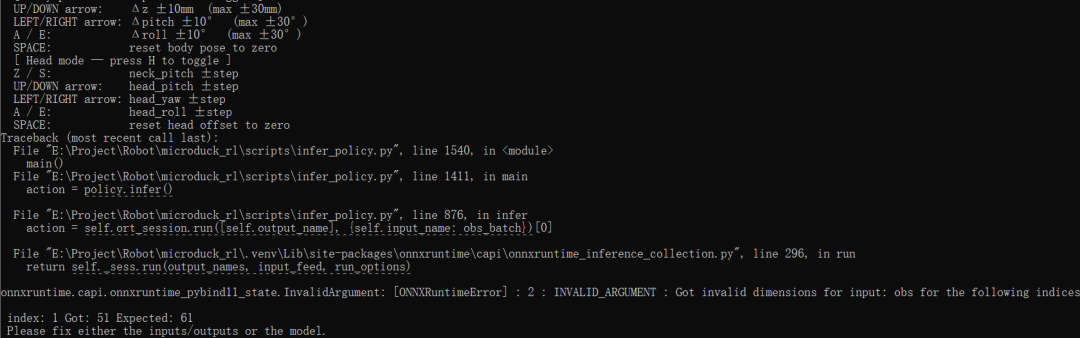
这里出现新报错,模型期望 61D 观测输入,但脚本默认输出 51D(旧格式 3D command)。这个策略是用新的 61D 布局训练的,需要加 --new-cmd-obs
注:61D = 48(本体感知)+ 13(command 块:twist 3 + head_pose 4 + body_pose 6)
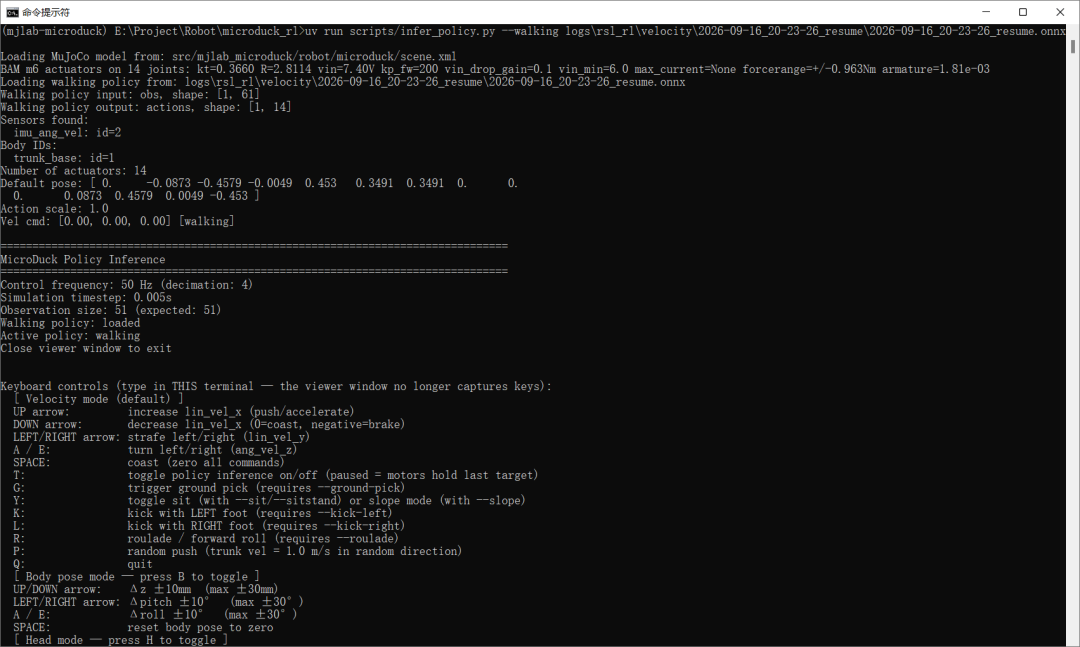
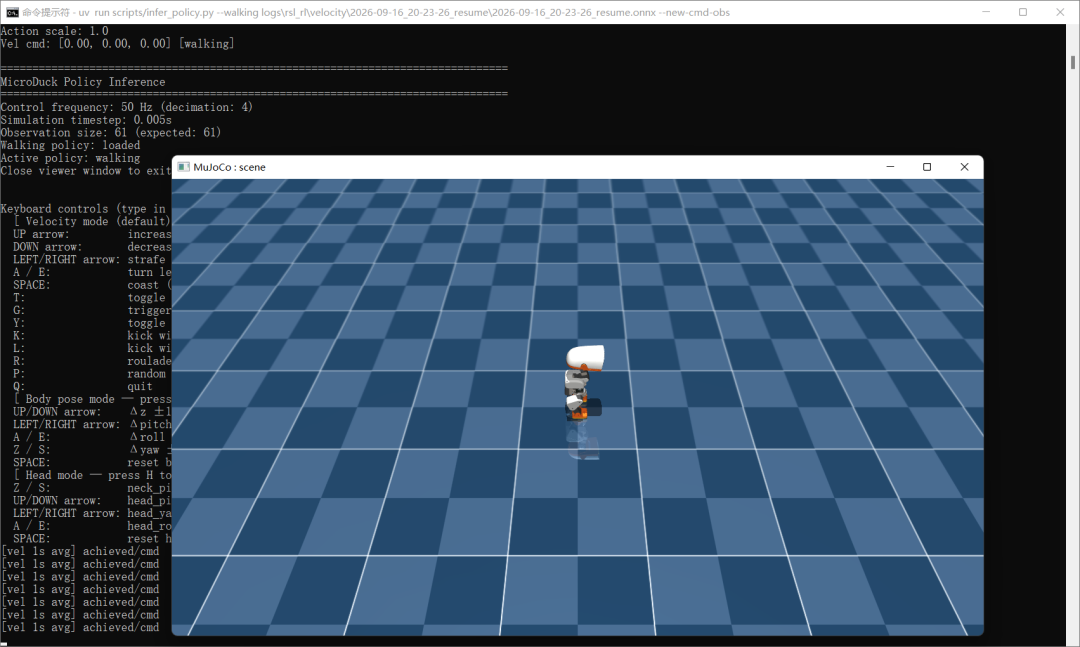
继续执行uv run scripts/infer_policy.py --walking logs\rsl_rl\velocity\2026-09-16_20-23-26_resume\2026-09-16_20-23-26_resume.onnx --new-cmd-obs启动机器人,通过按键控制移动
注:输入法应该切换英文
速度模式(默认模式)
|
按键 |
代码实际行为 |
取值范围(非轮滑模型) |
|---|---|---|
|
↑ |
lin_vel_x
直接设为 +0.3(全速前进) |
±0.3 m/s |
|
↓ |
lin_vel_x
直接设为 -0.3(全速刹车/倒退) |
同上 |
|
← |
lin_vel_y
设为 +0.2(向左平移) |
±0.2 m/s |
|
→ |
lin_vel_y
设为 -0.2(向右平移) |
同上 |
|
A |
ang_vel_z
设为 +1.5(左转) |
±1.5 rad/s |
|
E |
ang_vel_z
设为 -1.5(右转) |
同上 |
|
空格 |
三个速度指令全部归零(滑行减速停下) |
— |
|
T |
暂停/恢复策略推理(暂停时电机保持最后目标位置) |
— |
|
P |
随机方向推躯干一把(1.0 m/s,覆盖当前线速度) |
— |
|
Q |
退出 |
— |
| Z / S | 无任何响应
(代码里没有速度模式分支,静默忽略) |
— |
⚠️ 与帮助文本不一致①:打印的帮助写 "UP arrow: increase lin_vel_x",听起来是递增;但代码里 vel_step_x = 0.05 定义了却从未被使用,实际是按上下限直接跳变(一按就是满速 0.3)。想要渐进加速的手感,需要改 handle_key 用 vel_step_x 步进。
身体姿态模式(按 B 进入/退出,与速度模式互斥切换)
|
按键 |
行为 |
步进 / 上限 |
|---|---|---|
|
↑ / ↓ |
身体升降 Δz |
±10 mm / ±30 mm |
|
← / → |
俯仰 Δpitch |
±10° / ±30° |
|
A / E |
横滚 Δroll |
±10° / ±30° |
|
Z / S |
偏航 Δyaw |
仅 --new-cmd-obs 时有效
,±10° / ±30° |
|
空格 |
姿态指令全部归零 |
— |
注意:身体的 x/y 平移(代码里有 5 mm 步进常量)未接到任何按键(上游注释明确写 "not exposed on keyboard yet")。
头部模式(按 H 进入/退出)
|
按键 |
行为 |
说明 |
|---|---|---|
|
↑ / ↓ |
head_pitch ±步进 |
步进 = 0.1 rad(new-cmd-obs)/ 0.83 rad(旧版) |
|
← / → |
head_yaw ∓步进 |
⚠️ 方向与直觉相反:按 ← 是 +,按 → 是 - |
|
A / E |
head_roll ±步进 |
— |
|
Z / S |
neck_pitch ±步进 |
— |
|
空格 |
头部偏移归零 |
— |
上限 ±1.4 rad(new-cmd-obs)/ ±2.5 rad(旧版)。
功能键(当前只加载 --walking,按下后的实际输出)
|
按键 |
终端实际打印 |
鸭子动作 |
|---|---|---|
|
G |
Ground pick unavailable: no --ground-pick policy loaded |
无 |
|
Y |
Slope unavailable: no --slope policy loaded
(代码里 sit 未加载时落到 slope 分支) |
无 |
|
K / L |
kick_left/right unavailable: no --kick-left/right policy loaded |
无 |
|
R |
roulade unavailable: no --roulade policy loaded |
无 |
Windows 输入通路(改过的部分)
-
按键来自两条通路,互为补充:终端用
msvcrt.getwch()(阻塞读,能抓到 \x00/\xe0 前缀的方向键);viewer 窗口经launch_passive(key_callback=...)的 GLFW 回调(on_viewer_key),方向键经 GLFW 键码 265-268 映射。代码注释的说法"一个按键只到达其一"对脚本成立 -
但 MuJoCo viewer 自己的可视化快捷键仍然会被触发(G=关灯、R=倒影、T=半透明、D移除地面、S=影子)——这是你之前看到"按 G 出灯光效果"的原因,属 viewer 行为,与脚本无关
-
字母统一转小写处理,大小写不敏感
-
所有按键处理包在 try/except 里,异常只会打印
Key press error:不会崩
演示视频
microduck机器人走路仿真
创作不易,禁止抄袭,转载请附上原文标题及其链接

DAMO开发者矩阵,由阿里巴巴达摩院和中国互联网协会联合发起,致力于探讨最前沿的技术趋势与应用成果,搭建高质量的交流与分享平台,推动技术创新与产业应用链接,围绕“人工智能与新型计算”构建开放共享的开发者生态。
更多推荐
 3
3 0
0- 0


 已为社区贡献22条内容

所有评论(0)