程序员的算法趣题Q08: 优秀的扫地机器人
目录
1. 问题描述
现在市面上有些扫地机器人有时候会反复地清扫某一个地方。
假设有一款比较只能的知道避免重复清扫一个地方的扫地机器人,限定它只能前后左右移动,每次移动一格。举个例子,如果第1次向后移动,那么连续移动三次后,它的轨迹会出现9种情况,如下所示(0表示起点的位置,k={1,2,3}表示经过k步移动后机器人所在的位置)。
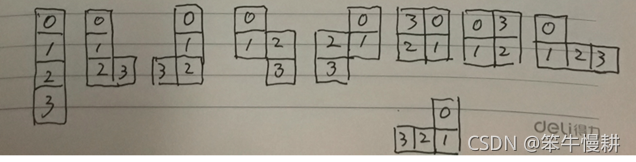
求这个机器移动12次时,有多少种移动路径?
2. 解题分析
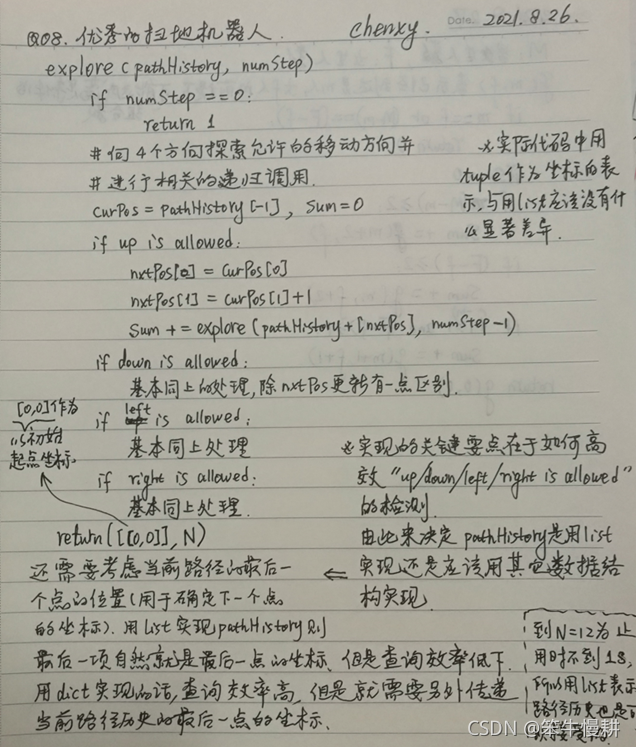
深度优先路径遍历搜索(我杜撰的?要查一查^-^)问题。
3. 代码及测试
# -*- coding: utf-8 -*-
"""
Created on Sat Aug 28 08:30:34 2021

@author: chenxy
"""

import sys
import time
import datetime
# import random
from   typing import List
# from   queue import Queue
# from   collections import deque

class Solution:
    def mopRobot(self, N: int) -> int:
        """
        :N:   The total number of steps
        :ret: The total number of moving paths
        """

        def explore(pathHistory, numSteps):
            # Baseline case: numSteps = 0 means the move is finished.
            if numSteps == 0:
                return 1

            # Explore the four directions to search the allowed move
            sum    = 0
            # up move
            curPos    = pathHistory[-1]
            nxtPos    = tuple([curPos[0], curPos[1] + 1])
            if nxtPos not in pathHistory:
                sum += explore(pathHistory + [nxtPos], numSteps-1)

            # down move
            curPos    = pathHistory[-1]
            nxtPos    = tuple([curPos[0], curPos[1] - 1])
            if nxtPos not in pathHistory:
                sum += explore(pathHistory + [nxtPos], numSteps-1)

            # left move
            curPos    = pathHistory[-1]
            nxtPos    = tuple([curPos[0] - 1, curPos[1]])
            if nxtPos not in pathHistory:
                sum += explore(pathHistory + [nxtPos], numSteps-1)

            # right move
            curPos    = pathHistory[-1]
            nxtPos    = tuple([curPos[0] + 1, curPos[1]])
            if nxtPos not in pathHistory:
                sum += explore(pathHistory + [nxtPos], numSteps-1)

            return sum

        return explore([(0,0)],N)
if __name__ == '__main__':
sln = Solution()
for N in range(1,13):
tStart = time.time()
ans = sln.mopRobot(N)
tCost = time.time() - tStart
print('N={0}, ans={1}, tCost = {2:.3f}(sec)'.format(N,ans,tCost)) 3.1 运行结果:
N=2, ans=12, tCost = 0.000(sec)
N=4, ans=100, tCost = 0.000(sec)
N=6, ans=780, tCost = 0.001(sec)
N=8, ans=5916, tCost = 0.006(sec)
N=10, ans=44100, tCost = 0.057(sec)
N=12, ans=324932, tCost = 0.454(sec)
N=14, ans=2374444, tCost = 3.502(sec)
4. 优化
Python种list的查询相比dict查询要低效得多,如果用dict来存储路径历史pathHistory的话应该可以快很多。但是用dict表示的话,路径的最后位置(即当前位置)就需要另行记忆。
上一篇:Q07: 日期的二进制转换
下一篇:Q09: 落单的男女
本系列总目录参见:程序员的算法趣题:详细分析和Python全解

DAMO开发者矩阵,由阿里巴巴达摩院和中国互联网协会联合发起,致力于探讨最前沿的技术趋势与应用成果,搭建高质量的交流与分享平台,推动技术创新与产业应用链接,围绕“人工智能与新型计算”构建开放共享的开发者生态。
更多推荐
 3
3 0
0- 0


 已为社区贡献14条内容

所有评论(0)