2021 睿抗机器人开发者大赛CAIP-编程技能赛-本科组(国赛)
7-1 绿地围栏
分数 20
作者 陈越
单位 浙江大学

市政规划了一块绿地,需要采购一批围栏将绿地围起来。
为了简单起见,我们假设绿地的形状是个封闭连通的规则多边形,即所有边都是互相垂直或平行的,并且没有交叉的十字边。我们指定某条垂直边上的一个点为原点 (0,0),然后按照顺时针记录这个多边形的拐角顶点的位置。显然两个相邻的点坐标中,总有一个是不变的,因为当我们从一个点沿着平行于 x 轴的边移动到下一个点时,这两个点的 y 坐标是不变的;当我们从一个点沿着平行于 y 轴的边移动到下一个点时,这两个点的 x 坐标是不变的,所以我们可以用一种简化的方式去记录这些拐角,即对于从原点开始顺时针出现的拐角点 P1、P2、P3、…… 我们只需要记录 y1、x2、y3、…… 即可,其中 Pi 的坐标是 (xi,yi)。
采购的围栏每一条有固定长度 L,但是可以从任何地方弯折 90 度角,并且超长的部分也可以截掉。我们需要在两条围栏的衔接处打桩固定连接。现按顺时针方向给出绿地多边形各个拐角的简化坐标列表,请你计算需要采购多少条围栏,以及应该在哪里打桩。
输入格式:
输入第一行给出 2 个正整数,分别是:N(≤103),为绿地拐角点的个数(原点不算在内);以及 L(≤100),是一条围栏的长度。
随后给出 N 个整数,即从原点开始,按顺时针方向给出多边形各个拐角的简化坐标列表。每个坐标的绝对值均不超过 104。数字间以空格分隔。题目保证没有重叠或交叉的边。
输出格式:
每行按格式 x y 输出一对坐标,即从原点出发顺时针给出的打桩点的坐标 (x,y)。注意原点肯定要打一个桩。规定从原点出发顺时针布置围栏,优先使用整条围栏,最后回到原点时,有多余的围栏才会被截掉。
输入样例:
14 5
2 1 1 4 3 5 2 6 -1 4 0 2 -1 0
输出样例:
0 0
2 1
5 3
6 -1
2 0
样例说明:
样例对应的多边形如下图所示(其中红色方块为原点):
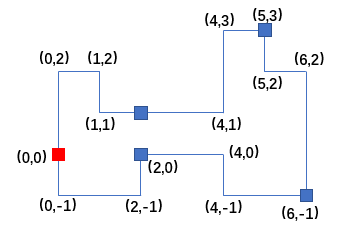
容易算出围栏的总长度为 24,而每条围栏的长度为 5,所以需要 5 条围栏,多余的 1 个单位长度的围栏可以拆掉。从红色的原点出发,每隔 5 个单位打一根桩,图中蓝色方块即为打桩的位置。
#include <bits/stdc++.h>
using namespace std;

// 点结构体
struct Point {
    int x, y;
};

int main() {
    ios::sync_with_stdio(false);
    cin.tie(nullptr);

    int N, L;
    cin >> N >> L;

    vector<int> b(N+1);
    for (int i = 1; i <= N; i++) {
        cin >> b[i];
    }

    // 还原顶点 P[0]..P[N+1]
    vector<Point> P(N+2);
    P[0] = {0, 0};
    for (int i = 1; i <= N; i++) {
        if (i & 1) {
            // 奇数:固定 x,改变 y
            P[i].x = P[i-1].x;
            P[i].y = b[i];
        } else {
            // 偶数:固定 y,改变 x
            P[i].x = b[i];
            P[i].y = P[i-1].y;
        }
    }
    // 回到原点
    P[N+1] = {0, 0};

    // 计算各边长度及前缀和 S
    vector<int> S(N+2, 0);
    for (int i = 0; i <= N; i++) {
        int dx = abs(P[i+1].x - P[i].x);
        int dy = abs(P[i+1].y - P[i].y);
        S[i+1] = S[i] + dx + dy;
    }
    int perim = S[N+1];

    // 对每个 k*L (k=0..floor(perim/L)) 打桩
    int maxK = perim / L;
    int idx = 0;  // 当前扫描到的边段
    for (int k = 0; k <= maxK; k++) {
        int d = k * L;  // 目标距离
        // 移动 idx 直到 S[idx] <= d < S[idx+1]
        while (idx < N+1 && S[idx+1] <= d) idx++;
        int delta = d - S[idx];  // 在 P[idx]→P[idx+1] 段上的偏移

        // 边方向
        int dx = P[idx+1].x - P[idx].x;
        int dy = P[idx+1].y - P[idx].y;
        int sx = (dx > 0) - (dx < 0);
        int sy = (dy > 0) - (dy < 0);

        int px = P[idx].x + sx * delta;
        int py = P[idx].y + sy * delta;
        if(k>0&&px==0&&py==0){
            return 0;
        }
        cout << px << " " << py << "\n";
    }

    return 0;
}
7-2 队列插入
分数 25
作者 DAI, Longao
单位 杭州百腾教育科技有限公司
现在有一个空队列 Q 以及 N 个数字需要按顺序插入,你可以选择插入队列的头部或尾部,请问在合理选择插入方式的前提下,插入后的队列的最长上升子序列的长度最大是多少?
最长上升子序列指的是在一个给定的数值序列中,找到一个子序列,使得这个子序列元素的数值依次递增,并且这个子序列的长度尽可能地大。子序列指的是通过删除原序列中零个或多个元素后获得的序列。
输入格式:
输入第一行是一个数 N (1≤N≤1000),表示有 N 个要按顺序插入的数字。
接下来一行 N 个数,表示要插入的数字,数字已经按插入顺序排列好,并且都在 32 位整数范围内。
输出格式:
输出两行,第一行是一个数字,表示最大的最长上升子序列的长度。
接下来一行,输出插入的方案,其中用L表示插入到头部,用R表示插入到尾部。当有多个相同长度的方案时,选择字典序最小的方案(L 的字典序小于 R)。
输入样例:
8
1 3 2 4 2 4 5 0
输出样例:
5
LLLLLRRL
样例解释:
样例最后队列内容为:0 2 4 2 3 1 4 5
#include <iostream>
#include <vector>
#include <deque>
#include <algorithm>
#include <string>
#include <functional>
using namespace std;

// 使用二分查找计算最长上升子序列的长度
int calculateLIS(const vector<int>& arr) {
    if (arr.empty()) return 0;

    vector<int> dp;
    for (int x : arr) {
        auto it = lower_bound(dp.begin(), dp.end(), x);
        if (it == dp.end()) {
            dp.push_back(x);
        } else {
            *it = x;
        }
    }
    return dp.size();
}

int main() {
    int n;
    cin >> n;
    vector<int> nums(n);
    for (int i = 0; i < n; i++) {
        cin >> nums[i];
    }

    int maxLIS = 0;
    string bestSolution = "";

    // 使用DFS搜索所有可能的插入方案
    function<void(int, deque<int>&, string&)> dfs = [&](int idx, deque<int>& q, string& path) {
        // 如果所有数字都已插入,计算当前方案的LIS长度
        if (idx == n) {
            vector<int> arr(q.begin(), q.end());
            int currentLIS = calculateLIS(arr);
            // 更新最优解(优先选择LIS更长的,其次选择字典序更小的)
            if (currentLIS > maxLIS || (currentLIS == maxLIS && path < bestSolution)) {
                maxLIS = currentLIS;
                bestSolution = path;
            }
            return;
        }

        // 剪枝:如果当前LIS + 剩余数字个数 <= 已知最优解,则无需继续搜索
        vector<int> arr(q.begin(), q.end());
        int currentLIS = calculateLIS(arr);
        if (currentLIS + (n - idx) <= maxLIS) {
            return;
        }

        // 优先尝试插入到头部(L),因为L的字典序小于R
        q.push_front(nums[idx]);
        path.push_back('L');
        dfs(idx + 1, q, path);
        path.pop_back();
        q.pop_front();

        // 然后尝试插入到尾部(R)
        q.push_back(nums[idx]);
        path.push_back('R');
        dfs(idx + 1, q, path);
        path.pop_back();
        q.pop_back();
    };

    deque<int> q;
    string path = "";
    dfs(0, q, path);

    cout << maxLIS << endl;
    cout << bestSolution << endl;

    return 0;
}
7-3 账户安全预警
分数 25
作者 陈越
单位 浙江大学
拼题 A 系统为提高用户账户的安全性,打算开发一个自动安全预警的功能。对每个账户的每次登录,系统会记录其登录的 IP 地址。每隔一段时间,系统将统计每个账户从多少不同的 IP 地址分别登录了多少次。如果某个账户的登录 IP 超过了 TIP 种,并且登录过于频繁,超过了 Tlogin 次,则会自动向管理员发出警报。
下面就请你实现这个预警功能。
输入格式:
输入首先在第一行中给出三个正整数:N(≤104)为登录记录的条数;TIP 和
Tlogin,定义如题面中所描述,均不超过 100。
随后 N 行,每行格式为:
账户邮箱 IP地址
其中 账户邮箱 为长度不超过 40 的、不包含空格的非空字符串;IP地址 为形如 xxx.xxx.xxx.xxx 的合法 IP 地址。
输出格式:
按照登录所用不同 IP 的数量的非递增顺序,输出每个预警账户的信息。格式为:
账户邮箱
IP1 登录次数
IP2 登录次数
……
其中 IP 按登录次数的非递增顺序输出,如有并列,则按 IP 的递增字典序输出。此外,对所用不同 IP 的数量并列的用户,按其账户邮箱的递增字典序输出。
另一方面,即使没有账户达到预警线,也输出登录所用不同 IP 的数量最多的一批账户的信息。
输入样例 1:
24 3 4
daohaole@qq.com 218.109.231.189
1jiadelaolao@163.com 112.192.203.187
chenyuelaolao@zju.edu.cn 112.18.235.143
jiadelaolao@163.com 112.192.203.187
chenyuelaolao@zju.edu.cn 113.18.235.143
jiadelaolao@163.com 111.192.203.187
daohaole@qq.com 218.109.231.189
chenyuelaolao@zju.edu.cn 111.18.235.143
1jiadelaolao@163.com 115.192.203.187
daohaole@qq.com 113.189.58.141
1jiadelaolao@163.com 111.192.203.187
daohaole@qq.com 112.18.58.145
1jiadelaolao@163.com 114.192.203.187
chenyuelaolao@zju.edu.cn 112.18.235.143
daohaole@qq.com 123.89.158.214
chenyuelaolao@zju.edu.cn 112.18.235.143
youdaohaole@qq.com 218.109.231.189
jiadelaolao@163.com 113.192.203.187
youdaohaole@qq.com 218.109.231.189
jiadelaolao@163.com 114.192.203.187
youdaohaole@qq.com 113.189.58.141
youdaohaole@qq.com 123.89.158.214
1jiadelaolao@163.com 113.192.203.187
youdaohaole@qq.com 112.18.58.145
输出样例 1:
1jiadelaolao@163.com
111.192.203.187 1
112.192.203.187 1
113.192.203.187 1
114.192.203.187 1
115.192.203.187 1
daohaole@qq.com
218.109.231.189 2
112.18.58.145 1
113.189.58.141 1
123.89.158.214 1
youdaohaole@qq.com
218.109.231.189 2
112.18.58.145 1
113.189.58.141 1
123.89.158.214 1
输入样例 2:
24 5 8
daohaole@qq.com 218.109.231.189
1jiadelaolao@163.com 112.192.203.187
chenyuelaolao@zju.edu.cn 112.18.235.143
jiadelaolao@163.com 112.192.203.187
chenyuelaolao@zju.edu.cn 113.18.235.143
jiadelaolao@163.com 111.192.203.187
daohaole@qq.com 218.109.231.189
chenyuelaolao@zju.edu.cn 111.18.235.143
1jiadelaolao@163.com 115.192.203.187
daohaole@qq.com 113.189.58.141
1jiadelaolao@163.com 111.192.203.187
daohaole@qq.com 112.18.58.145
1jiadelaolao@163.com 114.192.203.187
chenyuelaolao@zju.edu.cn 112.18.235.143
daohaole@qq.com 123.89.158.214
chenyuelaolao@zju.edu.cn 112.18.235.143
youdaohaole@qq.com 218.109.231.189
jiadelaolao@163.com 113.192.203.187
youdaohaole@qq.com 218.109.231.189
jiadelaolao@163.com 114.192.203.187
youdaohaole@qq.com 113.189.58.141
youdaohaole@qq.com 123.89.158.214
1jiadelaolao@163.com 113.192.203.187
youdaohaole@qq.com 112.18.58.145
输出样例 2:
1jiadelaolao@163.com
111.192.203.187 1
112.192.203.187 1
113.192.203.187 1
114.192.203.187 1
115.192.203.187 1
#include <bits/stdc++.h>
using namespace std;

int main() {
    ios::sync_with_stdio(false);
    cin.tie(nullptr);

    int N, T_IP, T_login;
    cin >> N >> T_IP >> T_login;

    // 统计
    map<string, map<string,int>> cnt;  // cnt[email][ip] = 次数
    map<string,int> totlogin;          // totlogin[email]
    for (int i = 0; i < N; i++) {
        string email, ip;
        cin >> email >> ip;
        cnt[email][ip]++;
        totlogin[email]++;
    }
    // 计算不同IP数
    map<string,int> ipnum;
    for (auto &p : cnt) {
        ipnum[p.first] = p.second.size();
    }

    // 筛预警:ipnum > T_IP 且 totlogin > T_login
    vector<string> warns;
    for (auto &p : ipnum) {
        const string &email = p.first;
        if (p.second > T_IP && totlogin[email] > T_login) {
            warns.push_back(email);
        }
    }
    // 如果没人预警,就找 ipnum 最大的一批
    if (warns.empty()) {
        int mx = 0;
        for (auto &p : ipnum) {
            mx = max(mx, p.second);
        }
        for (auto &p : ipnum) {
            if (p.second == mx) warns.push_back(p.first);
        }
    }

    // 排序账号:ipnum降序,email升序
    sort(warns.begin(), warns.end(), [&](const string &a, const string &b){
        if (ipnum[a] != ipnum[b]) return ipnum[a] > ipnum[b];
        return a < b;
    });

    // 输出
    for (auto &email : warns) {
        cout << email << "\n";
        // 收集该用户所有 (ip,次数)
        vector<pair<string,int>> vip;
        for (auto &q : cnt[email]) {
            vip.emplace_back(q.first, q.second);
        }
        // 排序:次数降序,ip升序
        sort(vip.begin(), vip.end(), [&](auto &x, auto &y){
            if (x.second != y.second) return x.second > y.second;
            return x.first < y.first;
        });
        // 打印
        for (auto &pr : vip) {
            cout << pr.first << " " << pr.second << "\n";
        }
    }

    return 0;
}
7-4 猛犸不上 Ban
分数 30
作者 DAI, Longao
单位 杭州百腾教育科技有限公司

在一个名叫刀塔的国家里,有一只猛犸正在到处跑着,希望能够用它的长角抛物技能来撞飞别人。已知刀塔国有 N 座城市,城市之间由 M 条道路互相连接,为了拦住这头猛犸,每条道路上设置了 Vi 人的团队。
这只猛犸从 S 号城市出发,它可以选择:
- 在不重复地经过若干条道路后回到 S 号城市;
- 在不重复地经过若干条道路后到达 T 号城市。
猛犸经过一条道路后,就会把路上的人全部撞飞。作为一头爱喝雪碧的仁慈的猛犸,自然希望尽可能的少撞飞人。请你帮忙计算一下在最优的选择下,最少需要撞飞多少人才能够到达目标城市?
输入格式:
输入第一行是四个正整数 N,M,S,T (2≤N≤500,1≤M≤105),表示有 N 个城市,M 条道路,猛犸从 S 号城市出发,可以选择到达 T 号城市。
接下来的 M 行,每行三个正整数 Xi,Yi,Vi (0≤Vi≤100),表示从 Xi 号城市到 Yi 号城市有一条道路,道路上有 Vi 人的团队。道路可双向通行,城市编号从 1 开始,两个城市之间最多只有一条道路,且没有一条道路连接相同的城市。
数据保证两种选择里至少有一种是可行的。
输出格式:
输出两行,第一行是两个数字,分别对应上面的两种选择分别最少需要撞飞多少人。如果无论撞飞多少人都无法满足选择要求,则输出 -1。
第二行是一个句子,如果第一种(回到原点)的选择比较好,就输出 Win!,否则输出Lose!。
输入样例:
5 6 1 5
1 2 1
2 3 2
3 4 3
4 1 5
3 5 4
4 5 1
输出样例:
在这里给出相应的输出。例如:
11 6
Lose!
#include <bits/stdc++.h>
using namespace std;
using ll = long long;
const ll INF = (ll)1e18;

int main(){
    ios::sync_with_stdio(false);
    cin.tie(nullptr);

    int N, M, S, T;
    cin >> N >> M >> S >> T;

    // 建图(无向)
    vector<vector<pair<int,int>>> adj(N+1);
    for(int i = 0; i < M; i++){
        int x, y, v;
        cin >> x >> y >> v;
        adj[x].push_back({y,v});
        adj[y].push_back({x,v});
    }

    // 1) Dijkstra 求 S->T 最短
    auto dijkstra = [&](int src, int ban_u, int ban_v){
        // ban_u, ban_v: 若同 (u,v) 或 (v,u) 则跳过那条边
        vector<ll> dist(N+1, INF);
        using pli = pair<ll,int>;
        priority_queue<pli, vector<pli>, greater<pli>> pq;
        dist[src] = 0;
        pq.push({0, src});
        while(!pq.empty()){
            auto [d,u] = pq.top(); pq.pop();
            if(d > dist[u]) continue;
            for(auto &ed: adj[u]){
                int v = ed.first, w = ed.second;
                // 如果是要“移除”的那条边,就跳过
                if( (u==ban_u && v==ban_v) || (u==ban_v && v==ban_u) )
                    continue;
                if(dist[v] > d + w){
                    dist[v] = d + w;
                    pq.push({dist[v], v});
                }
            }
        }
        return dist;
    };

    // 求 S->T
    ll best_ST = INF;
    {
        auto dist = dijkstra(S, -1, -1);
        best_ST = dist[T];
    }

    // 2) 求最小回路:枚举 (S,u) 邻边,移除它后算 S->u
    ll best_cycle = INF;
    for(auto &ed : adj[S]){
        int u = ed.first, w = ed.second;
        // 在 Dijkstra 中 ban 这条边
        auto dist = dijkstra(S, S, u);
        if(dist[u] < INF){
            best_cycle = min(best_cycle, dist[u] + w);
        }
    }

    // 输出结果
    if(best_cycle >= INF) cout << -1;
    else cout << best_cycle;
    cout << " ";
    if(best_ST >= INF) cout << -1;
    else cout << best_ST;
    cout << "\n";

    // 比较 Win / Lose
    // 注意:若某项为 -1(INF),则看另一项是否也是 -1,题目保证至少一种可行
    if(best_cycle <= best_ST) cout << "Win!";
    else cout << "Lose!";
    cout << "\n";

    return 0;
}

DAMO开发者矩阵,由阿里巴巴达摩院和中国互联网协会联合发起,致力于探讨最前沿的技术趋势与应用成果,搭建高质量的交流与分享平台,推动技术创新与产业应用链接,围绕“人工智能与新型计算”构建开放共享的开发者生态。
更多推荐


 17
17 0
0- 0


 已为社区贡献2条内容

所有评论(0)