主题094:多体系统的教育培训体系
目录
- 概述
- 教育培训目标
- 课程体系设计
- 教学方法与手段
- 实践教学环节
- 在线教育资源
- 认证与评估体系
- 产学研合作
- 国际化教育
- 总结
概述
教育培训的重要性
多体动力学作为机械工程、航空航天、机器人等领域的核心学科,其教育培训具有重要意义:
- 人才培养:为工业界和学术界输送专业人才
- 技术传承:确保知识和技能的代际传递
- 创新基础:为技术创新提供人才支撑
- 产业需求:满足制造业转型升级的人才需求
- 国际竞争:提升国家工程教育水平
教育培训体系架构
┌─────────────────────────────────────────────────────────────┐
│                  多体系统教育培训体系                        │
├─────────────────────────────────────────────────────────────┤
│  基础教育层  │ 本科课程、专业基础、通识教育                   │
├─────────────────────────────────────────────────────────────┤
│  专业教育层  │ 研究生课程、专业方向、前沿技术                 │
├─────────────────────────────────────────────────────────────┤
│  实践训练层  │ 实验课程、项目实践、企业实习                   │
├─────────────────────────────────────────────────────────────┤
│  继续教育层  │ 职业培训、在线学习、终身教育                   │
└─────────────────────────────────────────────────────────────┘
教育培训目标
知识目标
| 层次 |
知识要求 |
具体内容 |
| 基础层 |
数学力学基础 |
线性代数、微积分、理论力学、材料力学 |
| 核心层 |
多体动力学理论 |
运动学、动力学、约束处理、数值方法 |
| 应用层 |
工程应用知识 |
车辆动力学、机器人学、生物力学 |
| 前沿层 |
最新研究进展 |
柔性多体、接触碰撞、机器学习应用 |
能力目标
class CompetencyFramework:
    """多体动力学能力框架"""

    COMPETENCIES = {
        '理论分析能力': {
            '初级': ['理解刚体运动学', '掌握牛顿-欧拉方程'],
            '中级': ['建立多体系统模型', '分析约束条件'],
            '高级': ['推导复杂系统方程', '稳定性分析']
        },
        '建模仿真能力': {
            '初级': ['使用商业软件', '建立简单模型'],
            '中级': ['自定义建模', '参数优化'],
            '高级': ['开发求解器', '算法实现']
        },
        '工程应用能力': {
            '初级': ['案例分析', '结果解读'],
            '中级': ['系统设计', '性能评估'],
            '高级': ['创新设计', '问题解决']
        },
        '研究开发能力': {
            '初级': ['文献阅读', '实验设计'],
            '中级': ['独立研究', '论文撰写'],
            '高级': ['项目领导', '技术创新']
        }
    }

    @classmethod
    def assess_competency(cls, level, domain):
        """评估能力水平"""
        if domain in cls.COMPETENCIES:
            return cls.COMPETENCIES[domain].get(level, [])
        return []

    @classmethod
    def get_learning_path(cls, target_level):
        """获取学习路径"""
        path = []
        levels = ['初级', '中级', '高级']
        target_idx = levels.index(target_level)

        for domain in cls.COMPETENCIES:
            for i in range(target_idx + 1):
                path.append({
                    'domain': domain,
                    'level': levels[i],
                    'objectives': cls.COMPETENCIES[domain][levels[i]]
                })

        return path
素质目标
- 工程素养:系统思维、工程伦理、质量意识
- 创新精神:批判性思维、创新意识、探索精神
- 团队协作:沟通能力、合作精神、领导力
- 国际视野:跨文化交流、全球意识、国际竞争力
- 终身学习:自主学习能力、知识更新意识
课程体系设计
本科课程体系
基础课程(1-2年级)
| 课程名称 |
学分 |
主要内容 |
先修课程 |
| 高等数学 |
6 |
微积分、级数、微分方程 |
无 |
| 线性代数 |
3 |
矩阵运算、向量空间、特征值 |
无 |
| 理论力学 |
4 |
静力学、运动学、动力学 |
高等数学 |
| 材料力学 |
4 |
应力应变、强度理论 |
理论力学 |
| 计算方法 |
3 |
数值分析、算法设计 |
高等数学、线性代数 |
| 程序设计 |
3 |
Python/C++编程 |
无 |
专业核心课程(3年级)
class UndergraduateCurriculum:
"""本科课程体系"""
CORE_COURSES = [
{
'name': '多体系统动力学',
'credits': 3,
'hours': {'理论': 48, '实验': 16},
'content': [
'刚体运动学基础',
'牛顿-欧拉方程',
'拉格朗日方程',
'约束处理方法',
'数值积分方法',
'商业软件应用'
],
'prerequisites': ['理论力学', '线性代数', '计算方法'],
'objectives': '掌握多体动力学基本理论和方法'
},
{
'name': '计算多体系统动力学',
'credits': 3,
'hours': {'理论': 32, '实验': 32},
'content': [
'计算运动学',
'动力学算法',
'约束稳定化',
'接触碰撞处理',
'代码实现',
'性能优化'
],
'prerequisites': ['多体系统动力学', '程序设计'],
'objectives': '具备多体动力学编程实现能力'
},
{
'name': '车辆动力学',
'credits': 2,
'hours': {'理论': 32, '实验': 0},
'content': [
'轮胎模型',
'悬架系统',
'转向系统',
'整车建模',
'操纵稳定性',
'平顺性分析'
],
'prerequisites': ['多体系统动力学'],
'objectives': '掌握车辆动力学建模与分析方法'
},
{
'name': '机器人动力学与控制',
'credits': 3,
'hours': {'理论': 40, '实验': 8},
'content': [
'机器人运动学',
'动力学建模',
'轨迹规划',
'控制方法',
'仿真实现'
],
'prerequisites': ['多体系统动力学', '控制理论'],
'objectives': '掌握机器人动力学与控制技术'
}
]
@classmethod
def get_course_schedule(cls, semester):
"""获取学期课程安排"""
schedule = {
5: [cls.CORE_COURSES[0]],
6: [cls.CORE_COURSES[1], cls.CORE_COURSES[2]],
7: [cls.CORE_COURSES[3]]
}
return schedule.get(semester, [])
选修课程
- 柔性多体动力学:大变形、有限元耦合
- 生物力学:人体运动分析、假肢设计
- 航天器动力学:姿态控制、轨道力学
- 虚拟样机技术:ADAMS、Simulink应用
- 优化设计:参数优化、拓扑优化
研究生课程体系
硕士课程
| 课程名称 |
学分 |
类型 |
主要内容 |
| 高等多体动力学 |
3 |
必修 |
高级理论、最新进展 |
| 计算力学 |
3 |
必修 |
有限元、边界元、无网格法 |
| 动力学反问题 |
2 |
选修 |
参数辨识、状态估计 |
| 非线性动力学 |
2 |
选修 |
混沌、分岔、稳定性 |
| 多体系统优化 |
2 |
选修 |
优化算法、灵敏度分析 |
博士课程
class GraduateCurriculum:
    """研究生课程体系"""

    PHD_COURSES = [
        {
            'name': '多体动力学前沿',
            'credits': 2,
            'type': 'seminar',
            'topics': [
                '柔性多体系统最新进展',
                '接触碰撞动力学',
                '数据驱动建模',
                '机器学习在多体系统中的应用',
                '多尺度建模',
                '不确定性量化'
            ],
            'format': '文献阅读+专题报告+讨论',
            'assessment': '报告质量+参与度'
        },
        {
            'name': '独立研究',
            'credits': 6,
            'type': 'research',
            'requirements': [
                '完成前沿课题研究',
                '撰写高水平论文',
                '参加国际会议',
                '申请专利或软件著作权'
            ],
            'duration': '1-2年'
        }
    ]
教学方法与手段
传统教学方法
- 课堂讲授:系统传授理论知识
- 习题课:巩固理论,培养解题能力
- 讨论课:启发思维,促进交流
- 实验课:验证理论,培养动手能力
现代教学手段
class TeachingMethods:
    """教学方法库"""

    METHODS = {
        '翻转课堂': {
            'description': '学生课前自学,课堂讨论深化',
            'implementation': [
                '课前:视频学习+在线测试',
                '课中:问题讨论+案例分析',
                '课后:项目实践+反思总结'
            ],
            'advantages': ['提高主动性', '深化理解', '培养能力'],
            'suitable_for': ['概念性内容', '案例分析']
        },
        '项目式学习': {
            'description': '以项目为载体,综合应用知识',
            'implementation': [
                '项目选题与分组',
                '方案设计与论证',
                '实施与调试',
                '成果展示与评价'
            ],
            'advantages': ['综合能力', '团队协作', '解决实际问题'],
            'suitable_for': ['综合性课程', '毕业设计']
        },
        '案例教学': {
            'description': '真实工程案例驱动学习',
            'implementation': [
                '案例介绍与问题提出',
                '分组讨论与分析',
                '方案设计与优化',
                '总结与反思'
            ],
            'advantages': ['理论联系实际', '工程思维', '决策能力'],
            'suitable_for': ['应用性课程', '工程实践']
        },
        '虚拟仿真': {
            'description': '利用仿真软件进行虚拟实验',
            'implementation': [
                '仿真环境搭建',
                '模型建立与验证',
                '参数研究与优化',
                '结果分析与报告'
            ],
            'advantages': ['安全经济', '可重复', '可视化'],
            'suitable_for': ['实验教学', '设计优化']
        }
    }
数字化教学工具
| 工具类型 |
代表工具 |
应用场景 |
| 学习管理系统 |
Moodle、Canvas |
课程管理、作业提交 |
| 在线编程环境 |
JupyterHub、GitHub Classroom |
编程实践、协作开发 |
| 仿真软件 |
MATLAB/Simulink、ADAMS |
虚拟实验、项目实践 |
| 视频会议 |
Zoom、腾讯会议 |
远程教学、在线答疑 |
| 协作工具 |
Slack、飞书 |
团队沟通、项目管理 |
实践教学环节
实验教学体系
class LaboratoryCurriculum:
    """实验教学体系"""

    EXPERIMENTS = {
        '基础实验': [
            {
                'name': '刚体运动学实验',
                'hours': 4,
                'objectives': '验证刚体运动学理论',
                'equipment': ['运动捕捉系统', '刚体模型'],
                'tasks': [
                    '测量刚体位置和姿态',
                    '计算速度和加速度',
                    '验证运动学关系'
                ]
            },
            {
                'name': '单摆动力学实验',
                'hours': 4,
                'objectives': '理解动力学建模过程',
                'equipment': ['单摆装置', '传感器', '数据采集系统'],
                'tasks': [
                    '测量摆动周期',
                    '验证动力学方程',
                    '参数辨识'
                ]
            }
        ],
        '综合实验': [
            {
                'name': '四连杆机构分析',
                'hours': 8,
                'objectives': '掌握多体系统分析方法',
                'equipment': ['四连杆实验台', '力传感器', '位移传感器'],
                'tasks': [
                    '建立运动学模型',
                    '测量运动轨迹',
                    '动力学分析',
                    '仿真验证'
                ]
            },
            {
                'name': '车辆悬架测试',
                'hours': 8,
                'objectives': '理解车辆动力学特性',
                'equipment': ['悬架试验台', '振动台', '数据采集系统'],
                'tasks': [
                    '测量悬架特性',
                    '频率响应分析',
                    '仿真对比'
                ]
            }
        ],
        '创新实验': [
            {
                'name': '自主设计实验',
                'hours': 16,
                'objectives': '培养创新能力',
                'format': '开放式',
                'requirements': [
                    '自主选题',
                    '方案设计',
                    '实验实施',
                    '报告撰写'
                ]
            }
        ]
    }
课程设计/项目实践
| 项目类型 |
时长 |
内容 |
成果要求 |
| 课程设计 |
2周 |
简单机械系统建模与仿真 |
设计报告+仿真模型 |
| 综合项目 |
4周 |
复杂系统分析与优化 |
完整报告+演示 |
| 毕业设计 |
16周 |
独立研究或工程设计 |
论文+答辩 |
企业实习
class InternshipProgram:
    """企业实习项目"""

    INTERNSHIPS = {
        '认知实习': {
            'duration': '1周',
            'year': 2,
            'objectives': '了解行业概况',
            'activities': ['企业参观', '技术讲座', '座谈交流'],
            'assessment': '实习报告'
        },
        '专业实习': {
            'duration': '4周',
            'year': 3,
            'objectives': '应用专业知识',
            'activities': ['参与项目', '软件应用', '数据分析'],
            'assessment': '实习报告+企业评价'
        },
        '毕业实习': {
            'duration': '12周',
            'year': 4,
            'objectives': '综合工程能力',
            'activities': ['独立承担任务', '解决实际问题', '团队协作'],
            'assessment': '实习报告+答辩'
        }
    }
在线教育资源
MOOC课程
class MOOCResources:
    """MOOC资源库"""

    COURSES = [
        {
            'platform': '中国大学MOOC',
            'title': '多体系统动力学基础',
            'provider': '清华大学',
            'level': '本科',
            'duration': '16周',
            'content': [
                '刚体运动学',
                '动力学基础',
                '约束处理',
                '数值方法',
                '软件应用'
            ],
            'certification': '免费证书/付费认证'
        },
        {
            'platform': 'Coursera',
            'title': 'Multibody Dynamics for Engineers',
            'provider': 'University of Michigan',
            'level': '研究生',
            'duration': '12周',
            'content': [
                'Kinematics',
                'Dynamics',
                'Computational Methods',
                'Applications'
            ],
            'certification': 'Course Certificate'
        },
        {
            'platform': 'edX',
            'title': 'Vehicle Dynamics',
            'provider': 'MIT',
            'level': '高级',
            'duration': '10周',
            'content': [
                'Tire Mechanics',
                'Handling Dynamics',
                'Ride Dynamics',
                'Control Systems'
            ],
            'certification': 'Verified Certificate'
        }
    ]
开放教育资源
| 资源类型 |
代表资源 |
内容 |
| 开放课件 |
MIT OpenCourseWare |
完整课程资料 |
| 开放教材 |
OpenStax |
免费教科书 |
| 开源软件 |
MBDyn、Chrono |
学习工具 |
| 数据集 |
Kaggle、UCI |
实验数据 |
| 视频教程 |
YouTube、B站 |
技术讲解 |
虚拟实验室
class VirtualLab:
    """虚拟实验室平台"""

    LABS = {
        '运动学虚拟实验室': {
            'experiments': [
                '四连杆运动分析',
                '凸轮机构设计',
                '齿轮传动分析'
            ],
            'tools': ['在线仿真', '3D可视化', '参数调节'],
            'access': 'Web浏览器'
        },
        '动力学虚拟实验室': {
            'experiments': [
                '单摆动力学',
                '双摆混沌',
                '车辆平顺性'
            ],
            'tools': ['实时仿真', '数据记录', '结果分析'],
            'access': 'Web浏览器'
        },
        '机器人虚拟实验室': {
            'experiments': [
                '机械臂运动规划',
                '步行机器人',
                '协作机器人'
            ],
            'tools': ['3D仿真环境', '编程接口', '可视化'],
            'access': 'Web浏览器+本地软件'
        }
    }
认证与评估体系
能力认证体系
class CertificationSystem:
    """认证体系"""

    CERTIFICATIONS = {
        '基础级认证': {
            'name': '多体动力学基础认证',
            'level': 'Level 1',
            'requirements': [
                '完成基础课程学习',
                '通过理论考试(70分)',
                '完成基础实验',
                '通过软件操作测试'
            ],
            'validity': '永久',
            'issuer': '教育机构'
        },
        '专业级认证': {
            'name': '多体动力学工程师认证',
            'level': 'Level 2',
            'requirements': [
                '持有基础级认证',
                '2年以上相关工作经验',
                '完成专业培训课程',
                '通过综合考试(80分)',
                '提交项目案例'
            ],
            'validity': '3年(需继续教育)',
            'issuer': '行业协会'
        },
        '专家级认证': {
            'name': '多体动力学专家认证',
            'level': 'Level 3',
            'requirements': [
                '持有专业级认证',
                '5年以上高级工作经验',
                '发表高水平论文或专利',
                '通过专家评审',
                '技术答辩'
            ],
            'validity': '5年(需继续教育)',
            'issuer': '国际专业组织'
        }
    }
评估方法
| 评估类型 |
方法 |
权重 |
目的 |
| 形成性评估 |
作业、测验、讨论 |
30% |
监控学习过程 |
| 总结性评估 |
期末考试、项目 |
50% |
评价学习成果 |
| 实践评估 |
实验、实习 |
15% |
评价应用能力 |
| 自我评估 |
学习日志、反思 |
5% |
培养元认知 |
学习成果评估
class LearningOutcomeAssessment:
    """学习成果评估"""

    OUTCOMES = {
        '知识掌握': {
            'indicators': [
                '理论考试成绩',
                '概念理解程度',
                '知识体系完整性'
            ],
            'assessment_methods': ['笔试', '口试', '概念图']
        },
        '技能应用': {
            'indicators': [
                '建模能力',
                '仿真技能',
                '结果分析能力'
            ],
            'assessment_methods': ['实验报告', '项目作品', '实操考核']
        },
        '问题解决': {
            'indicators': [
                '问题分析能力',
                '方案设计能力',
                '创新思维能力'
            ],
            'assessment_methods': ['案例分析', '设计项目', '竞赛']
        },
        '团队协作': {
            'indicators': [
                '沟通能力',
                '合作精神',
                '领导能力'
            ],
            'assessment_methods': ['同伴评价', '项目评价', '360度反馈']
        }
    }
产学研合作
合作模式
class IndustryAcademiaCollaboration:
    """产学研合作模式"""

    MODELS = {
        '联合实验室': {
            'description': '企业与高校共建实验室',
            'parties': ['企业', '高校'],
            'investment': '共同出资',
            'benefits': {
                '企业': ['技术支持', '人才培养', '前沿研究'],
                '高校': ['经费支持', '实践基地', '就业渠道']
            },
            'examples': ['车辆动力学联合实验室', '机器人技术联合实验室']
        },
        '订单式培养': {
            'description': '根据企业需求定制培养方案',
            'process': [
                '企业提出人才需求',
                '校企共同制定培养方案',
                '学生定向培养',
                '企业实习与就业'
            ],
            'benefits': {
                '企业': ['精准人才', '提前培养', '降低招聘成本'],
                '学生': ['就业保障', '实践机会', '职业发展']
            }
        },
        '项目合作': {
            'description': '共同承担研发项目',
            'types': ['横向项目', '纵向项目', '国际合作'],
            'benefits': {
                '企业': ['技术创新', '问题解决', '人才参与'],
                '高校': ['科研经费', '实际问题', '成果转化']
            }
        },
        '企业导师制': {
            'description': '聘请企业专家担任导师',
            'roles': ['课程讲授', '项目指导', '论文指导', '职业规划'],
            'benefits': ['理论与实践结合', '行业视野', '就业指导']
        }
    }
实习基地建设
| 基地类型 |
合作企业 |
主要内容 |
容纳规模 |
| 车辆动力学 |
汽车企业 |
整车测试、悬架设计 |
20人/年 |
| 机器人技术 |
机器人公司 |
运动控制、路径规划 |
15人/年 |
| 航空航天 |
航空院所 |
飞行器动力学 |
10人/年 |
| 生物力学 |
医疗器械 |
假肢设计、康复工程 |
10人/年 |
国际化教育
国际合作项目
class InternationalEducation:
    """国际化教育项目"""

    PROGRAMS = {
        '双学位项目': {
            'type': 'Joint Degree',
            'partners': [
                {'university': 'University of Michigan', 'country': 'USA'},
                {'university': 'TU Munich', 'country': 'Germany'},
                {'university': 'Tokyo Institute of Technology', 'country': 'Japan'}
            ],
            'duration': '2+2或3+1',
            'requirements': [
                '完成国内课程',
                '语言成绩达标',
                'GPA要求',
                '通过面试'
            ],
            'benefits': ['双学位', '国际视野', '语言能力', '就业优势']
        },
        '交换生项目': {
            'type': 'Exchange',
            'duration': '1学期或1年',
            'destinations': ['欧洲', '北美', '亚洲'],
            'funding': ['奖学金', '免学费', '生活费补助'],
            'requirements': ['语言成绩', '学业成绩', '推荐信']
        },
        '暑期学校': {
            'type': 'Summer School',
            'duration': '2-4周',
            'content': ['课程学习', '文化体验', '企业参观'],
            'funding': '自费或部分资助'
        },
        '在线国际课程': {
            'type': 'Online',
            'platforms': ['edX', 'Coursera', 'FutureLearn'],
            'benefits': ['灵活学习', '国际资源', '证书认证']
        }
    }
国际认证
| 认证项目 |
颁发机构 |
认可度 |
要求 |
| ABET认证 |
美国工程与技术认证委员会 |
国际通用 |
课程体系、师资、设施 |
| EUR-ACE |
欧洲工程教育认证体系 |
欧洲认可 |
工程教育标准 |
| 华盛顿协议 |
国际工程联盟 |
多国互认 |
毕业要求、能力标准 |
总结
教育培训体系架构
┌─────────────────────────────────────────────────────────────┐
│                  多体系统教育培训体系                        │
├─────────────────────────────────────────────────────────────┤
│  基础教育    │ 数学力学、编程基础、通识教育                   │
├─────────────────────────────────────────────────────────────┤
│  专业教育    │ 多体动力学、计算方法、专业方向                 │
├─────────────────────────────────────────────────────────────┤
│  实践教育    │ 实验、项目、实习、毕业设计                     │
├─────────────────────────────────────────────────────────────┤
│  继续教育    │ 职业培训、在线学习、终身发展                   │
└─────────────────────────────────────────────────────────────┘
关键要点
- 分层培养:基础教育→专业教育→实践教育→继续教育
- 能力导向:理论分析、建模仿真、工程应用、研究开发
- 多元教学:传统教学+现代手段+虚拟仿真
- 实践为重:实验、项目、实习三位一体
- 开放共享:MOOC、开放资源、虚拟实验室
- 产教融合:联合培养、订单式、企业导师
- 国际视野:双学位、交换生、国际认证
发展趋势
- 数字化转型:AI辅助教学、虚拟实验室、在线学习
- 个性化学习:自适应学习路径、能力导向培养
- 终身学习:微证书、模块化课程、继续教育
- 跨界融合:多学科交叉、新工科建设
- 全球合作:国际联合培养、全球资源共享
参考文献
- 教育部. 普通高等学校本科专业类教学质量国家标准[S]. 2018.
- ABET. Criteria for Accrediting Engineering Programs[S]. 2023.
- EUR-ACE. Framework Standards for the Accreditation of Engineering Programmes[S]. 2015.
- 中国工程教育专业认证协会. 工程教育认证标准[S]. 2022.
- Haug, E.J. Computer-Aided Kinematics and Dynamics of Mechanical Systems[M]. 1989.
- Shabana, A.A. Dynamics of Multibody Systems[M]. 4th Edition. 2013.
- 洪嘉振. 计算多体系统动力学[M]. 高等教育出版社. 1999.
- 刘延柱. 多刚体系统动力学[M]. 高等教育出版社. 2018.
"""
主题094:多体系统的教育培训体系 - 仿真代码
演示课程体系、学习路径、能力评估和教学效果分析
"""
import numpy as np
import matplotlib.pyplot as plt
from matplotlib.patches import FancyBboxPatch, Circle, FancyArrowPatch, Rectangle
import matplotlib.patches as mpatches
plt.rcParams['font.sans-serif'] = ['SimHei', 'DejaVu Sans']
plt.rcParams['axes.unicode_minus'] = False
class EducationTrainingSimulation:
"""教育培训体系仿真"""
def __init__(self):
self.courses = []
self.students = []
self.learning_paths = []
def simulate_curriculum_structure(self):
"""仿真课程体系结构"""
print("=" * 60)
print("多体系统教育培训体系仿真")
print("=" * 60)
curriculum = {
'基础课程': {
'courses': [
{'name': '高等数学', 'credits': 6, 'hours': 96, 'difficulty': 0.7},
{'name': '线性代数', 'credits': 3, 'hours': 48, 'difficulty': 0.6},
{'name': '理论力学', 'credits': 4, 'hours': 64, 'difficulty': 0.75},
{'name': '材料力学', 'credits': 4, 'hours': 64, 'difficulty': 0.7},
{'name': '计算方法', 'credits': 3, 'hours': 48, 'difficulty': 0.65},
{'name': '程序设计', 'credits': 3, 'hours': 48, 'difficulty': 0.6}
],
'semester': '1-2年级'
},
'专业核心课程': {
'courses': [
{'name': '多体系统动力学', 'credits': 3, 'hours': 64, 'difficulty': 0.8},
{'name': '计算多体系统动力学', 'credits': 3, 'hours': 64, 'difficulty': 0.85},
{'name': '车辆动力学', 'credits': 2, 'hours': 32, 'difficulty': 0.75},
{'name': '机器人动力学与控制', 'credits': 3, 'hours': 48, 'difficulty': 0.8}
],
'semester': '3年级'
},
'选修课程': {
'courses': [
{'name': '柔性多体动力学', 'credits': 2, 'hours': 32, 'difficulty': 0.85},
{'name': '生物力学', 'credits': 2, 'hours': 32, 'difficulty': 0.75},
{'name': '航天器动力学', 'credits': 2, 'hours': 32, 'difficulty': 0.8},
{'name': '优化设计', 'credits': 2, 'hours': 32, 'difficulty': 0.7}
],
'semester': '3-4年级'
}
}
print("\n1. 课程体系结构")
print("-" * 60)
total_credits = 0
total_hours = 0
for category, info in curriculum.items():
print(f"\n{category} ({info['semester']}):")
print(f"{'课程名称':<20} {'学分':<8} {'学时':<8} {'难度':<8}")
print("-" * 50)
for course in info['courses']:
print(f"{course['name']:<20} {course['credits']:<8} "
f"{course['hours']:<8} {course['difficulty']:<8.2f}")
total_credits += course['credits']
total_hours += course['hours']
print(f"\n总计: {total_credits}学分, {total_hours}学时")
return curriculum
def simulate_learning_path(self):
"""仿真学习路径规划"""
print("\n2. 学习路径规划")
print("-" * 60)
competency_levels = {
'入门级': {
'duration': '1-2学期',
'courses': ['高等数学', '线性代数', '程序设计'],
'skills': ['基础数学', '编程基础'],
'mastery': 0.3
},
'基础级': {
'duration': '3-4学期',
'courses': ['理论力学', '材料力学', '计算方法'],
'skills': ['力学分析', '数值计算'],
'mastery': 0.5
},
'进阶级': {
'duration': '5-6学期',
'courses': ['多体系统动力学', '计算多体系统动力学'],
'skills': ['系统建模', '仿真分析'],
'mastery': 0.7
},
'专业级': {
'duration': '7-8学期',
'courses': ['车辆动力学', '机器人动力学与控制', '毕业设计'],
'skills': ['专业应用', '综合设计'],
'mastery': 0.85
}
}
print("能力进阶路径:")
for level, info in competency_levels.items():
print(f"\n{level} ({info['duration']}):")
print(f" 掌握度: {info['mastery']*100:.0f}%")
print(f" 核心课程: {', '.join(info['courses'])}")
print(f" 核心技能: {', '.join(info['skills'])}")
return competency_levels
def simulate_student_progress(self):
"""仿真学生学习进度"""
print("\n3. 学生学习进度仿真")
print("-" * 60)
np.random.seed(42)
n_students = 50
student_types = {
'优秀': 0.15,
'良好': 0.35,
'中等': 0.35,
'需努力': 0.15
}
students = []
for student_type, ratio in student_types.items():
n = int(n_students * ratio)
if student_type == '优秀':
base_ability = 0.85
learning_rate = 0.15
elif student_type == '良好':
base_ability = 0.7
learning_rate = 0.12
elif student_type == '中等':
base_ability = 0.55
learning_rate = 0.1
else:
base_ability = 0.4
learning_rate = 0.08
for i in range(n):
student = {
'id': len(students) + 1,
'type': student_type,
'base_ability': base_ability + np.random.normal(0, 0.05),
'learning_rate': learning_rate + np.random.normal(0, 0.02),
'progress': []
}
students.append(student)
semesters = np.arange(1, 9)
for student in students:
mastery = student['base_ability']
for sem in semesters:
growth = student['learning_rate'] * (1 - mastery) * np.random.uniform(0.8, 1.2)
mastery = min(mastery + growth, 0.98)
student['progress'].append(mastery)
print("各类型学生平均掌握度:")
print(f"{'学期':<8}", end='')
for stype in student_types.keys():
print(f"{stype:<10}", end='')
print()
print("-" * 50)
for i, sem in enumerate(semesters):
print(f"{sem:<8}", end='')
for stype in student_types.keys():
type_students = [s for s in students if s['type'] == stype]
avg_progress = np.mean([s['progress'][i] for s in type_students])
print(f"{avg_progress*100:<10.1f}", end='')
print()
return students, semesters
def simulate_assessment_system(self):
"""仿真评估体系"""
print("\n4. 多元化评估体系")
print("-" * 60)
assessment_methods = {
'形成性评估': {
'components': [
{'name': '平时作业', 'weight': 0.15, 'frequency': '每周'},
{'name': '课堂测验', 'weight': 0.10, 'frequency': '每两周'},
{'name': '课堂参与', 'weight': 0.05, 'frequency': '每课'}
],
'total_weight': 0.30,
'purpose': '监控学习过程'
},
'总结性评估': {
'components': [
{'name': '期中考试', 'weight': 0.20, 'format': '笔试'},
{'name': '期末考试', 'weight': 0.30, 'format': '笔试'}
],
'total_weight': 0.50,
'purpose': '评价学习成果'
},
'实践评估': {
'components': [
{'name': '实验报告', 'weight': 0.10, 'format': '报告'},
{'name': '项目作业', 'weight': 0.05, 'format': '作品'}
],
'total_weight': 0.15,
'purpose': '评价应用能力'
},
'自我评估': {
'components': [
{'name': '学习反思', 'weight': 0.03, 'format': '日志'},
{'name': '同伴评价', 'weight': 0.02, 'format': '互评'}
],
'total_weight': 0.05,
'purpose': '培养元认知'
}
}
print("评估方法及权重分配:")
for category, info in assessment_methods.items():
print(f"\n{category} (权重: {info['total_weight']*100:.0f}%):")
print(f" 目的: {info['purpose']}")
for comp in info['components']:
print(f" - {comp['name']}: {comp['weight']*100:.1f}%")
np.random.seed(123)
n_students = 100
final_scores = []
for _ in range(n_students):
score = 0
for category, info in assessment_methods.items():
for comp in info['components']:
comp_score = np.random.normal(75, 12)
comp_score = np.clip(comp_score, 0, 100)
score += comp_score * comp['weight']
final_scores.append(score)
final_scores = np.array(final_scores)
print(f"\n成绩统计:")
print(f" 平均分: {final_scores.mean():.1f}")
print(f" 标准差: {final_scores.std():.1f}")
print(f" 最高分: {final_scores.max():.1f}")
print(f" 最低分: {final_scores.min():.1f}")
print(f" 及格率: {(final_scores >= 60).sum() / len(final_scores) * 100:.1f}%")
return assessment_methods, final_scores
def simulate_teaching_effectiveness(self):
"""仿真教学效果分析"""
print("\n5. 教学效果分析")
print("-" * 60)
teaching_methods = {
'传统讲授': {'engagement': 0.5, 'retention': 0.6, 'satisfaction': 0.6},
'案例教学': {'engagement': 0.75, 'retention': 0.75, 'satisfaction': 0.8},
'项目式学习': {'engagement': 0.85, 'retention': 0.8, 'satisfaction': 0.85},
'翻转课堂': {'engagement': 0.8, 'retention': 0.75, 'satisfaction': 0.75},
'虚拟仿真': {'engagement': 0.9, 'retention': 0.85, 'satisfaction': 0.9}
}
print("教学方法效果对比:")
print(f"{'教学方法':<15} {'参与度':<10} {'知识保持':<10} {'满意度':<10} {'综合评分'}")
print("-" * 60)
for method, metrics in teaching_methods.items():
composite = np.mean(list(metrics.values()))
print(f"{method:<15} {metrics['engagement']*100:<10.0f} "
f"{metrics['retention']*100:<10.0f} {metrics['satisfaction']*100:<10.0f} "
f"{composite*100:.0f}")
return teaching_methods
def simulate_career_outcomes(self):
"""仿真职业发展 outcomes"""
print("\n6. 职业发展 outcomes 分析")
print("-" * 60)
career_paths = {
'继续深造': {'percentage': 0.35, 'avg_salary': 0, 'satisfaction': 0.8},
'汽车行业': {'percentage': 0.25, 'avg_salary': 12000, 'satisfaction': 0.75},
'机器人行业': {'percentage': 0.20, 'avg_salary': 15000, 'satisfaction': 0.8},
'航空航天': {'percentage': 0.10, 'avg_salary': 13000, 'satisfaction': 0.85},
'其他行业': {'percentage': 0.10, 'avg_salary': 10000, 'satisfaction': 0.7}
}
print("毕业生就业去向:")
print(f"{'去向':<15} {'比例':<10} {'平均薪资':<12} {'满意度'}")
print("-" * 50)
for path, info in career_paths.items():
salary_str = f"{info['avg_salary']}元/月" if info['avg_salary'] > 0 else "N/A"
print(f"{path:<15} {info['percentage']*100:<10.0f} {salary_str:<12} "
f"{info['satisfaction']*100:.0f}%")
avg_salary = sum(info['percentage'] * info['avg_salary']
for info in career_paths.values())
avg_satisfaction = sum(info['percentage'] * info['satisfaction']
for info in career_paths.values())
print(f"\n加权平均薪资: {avg_salary:.0f}元/月")
print(f"加权平均满意度: {avg_satisfaction*100:.0f}%")
return career_paths
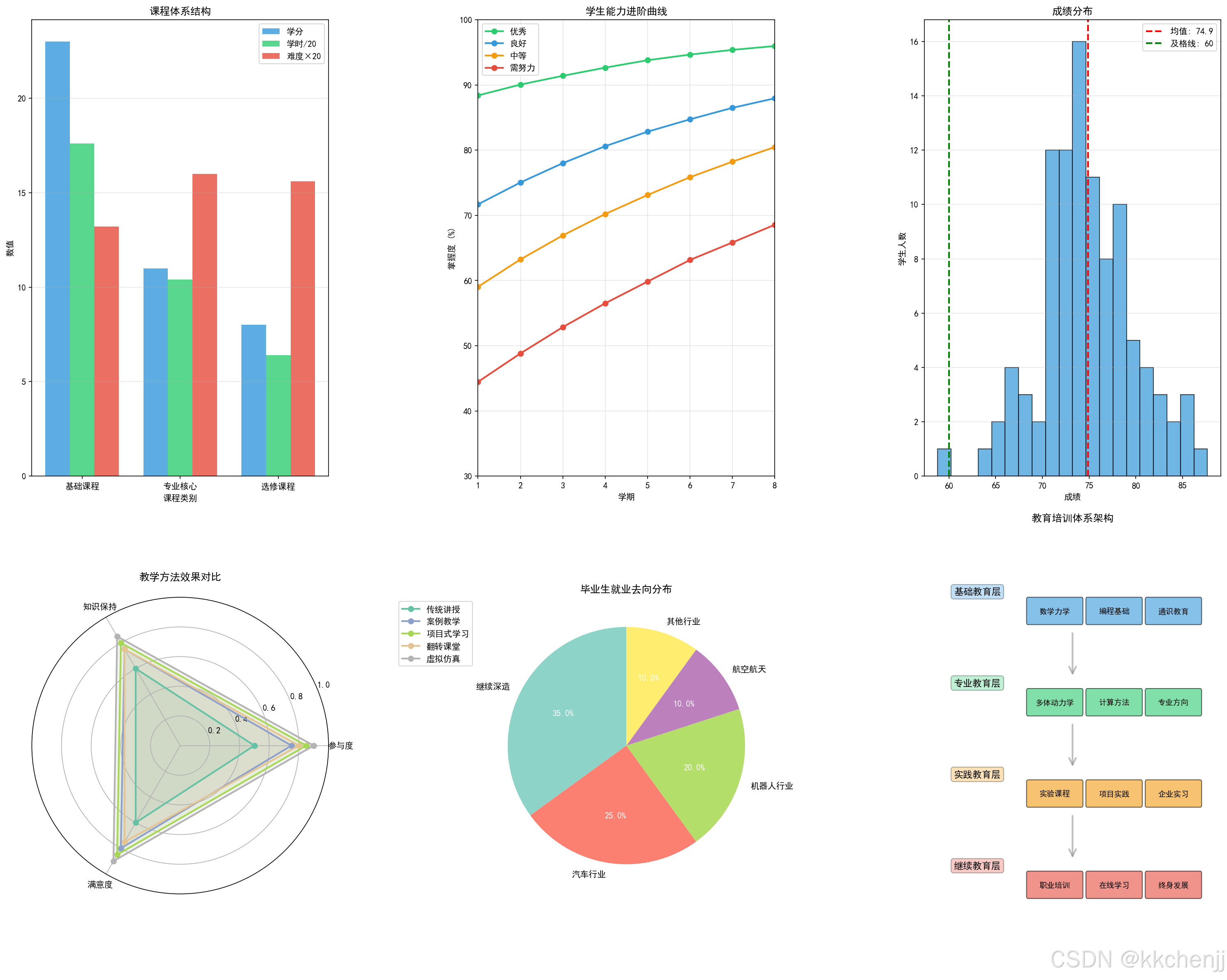
def create_visualizations(simulation):
"""创建可视化图表"""
fig = plt.figure(figsize=(20, 16))
ax1 = fig.add_subplot(2, 3, 1)
categories = ['基础课程', '专业核心', '选修课程']
credits = [23, 11, 8]
hours = [352, 208, 128]
difficulties = [0.66, 0.80, 0.78]
x = np.arange(len(categories))
width = 0.25
bars1 = ax1.bar(x - width, credits, width, label='学分', color='#3498db', alpha=0.8)
bars2 = ax1.bar(x, [h/20 for h in hours], width, label='学时/20', color='#2ecc71', alpha=0.8)
bars3 = ax1.bar(x + width, [d*20 for d in difficulties], width, label='难度×20', color='#e74c3c', alpha=0.8)
ax1.set_xlabel('课程类别')
ax1.set_ylabel('数值')
ax1.set_title('课程体系结构', fontsize=12, fontweight='bold')
ax1.set_xticks(x)
ax1.set_xticklabels(categories)
ax1.legend()
ax1.grid(axis='y', alpha=0.3)
ax2 = fig.add_subplot(2, 3, 2)
students, semesters = simulation.simulate_student_progress()
student_types = ['优秀', '良好', '中等', '需努力']
colors = ['#2ecc71', '#3498db', '#f39c12', '#e74c3c']
for stype, color in zip(student_types, colors):
type_students = [s for s in students if s['type'] == stype]
avg_progress = [np.mean([s['progress'][i] for s in type_students])
for i in range(len(semesters))]
ax2.plot(semesters, [p*100 for p in avg_progress],
'o-', linewidth=2, label=stype, color=color, markersize=6)
ax2.set_xlabel('学期')
ax2.set_ylabel('掌握度 (%)')
ax2.set_title('学生能力进阶曲线', fontsize=12, fontweight='bold')
ax2.legend()
ax2.grid(True, alpha=0.3)
ax2.set_xlim(1, 8)
ax2.set_ylim(30, 100)
ax3 = fig.add_subplot(2, 3, 3)
_, final_scores = simulation.simulate_assessment_system()
ax3.hist(final_scores, bins=20, color='#3498db', alpha=0.7, edgecolor='black')
ax3.axvline(final_scores.mean(), color='red', linestyle='--', linewidth=2, label=f'均值: {final_scores.mean():.1f}')
ax3.axvline(60, color='green', linestyle='--', linewidth=2, label='及格线: 60')
ax3.set_xlabel('成绩')
ax3.set_ylabel('学生人数')
ax3.set_title('成绩分布', fontsize=12, fontweight='bold')
ax3.legend()
ax3.grid(axis='y', alpha=0.3)
ax4 = fig.add_subplot(2, 3, 4, projection='polar')
methods = simulation.simulate_teaching_effectiveness()
categories = ['参与度', '知识保持', '满意度']
angles = np.linspace(0, 2 * np.pi, len(categories), endpoint=False).tolist()
angles += angles[:1]
colors_radar = plt.cm.Set2(np.linspace(0, 1, len(methods)))
for i, (method, metrics) in enumerate(methods.items()):
values = [metrics['engagement'], metrics['retention'], metrics['satisfaction']]
values += values[:1]
ax4.plot(angles, values, 'o-', linewidth=2, label=method, color=colors_radar[i])
ax4.fill(angles, values, alpha=0.15, color=colors_radar[i])
ax4.set_xticks(angles[:-1])
ax4.set_xticklabels(categories)
ax4.set_ylim(0, 1)
ax4.set_title('教学方法效果对比', fontsize=12, fontweight='bold', pad=20)
ax4.legend(loc='upper right', bbox_to_anchor=(1.5, 1.0))
ax5 = fig.add_subplot(2, 3, 5)
career_paths = simulation.simulate_career_outcomes()
labels = list(career_paths.keys())
sizes = [info['percentage'] for info in career_paths.values()]
colors_pie = plt.cm.Set3(np.linspace(0, 1, len(labels)))
wedges, texts, autotexts = ax5.pie(sizes, labels=labels, autopct='%1.1f%%',
colors=colors_pie, startangle=90)
for autotext in autotexts:
autotext.set_color('white')
autotext.set_fontweight('bold')
ax5.set_title('毕业生就业去向分布', fontsize=12, fontweight='bold')
ax6 = fig.add_subplot(2, 3, 6)
ax6.set_xlim(0, 10)
ax6.set_ylim(0, 10)
ax6.axis('off')
layers = [
{
'name': '基础教育层',
'y': 8,
'items': ['数学力学', '编程基础', '通识教育'],
'color': '#3498db'
},
{
'name': '专业教育层',
'y': 6,
'items': ['多体动力学', '计算方法', '专业方向'],
'color': '#2ecc71'
},
{
'name': '实践教育层',
'y': 4,
'items': ['实验课程', '项目实践', '企业实习'],
'color': '#f39c12'
},
{
'name': '继续教育层',
'y': 2,
'items': ['职业培训', '在线学习', '终身发展'],
'color': '#e74c3c'
}
]
for layer in layers:
ax6.text(1, layer['y'] + 0.3, layer['name'], fontsize=11, fontweight='bold',
bbox=dict(boxstyle='round', facecolor=layer['color'], alpha=0.3))
x_start = 3.5
for i, item in enumerate(layer['items']):
rect = FancyBboxPatch((x_start + i * 2, layer['y'] - 0.3), 1.8, 0.5,
boxstyle="round,pad=0.05",
facecolor=layer['color'], alpha=0.6, edgecolor='black')
ax6.add_patch(rect)
ax6.text(x_start + i * 2 + 0.9, layer['y'] - 0.05, item,
ha='center', va='center', fontsize=9, fontweight='bold')
for i in range(len(layers) - 1):
arrow = FancyArrowPatch((5, layers[i]['y'] - 0.5), (5, layers[i+1]['y'] + 0.5),
arrowstyle='->', mutation_scale=20,
linewidth=2, color='gray', alpha=0.5)
ax6.add_patch(arrow)
ax6.set_title('教育培训体系架构', fontsize=12, fontweight='bold', y=0.98)
plt.tight_layout()
plt.savefig('education_training_system.png', dpi=150, bbox_inches='tight')
print("\n可视化图表已保存至: education_training_system.png")
return fig
def main():
"""主函数"""
sim = EducationTrainingSimulation()
sim.simulate_curriculum_structure()
sim.simulate_learning_path()
sim.simulate_student_progress()
sim.simulate_assessment_system()
sim.simulate_teaching_effectiveness()
sim.simulate_career_outcomes()
create_visualizations(sim)
print("\n" + "=" * 60)
print("主题094仿真完成!")
print("=" * 60)
print("\n关键结论:")
print("1. 课程体系分层设计,基础-专业-选修循序渐进")
print("2. 学生能力进阶遵循学习曲线,不同类型学生差异明显")
print("3. 多元化评估体系全面评价学习成果")
print("4. 虚拟仿真和项目式学习效果最佳")
print("5. 毕业生就业面广,机器人行业薪资最高")
print("6. 教育培训体系分为基础、专业、实践、继续教育四层")
if __name__ == "__main__":
main()


 2
2 0
0


 已为社区贡献17条内容

所有评论(0)