工程类 SCI 期刊投稿全流程指南:从选刊到提交,避坑实战手册
《工程类SCI期刊投稿全流程指南》为机器人、自动化等领域的科研新人提供实用投稿策略。指南强调精准选刊(理论/应用/交叉类型判断)、盲审识别技巧(IEEE/Elsevier/Springer多为单盲)和核心材料准备(Cover Letter突出技术贡献点、声明规范模板)。关键提示包括:实验需实物验证规避拒稿、与最新方法对比、明确创新点表述,以及格式合规性检查(返修必须用.docx)。全文以工程问题解
📤 工程类 SCI 期刊投稿全流程指南:从选刊到提交,避坑实战手册
——适用于机器人、自动化、智能系统等方向(含盲审判别)
作者:@石去皿
适用对象:硕士研究生、青年工程师、科研新人
目标:帮你高效完成一次规范、专业的 SCI 投稿
一、选刊:先定“战场”,再写“战书”
1. 判断期刊类型
- 偏理论(如 IEEE TAC, Automatica):重数学证明、稳定性分析;
- 偏应用(如 IEEE T-IE, T-MECH, Robotics and CIM):重系统实现、实验对比;
- 偏交叉(如 Engineering Applications of AI):重 AI+工程结合、数据驱动。
✅ 建议:用 Web of Science / Scopus 查近 3 年与你工作最相似的 5 篇论文,它们发在哪,你就优先投哪。
2. 查看 Aims & Scope
务必精读!很多拒稿源于“主题不符”。
例如:某刊明确写 “Does not consider pure algorithmic improvements without engineering validation”,则纯仿真的论文会被拒。
二、是否盲审?——通用判别法(无需登录系统)
| 判断方式 | 操作 |
|---|---|
| 期刊官网 | 进入 “Guide for Authors” → 搜索 “anonymous” / “blind” |
| 出版社惯例 | - IEEE 期刊:几乎全部单盲(保留作者信息) - Elsevier 工程类:多数单盲 - Springer 工程类:多数单盲 |
| 投稿系统提示 | 首次上传时若有 “remove author info” 提示 → 双盲;否则 → 单盲 |
| 返修阶段 | 99% 非盲!必须恢复作者信息 |
📌 结论:
如果你投的是 IEEE、Elsevier、Springer 的工程/机器人/自动化期刊,默认按非盲审准备(保留作者、单位、基金、致谢)。
三、投稿材料准备清单(通用安全模板)
根据期刊要求准备相应的文件,并且必要时/需要时提供视频材料。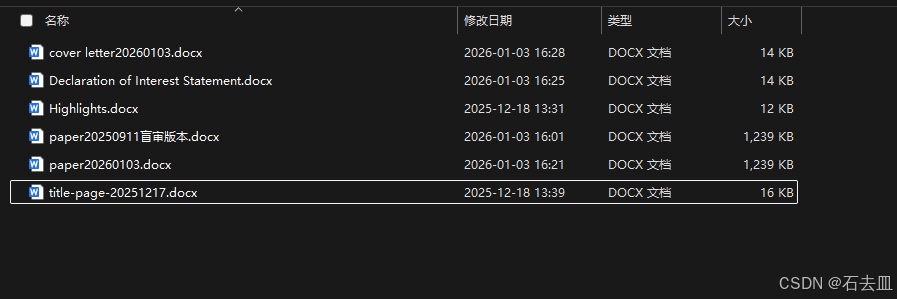
在投稿系统上显示下面三个文件是必须的(一些期刊如NCAA,EAAI等,需要提交盲审稿件):
Cover Letter
Manuscript File
Declaration of Interest Statement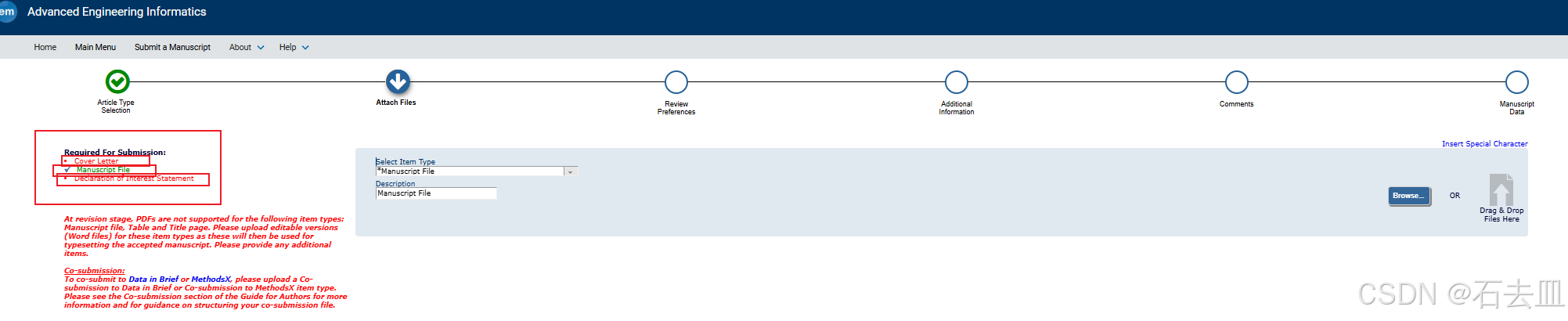
✅ 1. Cover Letter(投稿信)——通用版
Dear Editor,

We are pleased to submit our manuscript entitled “[Title]” for consideration in your journal.

This work addresses [briefly state the engineering problem, e.g., “the challenge of precise physical interaction in unstructured environments”]. We propose [briefly state method, e.g., “a novel vision-force integrated framework”] that achieves [key result, e.g., “100% task success under realistic uncertainties”].

Our contributions include:
• [Contribution 1: e.g., A new fusion strategy for multimodal sensing]
• [Contribution 2: e.g., A real-time adaptive controller for compliant execution]
• [Contribution 3: e.g., Comprehensive validation on a physical robotic platform]

This manuscript is original, unpublished, and not under review elsewhere. All authors have approved the submission and declare no conflicts of interest.

We believe this work will interest your readers in robotics, automation, and intelligent systems.

Thank you for your time and consideration.

Sincerely,
On behalf of all authors
💡 亮点:用 bullet points 清晰列出技术贡献,编辑一目了然。
✅ 2. Declarations(嵌入主稿)
\section*{Declarations}

\textbf{Funding}
This work was supported by a provincial science and technology project.

\textbf{Conflict of Interest}
The authors declare no conflict of interest.

\textbf{Data Availability}
The data that support the findings of this study are available from the corresponding author upon reasonable request.
✅ 支持信息可写 “a provincial project” 而不透露编号,兼顾合规与隐私。
✅ 3. “投稿说明” / Comments to Editor(如系统要求)
多数工程期刊不要求单独写贡献声明。
但若系统强制填写,可简写:
“This work presents a novel engineering solution to [problem], validated on a physical platform with comprehensive comparisons to state-of-the-art baselines. It aligns with the journal’s scope on intelligent automation and robotic systems.”
四、格式与系统操作关键点
| 事项 | 建议 |
|---|---|
| 主稿格式 | 返修阶段必须用 .docx(Elsevier/Springer 明确禁止 PDF) |
| 图表 | 嵌入 Word 或单独上传(TIFF/EPS),但主稿需有占位图 |
| 作者信息 | 单盲期刊:保留完整信息(姓名、单位、邮箱) |
| 通讯作者 | 在系统中标记,并确保邮箱有效 |
| 利益声明 | 系统在线勾选 + 稿件文字声明(双重保险) |
五、常见拒稿原因(可提前规避)
| 原因 | 对策 |
|---|---|
| 实验仅仿真 | 至少加入实物平台验证(哪怕简化) |
| 对比方法过时 | 与近 2–3 年 SOTA 方法对比 |
| 创新点模糊 | 在摘要/引言明确写 “Our contributions are threefold: …” |
| 语言问题 | 投稿前用 Grammarly / 专业润色(很多期刊提供免费润色链接) |
| 格式不符 | 严格按模板排版(Elsevier 有 .docx 模板下载) |
六、结语
SCI 投稿不是“把代码包装成论文”,而是用学术语言讲清楚一个工程问题的完整解决链条:问题为什么重要?别人怎么做?我为什么不同?我做得有多好?
只要逻辑闭环、实验扎实、写作规范,你的工作就值得被看见。
欢迎关注 @石去皿,将持续分享 机器人、AI工程化、SCI 写作与嵌入式开发 实战经验!
#SCI投稿 #工程论文 #机器人 #自动化 #研究生科研 #投稿指南 #CSDN

DAMO开发者矩阵,由阿里巴巴达摩院和中国互联网协会联合发起,致力于探讨最前沿的技术趋势与应用成果,搭建高质量的交流与分享平台,推动技术创新与产业应用链接,围绕“人工智能与新型计算”构建开放共享的开发者生态。
更多推荐
 19
19 0
0- 0


 已为社区贡献3条内容

所有评论(0)