多履带曲面自适应爬壁机器人机械设计(设计说明书+三维图)
摘要
当今,机器人已经在各方面进入了我们的生活之中。尤其是在我国工业的发展上起到了决定性的作用,如:检测,喷涂,焊接,清洗等方面。
其中爬壁机器人是的应用在检测方面的贡献尤为突出,它的出现可解决国内一些替代人工进行设备维护与检修、设备清表面理与清洗、焊接、除锈等作业任务。既提高了作业效率、又降低人力成本。与此同时,今日的爬壁机器人机构设计仍存在着一些问题,如:体积大、结构笨重、转向困难、工作环境受限、越障能力不高等。
本文课题源于国家质检总局项目,要求此爬壁机器人能够在大型压力容器罐内壁实现行走。对提高大型压力容器焊缝检测效率,降低检测成本具有工程实际意义。
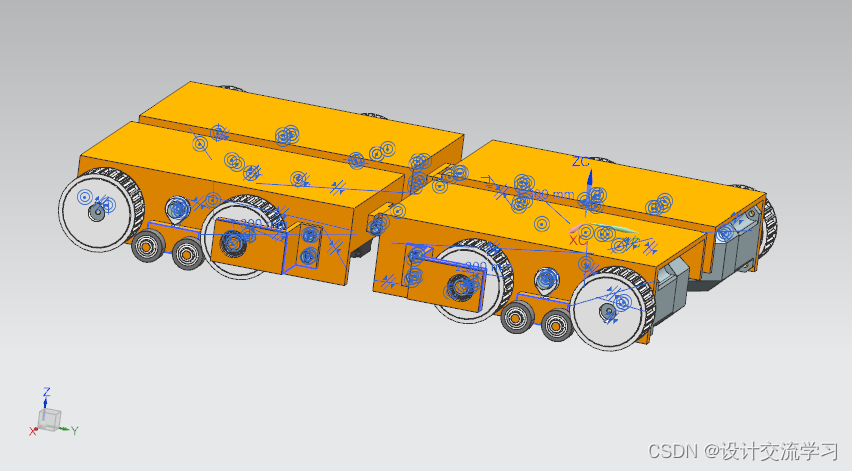
本设计采用多履带,多电机的驱动方式实现了机器人在运动时的转向和直线运动的可控性;利用活页机构和压紧机构实现了机器人对大型压力容器罐内壁曲面的自适应;采用由四个部分车体拼接的而成的主车体方式,减少了车体的自重,同时提高负载能力。
使用UG软件对机械结构方案进行设计,建立起三维装配机构图,详细解读爬壁机器人的机械结构如何运行以及机器人在现实中的装配方式和顺序。
关键词:爬壁机器人;履带式;电机驱动;永磁吸附
Abstract
Today, robots have entered our lives in many ways. Especially in the development of China's industry has played a decisive role, such as: detection, spraying, welding, cleaning and so on.
Among them, the contribution of the wall-climbing robot is particularly outstanding in the application of detection. Its emergence can solve some domestic tasks such as equipment maintenance and overhaul, equipment cleaning and cleaning, welding, rust removal and other tasks instead of manual work. It not only improves the operation efficiency, but also reduces the labor cost. At the same time, there are still some problems in the mechanism design of today's wall-climbing robots, such as: large volume, bulky structure, difficult steering, limited working environment, and poor ability to overcome obstacles.
The subject of this paper comes from the project of AQSIQ, which requires the wall-climbing robot to walk on the inner wall of a large pressure vessel. It has practical engineering significance to improve the inspection efficiency of large pressure vessel and reduce the inspection cost.
This design uses multi-track, multi-motor drive mode to achieve the robot in the movement of the steering and linear motion of the controllabilit; The adaptive robot to the inner surface of large pressure vessel was realized by using the loose-leaf mechanism and the pressing mechanism. The main car body is composed of four parts of the car body, which reduces the dead weight of the car body and improves the load capacity.
UG software is used to design the mechanical structure scheme, and a three-dimensional assembly mechanism diagram is established to explain in detail how the mechanical structure of the wall-climbing robot runs and how the robot is assembled in reality and in sequence.
Keywords: wall-climbing robot; caterpillar; motor drive; permanent magnetic adsorption
引言 1
1.2.3现存问题 6
总结 19
谢辞 22
……

DAMO开发者矩阵,由阿里巴巴达摩院和中国互联网协会联合发起,致力于探讨最前沿的技术趋势与应用成果,搭建高质量的交流与分享平台,推动技术创新与产业应用链接,围绕“人工智能与新型计算”构建开放共享的开发者生态。
更多推荐
 2
2 0
0- 0


 已为社区贡献49条内容

所有评论(0)