数据分析学习之:如何均衡样本——使用 imblearn 库实现重采样(resampling),过采样(over-sampling) + 欠采样(under-sampling))
·
文章目录
什么是样本不平衡
import pandas as pd
import numpy as np
import seaborn as sns
values = {"姓名":["A","B","C","D","E","F","G","H","I","J","K","L","G","H","I","J","K","L"],
         "年龄":[55,70,80,90,60,30,67,44,60,30,67,44,30,67,30,67,30,67],
          "头发颜色":["白","白","白","白","白","黑","白","黑","白","白","黑","白","白","黑","白","白","黑","黑"]}
table = pd.DataFrame(values)
table
| 姓名 | 年龄 | 头发颜色 | |
|---|---|---|---|
| 0 | A | 55 | 白 |
| 1 | B | 70 | 白 |
| 2 | C | 80 | 白 |
| 3 | D | 90 | 白 |
| 4 | E | 60 | 白 |
| 5 | F | 30 | 黑 |
| 6 | G | 67 | 白 |
| 7 | H | 44 | 黑 |
| 8 | I | 60 | 白 |
| 9 | J | 30 | 白 |
| 10 | K | 67 | 黑 |
| 11 | L | 44 | 白 |
| 12 | G | 30 | 白 |
| 13 | H | 67 | 黑 |
| 14 | I | 30 | 白 |
| 15 | J | 67 | 白 |
| 16 | K | 30 | 黑 |
| 17 | L | 67 | 黑 |
table["头发颜色"] = pd.Categorical(table["头发颜色"]).codes
table
| 姓名 | 年龄 | 头发颜色 | |
|---|---|---|---|
| 0 | A | 55 | 0 |
| 1 | B | 70 | 0 |
| 2 | C | 80 | 0 |
| 3 | D | 90 | 0 |
| 4 | E | 60 | 0 |
| 5 | F | 30 | 1 |
| 6 | G | 67 | 0 |
| 7 | H | 44 | 1 |
| 8 | I | 60 | 0 |
| 9 | J | 30 | 0 |
| 10 | K | 67 | 1 |
| 11 | L | 44 | 0 |
| 12 | G | 30 | 0 |
| 13 | H | 67 | 1 |
| 14 | I | 30 | 0 |
| 15 | J | 67 | 0 |
| 16 | K | 30 | 1 |
| 17 | L | 67 | 1 |
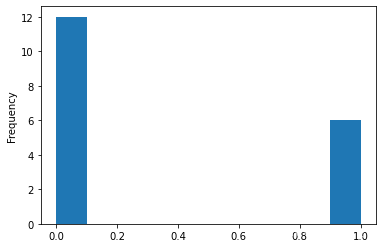
- 从下面的统计图中可以看出,以头发颜色作为 label 进行分类的时候,样本是不均衡的
- 因为 12个白头发,但是有 6 个黑头发
table["头发颜色"].plot(x=[0,1],kind="hist")
如何平衡数据集的样本——重采样
- 我们的最终目标是保证数据集中各个 label 下的样本数量是几乎完全相等的
- 要么我们就需要把样本多的组的样本按照随机的原则砍掉一部分来平衡,要么就把少样本的一组进行扩充
欠采样(也叫 undersampling)
- 顾名思义,削减大的样本集
将大的样本集的数据全部筛选出来
df_white = table.loc[table["头发颜色"] == 0]  #选出头发为白色的人
df_black = table.loc[table["头发颜色"] == 1] #选出头发为黑色的人
df_white
| 姓名 | 年龄 | 头发颜色 | |
|---|---|---|---|
| 0 | A | 55 | 0 |
| 1 | B | 70 | 0 |
| 2 | C | 80 | 0 |
| 3 | D | 90 | 0 |
| 4 | E | 60 | 0 |
| 6 | G | 67 | 0 |
| 8 | I | 60 | 0 |
| 9 | J | 30 | 0 |
| 11 | L | 44 | 0 |
| 12 | G | 30 | 0 |
| 14 | I | 30 | 0 |
| 15 | J | 67 | 0 |
df_black
| 姓名 | 年龄 | 头发颜色 | |
|---|---|---|---|
| 5 | F | 30 | 1 |
| 7 | H | 44 | 1 |
| 10 | K | 67 | 1 |
| 13 | H | 67 | 1 |
| 16 | K | 30 | 1 |
| 17 | L | 67 | 1 |
通过随机采样操作采样固定个数的样本留下
df_white = df_white.sample(n=6,random_state=30)
df_white
| 姓名 | 年龄 | 头发颜色 | |
|---|---|---|---|
| 0 | A | 55 | 0 |
| 8 | I | 60 | 0 |
| 12 | G | 30 | 0 |
| 11 | L | 44 | 0 |
| 1 | B | 70 | 0 |
| 3 | D | 90 | 0 |
和少样本的样本集拼合成最终的样本集
table_undersampling = pd.concat([df_black,df_white],axis=0,ignore_index=True)
table_undersampling
| 姓名 | 年龄 | 头发颜色 | |
|---|---|---|---|
| 0 | F | 30 | 1 |
| 1 | H | 44 | 1 |
| 2 | K | 67 | 1 |
| 3 | H | 67 | 1 |
| 4 | K | 30 | 1 |
| 5 | L | 67 | 1 |
| 6 | A | 55 | 0 |
| 7 | I | 60 | 0 |
| 8 | G | 30 | 0 |
| 9 | L | 44 | 0 |
| 10 | B | 70 | 0 |
| 11 | D | 90 | 0 |
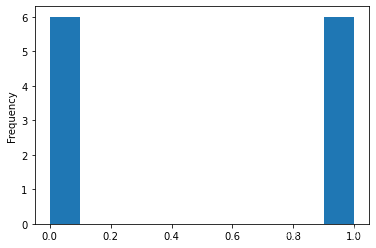
样本均衡了
table_undersampling["头发颜色"].plot(kind="hist")
过采样(over-sampling)
通过 imblearn 库扩充小的样本集
from imblearn.over_sampling import SMOTE
# Resample the minority class. You can change the strategy to 'auto' if you are not sure.

# 如果这里选 minority 只能保证两个 class 样本均衡
# 但是使用 auto 可以保证多个类样本均衡
sm = SMOTE(sampling_strategy='auto', random_state=7)


# Fit the model to generate the data.

oversampled_data,oversampled_label=sm.fit_resample(table.drop(['姓名','头发颜色'], axis=1), table['头发颜色'])
oversampled_table =pd.concat([oversampled_data, oversampled_label], axis=1)
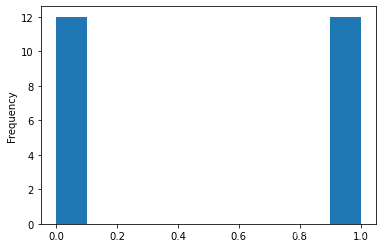
样本均衡了
oversampled_table["头发颜色"].plot(kind="hist")

DAMO开发者矩阵,由阿里巴巴达摩院和中国互联网协会联合发起,致力于探讨最前沿的技术趋势与应用成果,搭建高质量的交流与分享平台,推动技术创新与产业应用链接,围绕“人工智能与新型计算”构建开放共享的开发者生态。
更多推荐

 2
2 0
0- 0


 已为社区贡献2条内容

所有评论(0)