STM32用SPI读取ICM42688-P六轴数据和温度
·
STM32用SPI读取ICM42688-P六轴数据和温度
1、环境
IDE用CLion,配置用cubemx,芯片用STM32F103C8t6
全靠deepseek,元宝。
1、硬件连接
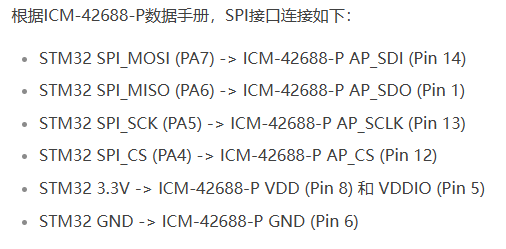
RESV(Pin7)也接地。如此接法是完备的,其它引脚不管。其中ICM42688的Pin1, Pin12, Pin13, Pin14都加了10kΩ的上拉电阻,可能不是必须的,没试,反正这样能用;另外电源随便弄点滤波电容。
下图是文档参考: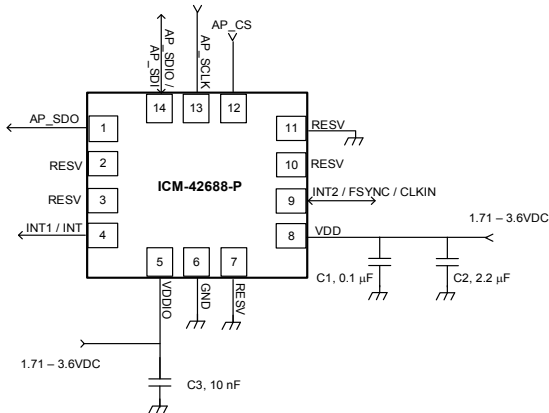
下图是实物图: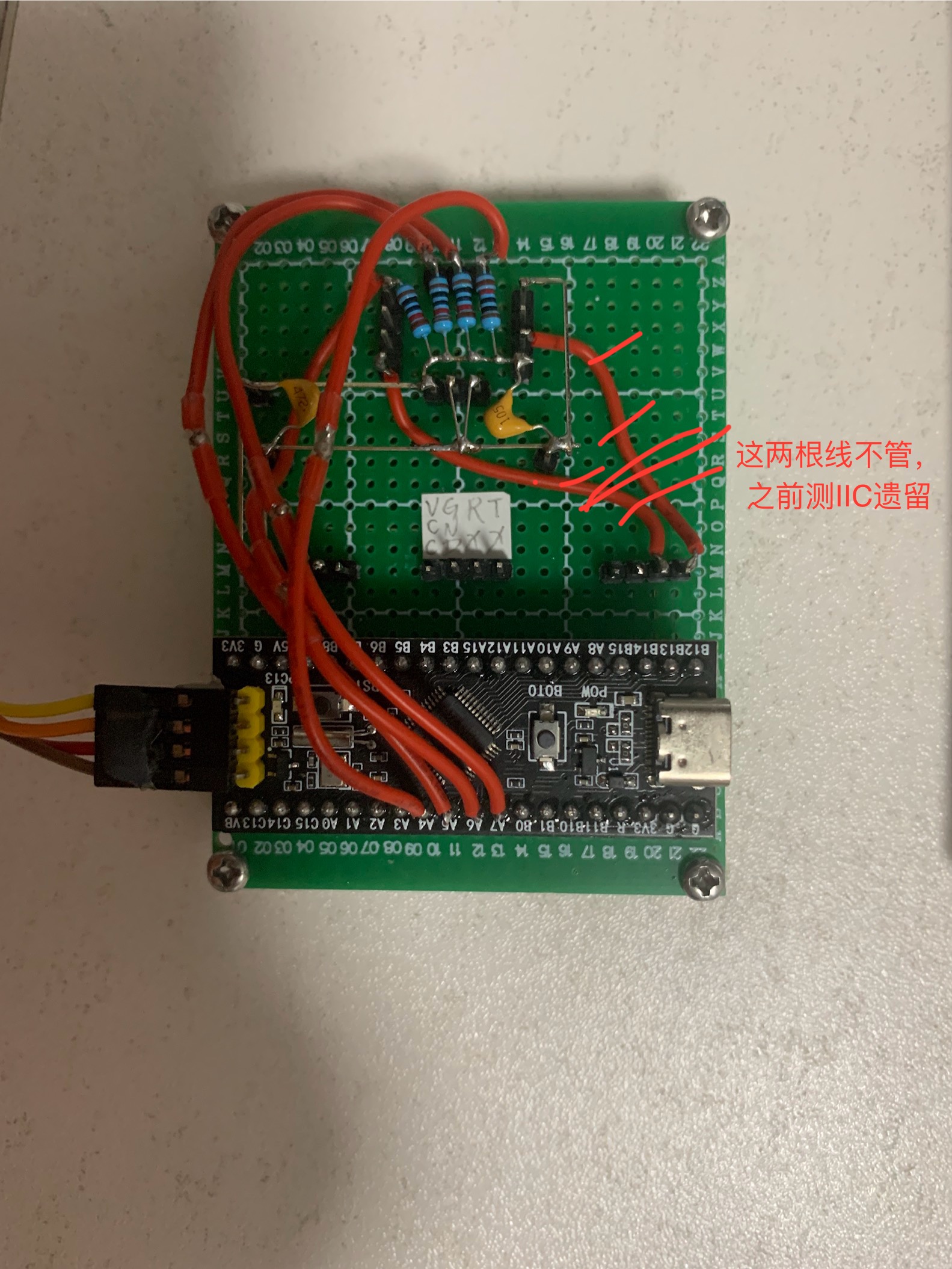
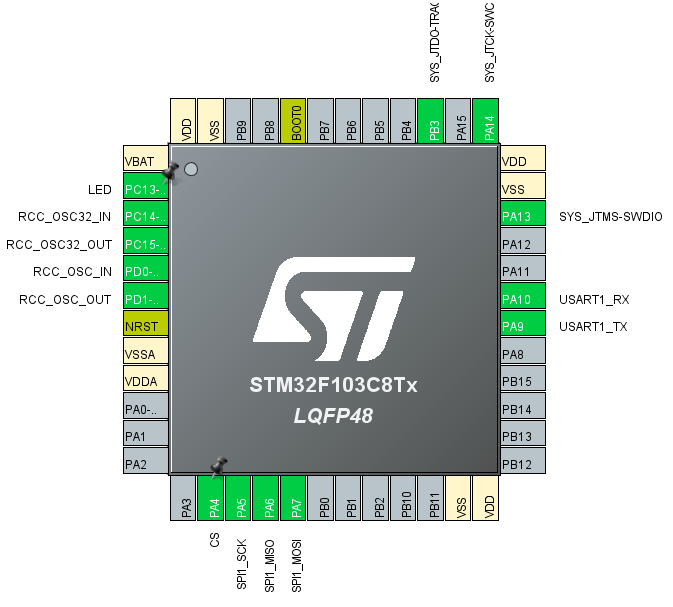
SPI配置,Prescaler要让Baud Rate < 24M/s: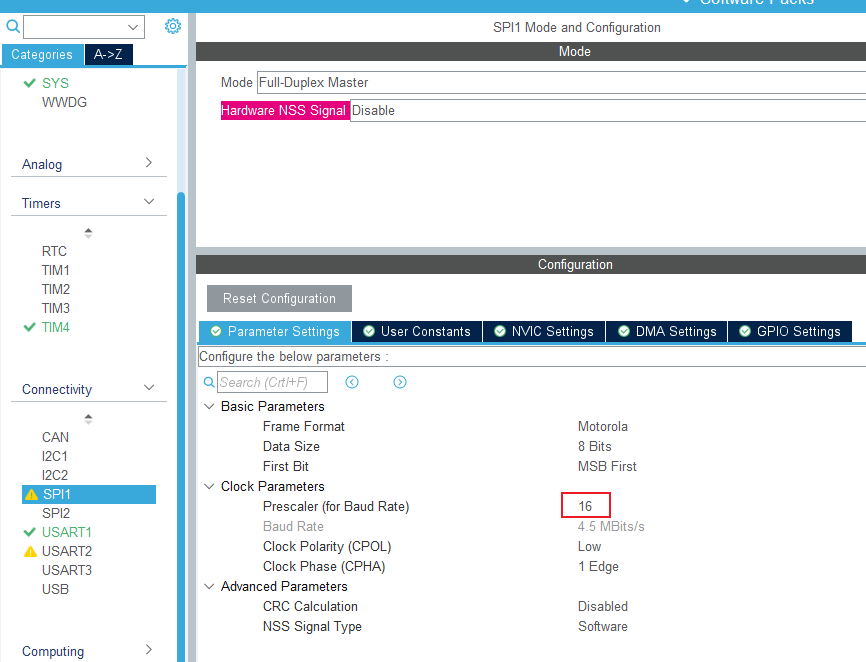
代码
1、结构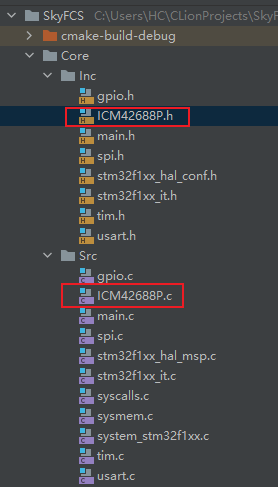
2、ICM42688P.h
#ifndef SKYFCS_ICM42688P_H
#define SKYFCS_ICM42688P_H

#include "stm32f1xx_hal.h"

void ICM42688_Init(void);
void ICM42688_WriteRegister(uint8_t reg, uint8_t data);
uint8_t ICM42688_ReadRegister(uint8_t reg);
void ReadSensorData(int16_t* accel, int16_t* gyro);
float ICM42688_ReadTemperature(void);
void ConvertRawData(int16_t raw_accel[3], int16_t raw_gyro[3], float* accel_g, float* gyro_dps);
#endif //SKYFCS_ICM42688P_H
3、ICM42688P.c
#include "ICM42688P.h"
#include "spi.h"

#define ICM42688_CS_PIN GPIO_PIN_4
#define ICM42688_CS_PORT GPIOA

// ICM-42688-P寄存器定义
#define WHO_AM_I_REG 0x75
#define PWR_MGMT0_REG 0x4E
#define GYRO_CONFIG0_REG 0x4F
#define ACCEL_CONFIG0_REG 0x50
#define FIFO_CONFIG_REG 0x16
#define FIFO_DATA_REG 0x34


// 初始化函数
void ICM42688_Init(void) {
    uint8_t whoami;
    uint8_t tx_data;

    // 复位设备
    ICM42688_WriteRegister(PWR_MGMT0_REG, 0x00);
    HAL_Delay(10);

    // 检查WHO_AM_I
    whoami = ICM42688_ReadRegister(WHO_AM_I_REG);
    if(whoami != 0x47) { // ICM-42688-P的WHO_AM_I值应为0x42
        while(1);
    }

    // 配置电源管理
    tx_data = 0x0F; // 启用加速度计和陀螺仪
    ICM42688_WriteRegister(PWR_MGMT0_REG, tx_data);

    // 配置陀螺仪
    tx_data = (0x03 << 5) | 0x06; // ±500dps, 1kHz ODR
    ICM42688_WriteRegister(GYRO_CONFIG0_REG, tx_data);

    // 配置加速度计
    tx_data = (0x01 << 5) | 0x06; // ±8g, 1kHz ODR
    ICM42688_WriteRegister(ACCEL_CONFIG0_REG, tx_data);

    // 配置FIFO
    tx_data = 0x03; // 启用加速度计和陀螺仪数据到FIFO
    ICM42688_WriteRegister(FIFO_CONFIG_REG, tx_data);

    HAL_Delay(100); // 等待传感器稳定
}

// 写寄存器函数
void ICM42688_WriteRegister(uint8_t reg, uint8_t data) {
    uint8_t tx_buffer[2] = {reg & 0x7F, data}; // 清除最高位(写操作)

    HAL_GPIO_WritePin(ICM42688_CS_PORT, ICM42688_CS_PIN, GPIO_PIN_RESET);
    HAL_SPI_Transmit(&hspi1, tx_buffer, 2, HAL_MAX_DELAY);
    HAL_GPIO_WritePin(ICM42688_CS_PORT, ICM42688_CS_PIN, GPIO_PIN_SET);
}

// 读寄存器函数
uint8_t ICM42688_ReadRegister(uint8_t reg) {
    uint8_t tx_buffer[2] = {reg | 0x80, 0x00}; // 设置最高位(读操作)
    uint8_t rx_buffer[2] = {0};

    HAL_GPIO_WritePin(ICM42688_CS_PORT, ICM42688_CS_PIN, GPIO_PIN_RESET);
    HAL_SPI_TransmitReceive(&hspi1, tx_buffer, rx_buffer, 2, HAL_MAX_DELAY);
    HAL_GPIO_WritePin(ICM42688_CS_PORT, ICM42688_CS_PIN, GPIO_PIN_SET);

    return rx_buffer[1];
}

// 读取传感器数据
void ReadSensorData(int16_t* accel, int16_t* gyro) {
    // 读取加速度计数据
    accel[0] = (int16_t)((ICM42688_ReadRegister(0x1F) << 8) | ICM42688_ReadRegister(0x20));
    accel[1] = (int16_t)((ICM42688_ReadRegister(0x21) << 8) | ICM42688_ReadRegister(0x22));
    accel[2] = (int16_t)((ICM42688_ReadRegister(0x23) << 8) | ICM42688_ReadRegister(0x24));

    // 读取陀螺仪数据
    gyro[0] = (int16_t)((ICM42688_ReadRegister(0x25) << 8) | ICM42688_ReadRegister(0x26));
    gyro[1] = (int16_t)((ICM42688_ReadRegister(0x27) << 8) | ICM42688_ReadRegister(0x28));
    gyro[2] = (int16_t)((ICM42688_ReadRegister(0x29) << 8) | ICM42688_ReadRegister(0x2A));

}

// 将原始数据转换为实际值
void ConvertRawData(int16_t raw_accel[3], int16_t raw_gyro[3], float* accel_g, float* gyro_dps) {
    // 加速度计转换 (±8g范围)
    for(int i = 0; i < 3; i++) {
        accel_g[i] = (float)raw_accel[i] / 4096.0f; // 4096 LSB/g (对于±8g范围)
    }

    // 陀螺仪转换 (±500dps范围)
    for(int i = 0; i < 3; i++) {
        gyro_dps[i] = (float)raw_gyro[i] / 65.5f; // 65.5 LSB/dps (对于±500dps范围)
    }
}

#define TEMP_SENSITIVITY 132.48f  // LSB/℃
#define TEMP_OFFSET      25.0f    // 25℃时输出0

float ICM42688_ReadTemperature(void) {
    // 读取两个8位寄存器并组合成16位数据
    int16_t temp_raw = (int16_t)((ICM42688_ReadRegister(0x1D) << 8) | ICM42688_ReadRegister(0x1E));

    // 转换为实际温度值
    return ((float)temp_raw / TEMP_SENSITIVITY) + TEMP_OFFSET;
}
4、main.c
/* USER CODE BEGIN Header */
/**
******************************************************************************
* @file : main.c
* @brief : Main program body
******************************************************************************
* @attention
*
* <h2><center>© Copyright (c) 2025 STMicroelectronics.
* All rights reserved.</center></h2>
*
* This software component is licensed by ST under BSD 3-Clause license,
* the "License"; You may not use this file except in compliance with the
* License. You may obtain a copy of the License at:
* opensource.org/licenses/BSD-3-Clause
*
******************************************************************************
*/
/* USER CODE END Header */
/* Includes ------------------------------------------------------------------*/
#include "main.h"
#include "spi.h"
#include "tim.h"
#include "usart.h"
#include "gpio.h"
/* Private includes ----------------------------------------------------------*/
/* USER CODE BEGIN Includes */
#include "ICM42688P.h"
#include "stdio.h"
/* USER CODE END Includes */
/* Private typedef -----------------------------------------------------------*/
/* USER CODE BEGIN PTD */
volatile uint32_t timer_overflow_count = 0; // 溢出次数的32位扩展)
uint64_t Get_Global_Time_us(void) {
uint32_t overflow, counter;
do {
overflow = timer_overflow_count;
counter = __HAL_TIM_GET_COUNTER(&htim4);
} while (overflow != timer_overflow_count); // 无锁校验
return (uint64_t)overflow * 65536 + counter; // 组合成64位时间戳
}
#ifdef __GNUC__
#define PUTCHAR_PROTOTYPE int __io_putchar(int ch)
PUTCHAR_PROTOTYPE
{
HAL_UART_Transmit(&huart1, (uint8_t*)&ch, 1, HAL_MAX_DELAY);
return ch;
}
#endif
/* USER CODE END PTD */
/* Private define ------------------------------------------------------------*/
/* USER CODE BEGIN PD */
void LedFlash(void)
{
static uint64_t timeStampForLED;
uint64_t crrTime = Get_Global_Time_us();
if(crrTime > timeStampForLED+1000000)
{
HAL_GPIO_TogglePin(LED_GPIO_Port,LED_Pin);
timeStampForLED = crrTime;
}
}
/* USER CODE END PD */
/* Private macro -------------------------------------------------------------*/
/* USER CODE BEGIN PM */
/* USER CODE END PM */
/* Private variables ---------------------------------------------------------*/
/* USER CODE BEGIN PV */
/* USER CODE END PV */
/* Private function prototypes -----------------------------------------------*/
void SystemClock_Config(void);
/* USER CODE BEGIN PFP */
/* USER CODE END PFP */
/* Private user code ---------------------------------------------------------*/
/* USER CODE BEGIN 0 */
/* USER CODE END 0 */
/**
* @brief The application entry point.
* @retval int
*/
int main(void)
{
/* USER CODE BEGIN 1 */
/* USER CODE END 1 */
/* MCU Configuration--------------------------------------------------------*/
/* Reset of all peripherals, Initializes the Flash interface and the Systick. */
HAL_Init();
/* USER CODE BEGIN Init */
/* USER CODE END Init */
/* Configure the system clock */
SystemClock_Config();
/* USER CODE BEGIN SysInit */
/* USER CODE END SysInit */
/* Initialize all configured peripherals */
MX_GPIO_Init();
MX_SPI1_Init();
MX_USART1_UART_Init();
MX_TIM4_Init();
/* USER CODE BEGIN 2 */
HAL_TIM_Base_Start_IT(&htim4);
ICM42688_Init();
/* USER CODE END 2 */
/* Infinite loop */
/* USER CODE BEGIN WHILE */
while (1)
{
LedFlash();
int16_t accel[3],gyro[3];
ReadSensorData(accel,gyro);
float t = ICM42688_ReadTemperature();
float accel_g[3],gyro_dps[3];
ConvertRawData(accel,gyro,accel_g,gyro_dps);
printf("T=%f,AX=%f,AY=%f,AZ=%f,GX=%f,GY=%f,GZ=%f\r\n",t,accel_g[0],accel_g[1],accel_g[2],gyro_dps[0],gyro_dps[1],gyro_dps[2]);
/* USER CODE END WHILE */
/* USER CODE BEGIN 3 */
}
/* USER CODE END 3 */
}
/**
* @brief System Clock Configuration
* @retval None
*/
void SystemClock_Config(void)
{
RCC_OscInitTypeDef RCC_OscInitStruct = {0};
RCC_ClkInitTypeDef RCC_ClkInitStruct = {0};
/** Initializes the RCC Oscillators according to the specified parameters
* in the RCC_OscInitTypeDef structure.
*/
RCC_OscInitStruct.OscillatorType = RCC_OSCILLATORTYPE_HSE;
RCC_OscInitStruct.HSEState = RCC_HSE_ON;
RCC_OscInitStruct.HSEPredivValue = RCC_HSE_PREDIV_DIV1;
RCC_OscInitStruct.HSIState = RCC_HSI_ON;
RCC_OscInitStruct.PLL.PLLState = RCC_PLL_ON;
RCC_OscInitStruct.PLL.PLLSource = RCC_PLLSOURCE_HSE;
RCC_OscInitStruct.PLL.PLLMUL = RCC_PLL_MUL9;
if (HAL_RCC_OscConfig(&RCC_OscInitStruct) != HAL_OK)
{
Error_Handler();
}
/** Initializes the CPU, AHB and APB buses clocks
*/
RCC_ClkInitStruct.ClockType = RCC_CLOCKTYPE_HCLK|RCC_CLOCKTYPE_SYSCLK
|RCC_CLOCKTYPE_PCLK1|RCC_CLOCKTYPE_PCLK2;
RCC_ClkInitStruct.SYSCLKSource = RCC_SYSCLKSOURCE_PLLCLK;
RCC_ClkInitStruct.AHBCLKDivider = RCC_SYSCLK_DIV1;
RCC_ClkInitStruct.APB1CLKDivider = RCC_HCLK_DIV2;
RCC_ClkInitStruct.APB2CLKDivider = RCC_HCLK_DIV1;
if (HAL_RCC_ClockConfig(&RCC_ClkInitStruct, FLASH_LATENCY_2) != HAL_OK)
{
Error_Handler();
}
}
/* USER CODE BEGIN 4 */
void HAL_TIM_PeriodElapsedCallback(TIM_HandleTypeDef *htim) {
if (htim->Instance == TIM4) {
timer_overflow_count++;
}
}
/* USER CODE END 4 */
/**
* @brief This function is executed in case of error occurrence.
* @retval None
*/
void Error_Handler(void)
{
/* USER CODE BEGIN Error_Handler_Debug */
/* User can add his own implementation to report the HAL error return state */
__disable_irq();
while (1)
{
}
/* USER CODE END Error_Handler_Debug */
}
#ifdef USE_FULL_ASSERT
/**
* @brief Reports the name of the source file and the source line number
* where the assert_param error has occurred.
* @param file: pointer to the source file name
* @param line: assert_param error line source number
* @retval None
*/
void assert_failed(uint8_t *file, uint32_t line)
{
/* USER CODE BEGIN 6 */
/* User can add his own implementation to report the file name and line number,
ex: printf("Wrong parameters value: file %s on line %d\r\n", file, line) */
/* USER CODE END 6 */
}
#endif /* USE_FULL_ASSERT */
/************************ (C) COPYRIGHT STMicroelectronics *****END OF FILE****/
以上代码中包含了TIM4产生us级时间戳和printf重定向的实现。
效果图
串口数据: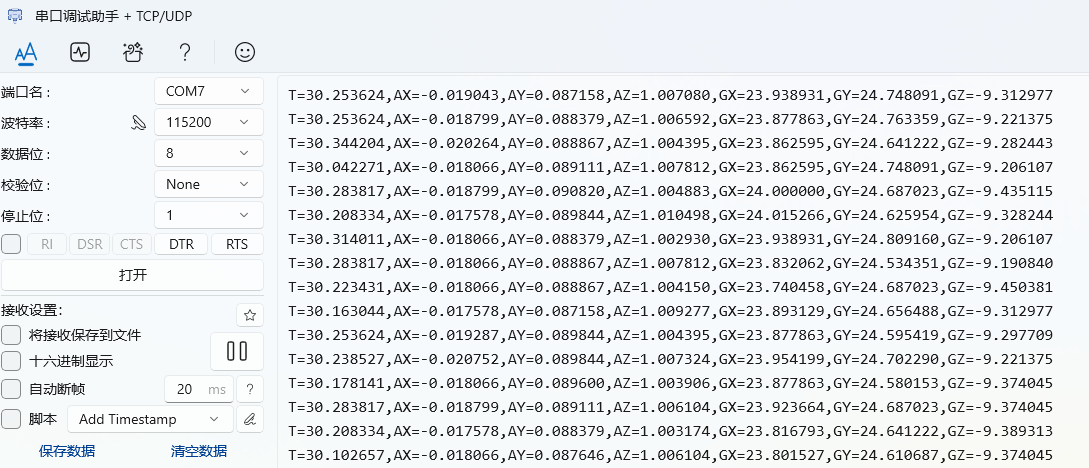
波形图: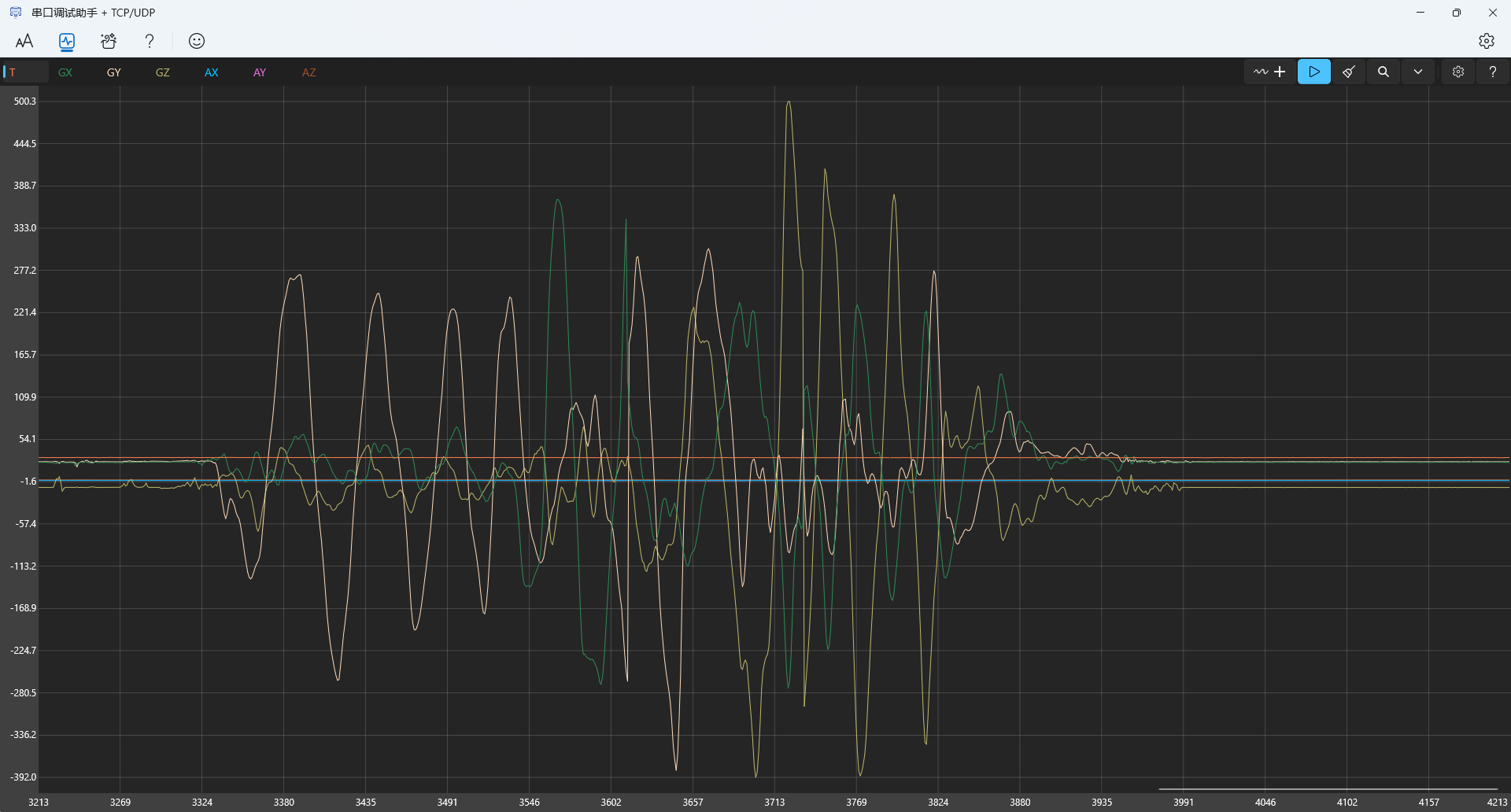

DAMO开发者矩阵,由阿里巴巴达摩院和中国互联网协会联合发起,致力于探讨最前沿的技术趋势与应用成果,搭建高质量的交流与分享平台,推动技术创新与产业应用链接,围绕“人工智能与新型计算”构建开放共享的开发者生态。
更多推荐


 13
13 0
0- 0


 已为社区贡献2条内容

所有评论(0)