MIT_BIH数据库介绍
MIT-BIH 是由美国麻省理工学院提供的研究心律失常的数据库。目前国际上公认的可作为标准的心电数据库有三个,分别是美国麻省理工学院提供的MIT-BIH 数据库,美国心脏学会的AHA数据库以及欧洲AT-T心电数据库。其中MIT-BIH 数据库近年来应用比较广泛。
MIT-BIH 是由美国麻省理工学院提供的研究心律失常的数据库。目前国际上公认的可作为标准的心电数据库有三个,分别是美国麻省理工学院提供的MIT-BIH 数据库,美国心脏学会的AHA数据库以及欧洲AT-T心电数据库。其中MIT-BIH 数据库近年来应用比较广泛。
MIT-BIH 的数据格式:
MIT-BIH 为了节省文件长度和存储空间,使用了自定义的格式。一个心电记录由三个部分组成:
(1)头文件[.hea],存储方式ASCII码字符。
(2)数据文件[.dat],按二进制存储,每三个字节存储两个数,一个数12bit。
(3)注释文件[.art],按二进制存储。
[.hea]为头文件,其由一行或多行ASCII码字符组成。以100.hea为例
100 2 360 650000
100.dat 212 200 11 1024 995 -22131 0 MLII
100.dat 212 200 11 1024 1011 20052 0 V5
# 69 M 1085 1629 x1
# Aldomet, Inderal
第一行为记录行,指出该记录为一包含两个采样率为360Hz的信号,每一信号的长度为65万个采样点,采样开始时间和日期没有记录。后面紧跟的两行为信号技术规范说明行,从中可以看出,两个信号都包含在文件格式100.dat中,每一信号都是以12位的位压缩格式(即“212”格式)进行存储的,两个信号的增益都是每200ADC uints/mV,ADC的分辨率为11位,ADC零值为1024,在这里基线值没有明确给出,但可以认为他等于ADC零值1024。两个信号的第一采样点的值分别为995和1011(可以看出这他们都略低于0V),65万个采样点的校验数分别为-22131和20052,输入输出可以以任何尺寸的块来执行,因为文件内容说明了这两个信号的该值都为0,信号描述字段说明了这两个信号分别采自MLII导联和V5导联。文件的最后两行包含了注释字符串,其中第一行说明了患者的性别和年龄以及记录数据,第二行列出了患者的用药情况。(MIT—BIH心率失常数据库的识读及应用,宋喜国,中国医学物理学杂志,2004年7月第21卷第4期)
[.dat]为数据文件,MIT-BIH数据库中的数据存储格式有Format8、Format16、Format80、Format212、Format310等8种,心律失常数据库统一采用212格式进行存储。
“212”格式是针对两个信号的数据库记录,这两个信号的数据交替存储,每三个字节存储两个数据。假设这两个数据分别采样自信号0和信号1,信号0的采样数据取自第一、二字节(16位)的高12位,其中第一字节作为低8位,第二字节的高4位作为其高4位;信号1的采样数据由第二字节的低4位(作为组成信号1采样数据的12位的高4位)和下一字节的8位(作为组成信号1采样数据的12位的低8位)共同组成。以100.dat为例。
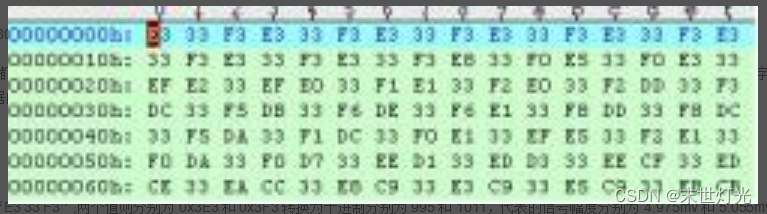
按照“212”的格式,从第一字节读起,每三个字节(24 位)表示两个值,第一组为“E3 33 F3”,两个值则分别为0x3E3和0x3F3转换为十进制分别为995和1011,代表的信号幅度分别为4.975mv和5.055mv,这两个值分别是两个信号的第一采样点,后面依此类推,分别表示了两个信号的采样值。
“.atr”为注释文件,记录了心电专家对相应的心电信号的诊断信息,主要有两种格式:MIT格式和AHA格式。MIT格式是一种紧凑型格式,每一注释的长度占用偶数个字节空间,多数情况下是占用两个字节,多用于在线的注释文件;而AHA格式的每一注释占用16个字节的空间,多用于交换文件的情况。这两种格式的在文件中的区分决定于前两个字节的值,若文件的第一字节不为0或第二字节等于“[”(0x5B)或“]”(0x5D),则该文件是以MIT格式存储的,否则是按AHA格式存储的。心律失常数据库采用的MIT格式。
MIT格式,每一注释单元的前两个字节的第一个字节为最低有效位,16位中的最高6位表示了注释类型代码(具体代码见后表),剩余的10位说明了该注释点的发生时间或辅助信息,若为发生时间,其值为该注释点到前一注释点的间隔(对于第一个注释点为从记录开始到该点的间隔),若为辅助信息则说明了附加信息的长度。以100.atr为例。
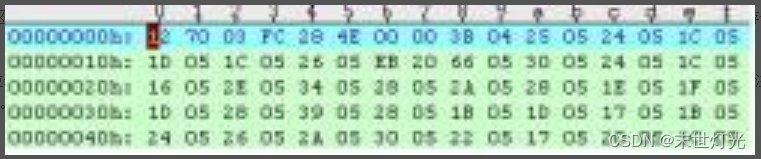
从文件中的第一字节不为0可以判断该文件是以MIT格式存储的。从第一字节开始按照MIT格式进行分析,首先读出16位值0x7012,其高6位的值为0x1C(十进制28),低10位的值为0x12,该类型代码为28,代表意义是节律变化,发生时间在0.05秒(18/360Hz);接着读出后面的16位值0xFC03,其高6为的值为0x3F(十进制63),低10位的值为0x03,该类型代码为63,代表的意义是在该16位值后附加了3个(低10位值代表的数)字节的辅助信息,若字节个数为奇数,则再附加一个字节的空值,在本例中就是“28 4E 00 00”;然后再从下一字节读16位值0x043B,其高6位的值为1,低10位的值为0x3B(十进制59),该类型码1代表正常心搏,发生时间为0.213秒((18+59)/360Hz);依次类推即可读出所有的注释,当读到的16位值为0时,就表示到了文件尾。
另,当高6位为十进制59时,读取之后第3个16位的高6位,作为类型代码,读取之后第二个16位+第一个16位*2^16;
高6位为十进制60,61,62时,继续读下一个16位。
|
注释代码 |
说明 |
||
|
0 |
No TQRS |
||
|
1 |
N |
Normal beat |
正常搏动 |
|
2 |
L |
Left bundle branch block beat |
左束支传导阻滞 |
|
3 |
R |
Right bundle branch block beat |
右束支传导阻滞 |
|
4 |
a |
Aberrated atrial premature beat |
异常房性早搏 |
|
5 |
V |
Premature ventricular contraction |
室性早搏 |
|
6 |
F |
Fusuion of ventricular and normal beat |
心室融合心跳 |
|
7 |
J |
Nodal (junctional) premature beat |
交界性早搏 |
|
8 |
A |
Atrial premature beat |
房性早搏 |
|
9 |
S |
Premature or ectopic supraventricular beat |
室上性早搏或异常 |
|
10 |
E |
Ventricular escape beat |
室性逸搏 |
|
11 |
j |
Nodal (junctional) escape beat |
交界性逸搏 |
|
12 |
/ |
Paced beat |
起搏心跳 |
|
13 |
Q |
Unclassifiable beat |
未分类心跳 |
|
14 |
~ |
Signal quality change |
信号质量发生变化 |
|
15 |
Not specified |
||
|
16 |
| |
Isolated QRS-like artifact |
孤立的类QRS伪迹 |
|
17 |
Not specified |
||
|
18 |
s |
ST change |
|
|
19 |
T |
T-wave change |
|
|
20 |
* |
Systole |
|
|
21 |
D |
Diastole |
|
|
22 |
" |
Comment annotation |
|
|
23 |
= |
Measurement annotation |
|
|
24 |
p |
P-wave peak |
|
|
25 |
B |
Left or right bundle branch block |
|
|
26 |
^ |
Non-conducted pacer spike |
|
|
27 |
t |
T-wave peak |
|
|
28 |
+ |
Rythm change |
|
|
29 |
u |
U-wave peak |
|
|
30 |
? |
Learning |
|
|
31 |
! |
Ventricular flutter wave |
|
|
32 |
[ |
Start of ventricular flutter/fibrillation |
|
|
33 |
] |
End of ventricular flutter/fibrillation |
|
|
34 |
e |
Atrial escape beat |
|
|
35 |
n |
Supraventricular espace beat |
|
|
36 |
Not specified |
||
|
37 |
x |
Non-conducted P-wave (blocked APB) |
|
|
38 |
f |
Fusion of paced and normal beat |
|
|
39 |
( |
Waveform onset, PQ junction(begin of QRS) |
|
|
40 |
) |
Waveform end, JPT(J point, end of QRS) |
|
|
41 |
r |
R-on-T premature ventricular contraction |
|
第二部分:读取代码
% This programm reads ECG data which are saved in format 212.- % (e.g., 100.dat from MIT-BIH-DB, cu01.dat from CU-DB,...)
- % The data are displayed in a figure together with the annotations.
- % The annotations are saved in the vector ANNOT, the corresponding
- % times (in seconds) are saved in the vector ATRTIME.
- % The annotations are saved as numbers, the meaning of the numbers can
- % be found in the codetable "ecgcodes.h" available at www.physionet.org.
- %
- % ANNOT only contains the most important information, which is displayed
- % with the program rdann (available on www.physionet.org) in the 3rd row.
- % The 4th to 6th row are not saved in ANNOT.
- %
- %
- % created on Feb. 27, 2003 by
- % Robert Tratnig (Vorarlberg University of Applied Sciences)
- % (email: rtratnig@gmx.at),
- %
- % algorithm is based on a program written by
- % Klaus Rheinberger (University of Innsbruck)
- % (email: klaus.rheinberger@uibk.ac.at)
- %
- % -------------------------------------------------------------------------
- clc; clear all;
- %------ SPECIFY DATA ------------------------------------------------------
- PATH= 'E:\2.课题资料\3.09-10年初项目计划——特异性诊断指标挖掘\4.MIT-BIH'; % path, where data are saved
- HEADERFILE= '105.hea'; % header-file in text format
- ATRFILE= '105.atr'; % attributes-file in binary format
- DATAFILE='105.dat'; % data-file
- SAMPLES2READ=3000; % number of samples to be read
- % in case of more than one signal:
- % 2*SAMPLES2READ samples are read
- %------ LOAD HEADER DATA --------------------------------------------------
- fprintf(1,'\\n$> WORKING ON %s ...\n', HEADERFILE);
- signalh= fullfile(PATH, HEADERFILE);
- fid1=fopen(signalh,'r');
- z= fgetl(fid1);
- A= sscanf(z, '%*s %d %d %d',[1,3]);
- nosig= A(1); % number of signals
- sfreq=A(2); % sample rate of data
- clear A;
- for k=1:nosig
- z= fgetl(fid1);
- A= sscanf(z, '%*s %d %d %d %d %d',[1,5]);
- dformat(k)= A(1); % format; here only 212 is allowed
- gain(k)= A(2); % number of integers per mV
- bitres(k)= A(3); % bitresolution
- zerovalue(k)= A(4); % integer value of ECG zero point
- firstvalue(k)= A(5); % first integer value of signal (to test for errors)
- end;
- fclose(fid1);
- clear A;
- %------ LOAD BINARY DATA --------------------------------------------------
- if dformat~= [212,212], error('this script does not apply binary formats different to 212.'); end;
- signald= fullfile(PATH, DATAFILE); % data in format 212
- fid2=fopen(signald,'r');
- A= fread(fid2, [3, SAMPLES2READ], 'uint8')'; % matrix with 3 rows, each 8 bits long, = 2*12bit
- fclose(fid2);
- M2H= bitshift(A(:,2), -4); %字节向右移四位,即取字节的高四位
- M1H= bitand(A(:,2), 15); %取字节的低四位
- PRL=bitshift(bitand(A(:,2),8),9); % sign-bit 取出字节低四位中最高位,向右移九位
- PRR=bitshift(bitand(A(:,2),128),5); % sign-bit 取出字节高四位中最高位,向右移五位
- M( : , 1)= bitshift(M1H,8)+ A(:,1)-PRL;
- M( : , 2)= bitshift(M2H,8)+ A(:,3)-PRR;
- if M(1,:) ~= firstvalue, error('inconsistency in the first bit values'); end;
- switch nosig
- case 2
- M( : , 1)= (M( : , 1)- zerovalue(1))/gain(1);
- M( : , 2)= (M( : , 2)- zerovalue(2))/gain(2);
- TIME=(0:(SAMPLES2READ-1))/sfreq;
- case 1
- M( : , 1)= (M( : , 1)- zerovalue(1));
- M( : , 2)= (M( : , 2)- zerovalue(1));
- M=M';
- M(1)=[];
- sM=size(M);
- sM=sM(2)+1;
- M(sM)=0;
- M=M';
- M=M/gain(1);
- TIME=(0:2*(SAMPLES2READ)-1)/sfreq;
- otherwise % this case did not appear up to now!
- % here M has to be sorted!!!
- disp('Sorting algorithm for more than 2 signals not programmed yet!');
- end;
- clear A M1H M2H PRR PRL;
- fprintf(1,'\\n$> LOADING DATA FINISHED \n');
- %------ LOAD ATTRIBUTES DATA ----------------------------------------------
- atrd= fullfile(PATH, ATRFILE); % attribute file with annotation data
- fid3=fopen(atrd,'r');
- A= fread(fid3, [2, inf], 'uint8')';
- fclose(fid3);
- ATRTIME=[];
- ANNOT=[];
- sa=size(A);
- saa=sa(1);
- i=1;
- while i<=saa
- annoth=bitshift(A(i,2),-2);
- if annoth==59
- ANNOT=[ANNOT;bitshift(A(i+3,2),-2)];
- ATRTIME=[ATRTIME;A(i+2,1)+bitshift(A(i+2,2),8)+...
- bitshift(A(i+1,1),16)+bitshift(A(i+1,2),24)];
- i=i+3;
- elseif annoth==60
- % nothing to do!
- elseif annoth==61
- % nothing to do!
- elseif annoth==62
- % nothing to do!
- elseif annoth==63
- hilfe=bitshift(bitand(A(i,2),3),8)+A(i,1);
- hilfe=hilfe+mod(hilfe,2);
- i=i+hilfe/2;
- else
- ATRTIME=[ATRTIME;bitshift(bitand(A(i,2),3),8)+A(i,1)];
- ANNOT=[ANNOT;bitshift(A(i,2),-2)];
- end;
- i=i+1;
- end;
- ANNOT(length(ANNOT))=[]; % last line = EOF (=0)
- ATRTIME(length(ATRTIME))=[]; % last line = EOF
- clear A;
- ATRTIME= (cumsum(ATRTIME))/sfreq;
- ind= find(ATRTIME <= TIME(end));
- ATRTIMED= ATRTIME(ind);
- ANNOT=round(ANNOT);
- ANNOTD= ANNOT(ind);
- %------ DISPLAY DATA ------------------------------------------------------
- figure(1); clf, box on, hold on
- plot(TIME, M(:,1),'r');
- if nosig==2
- plot(TIME, M(:,2),'b');
- end;
- for k=1:length(ATRTIMED)
- text(ATRTIMED(k),0,num2str(ANNOTD(k)));
- end;
- xlim([TIME(1), TIME(end)]);
- xlabel('Time / s'); ylabel('Voltage / mV');
- string=['ECG signal ',DATAFILE];
- title(string);
- fprintf(1,'\\n$> DISPLAYING DATA FINISHED \n');
- % -------------------------------------------------------------------------
- fprintf(1,'\\n$> ALL FINISHED \n');

DAMO开发者矩阵,由阿里巴巴达摩院和中国互联网协会联合发起,致力于探讨最前沿的技术趋势与应用成果,搭建高质量的交流与分享平台,推动技术创新与产业应用链接,围绕“人工智能与新型计算”构建开放共享的开发者生态。
更多推荐
 5
5 0
0- 0


 已为社区贡献9条内容

所有评论(0)