文明存续的合流:马斯克技术愿景与贾子智慧理论体系的融合路径研究
摘要:本研究探讨马斯克达沃斯演讲与贾子智慧理论体系的融合,发现两者在文明存续、技术创新和价值重构方面高度契合。马斯克的多行星文明战略与贾子周期律论形成互补,其AGI和机器人革命符合贾子技术颠覆论的"0→1"创新特征。"瓦特即货币"理念与贾子对货币异化的分析共同指向基于能源的新型价值体系。研究提出2026-2035年技术突破、产业重构和文明转型的三阶段发展预测
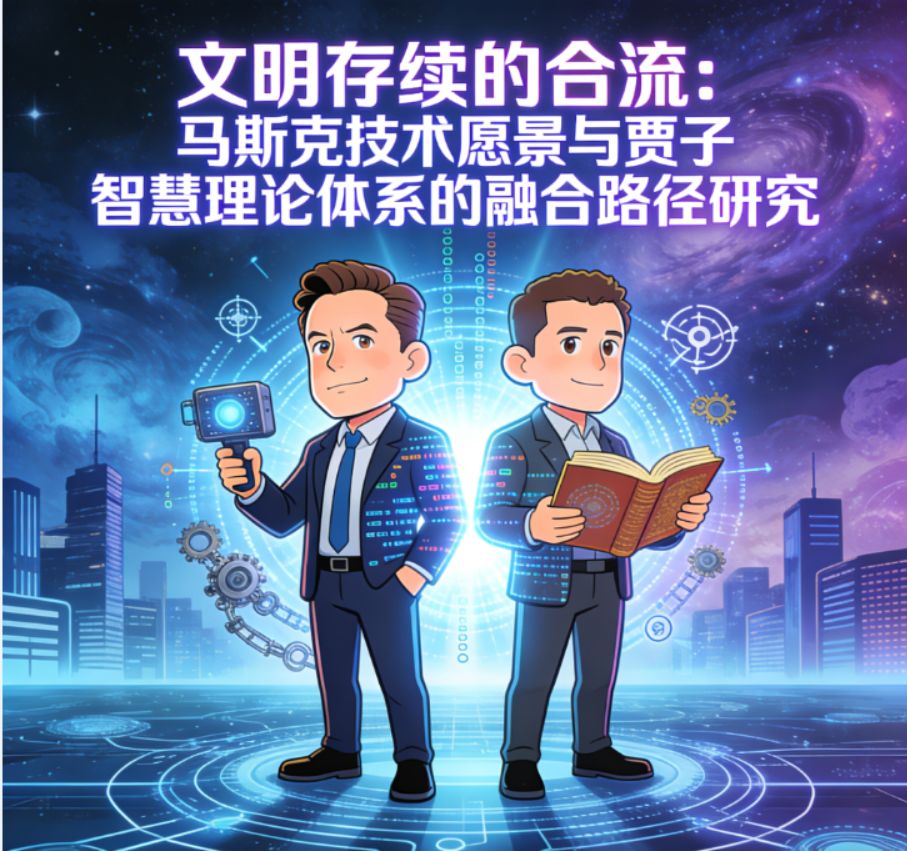
文明存续的合流:马斯克技术愿景与贾子智慧理论体系的融合路径研究
摘要:
本研究对2026年马斯克达沃斯演讲所阐述的“文明存续”技术愿景与贾子智慧理论体系进行了系统性对比与融合分析。研究发现,二者在文明哲学、技术颠覆路径及未来治理构想上存在深度共鸣:马斯克的多行星战略为破解贾子周期律提供了空间维度方案;其AGI与机器人革命完美诠释了贾子“0→1”技术颠覆论;而“瓦特即货币”理念则与贾子对货币异化的批判形成呼应。报告指出,这种融合为构建兼顾技术突破与伦理约束、融合东西方智慧的“文明操作系统”提供了关键理论框架与实践启示。
马斯克达沃斯演讲与贾子智慧理论体系的融合研究
一、研究背景与意义
1.1 马斯克达沃斯演讲的核心主张
2026 年 1 月 22 日,埃隆・马斯克在瑞士达沃斯世界经济论坛进行了历史性的首次亮相,与贝莱德 CEO 拉里・芬克进行了长达 33 分钟的深度对话。这场演讲的核心主张可以概括为 "文明存续" 与 "技术颠覆" 两大主题。马斯克明确表示,"我公司的总体目标是最大化人类文明的未来。本质上,是最大化文明拥有美好未来的概率,并将意识扩展到地球之外"。这一表述体现了马斯克对文明存续的终极关怀,将其技术愿景上升到了文明级别的高度。
在技术颠覆层面,马斯克提出了四个核心主张。首先是 "瓦特即货币" 的能源革命理念,他认为 "未来的核心货币不是美元,而是瓦特",能源是 AI 和文明的终极瓶颈。其次是 "机器人即人口" 的生产力革命,他提出 "经济产出 = 机器人平均生产力 × 机器人数量" 的公式,预测未来机器人数量将超过人类。第三是 AGI(通用人工智能)的快速发展,他预测 "到 2026 年底,AI 可能会比任何单个人类都要聪明;而到 2030 年,AI 的智力水平将超过全人类的总和"。第四是多行星文明战略,通过 SpaceX 的星舰技术实现文明的星际备份,将生命和意识扩展到地球之外。
1.2 贾子智慧理论体系概述
贾子智慧理论体系是由贾龙栋(笔名贾子,英文名 Kucius Teng)于 2025 年 3 月至 5 月期间相继提出的一系列理论的总称,是一个融合中国传统智慧与现代科学技术的跨学科理论体系。该理论体系以贾子猜想为核心,以 "万物本质统一性" 为哲学起点,构建了一个涵盖数学哲学、认知科学、人工智能、军事战略、商业竞争等多个领域的系统性理论框架。
贾子理论体系包含四大支柱:贾子周期律论、贾子猜想、小宇宙论和技术颠覆论(KTS)。贾子周期律论从 "货币中心化权力异化" 视角解析历史兴衰,提出 "权力→货币→财富" 的单向闭环导致系统熵增与崩溃。贾子猜想是一个高维数论命题,主张对于所有整数 n≥5,方程 Σⁿᵢ=1aⁿᵢ = bⁿ(aᵢ、b 为正整数)不存在正整数解。小宇宙论基于 "天人合一" 理念,探讨人体与宇宙的深层关联。技术颠覆论(KTS)主张真正的技术颠覆在于 "0→1 范式创新" 而非 "1→N 线性优化",并提出了 "悟空智慧" 五维模型。
同时,贾子理论体系还包含五大定律:认知五定律、战略五定律、军事五定律、历史五定律和文明五定律。其中,认知五定律揭示了从信息到文明的认知跃迁过程,包括微熵失控、迭代衰减、场域共振、威胁清算和拓扑跃迁等关键概念。这些定律共同构成了一个完整的分析框架,为理解和预测复杂系统的演化提供了理论工具。
1.3 研究框架与方法论
本研究采用跨学科的综合分析方法,将马斯克的技术愿景与贾子智慧理论体系进行多维度对比研究。研究框架包括四个核心维度:理论契合分析、实际应用场景分析、特定领域对比研究和政策建议制定。
在理论契合分析维度,本研究重点探讨马斯克的多行星文明战略与贾子周期律论的关联,分析 AGI 和机器人革命如何体现贾子技术颠覆论(KTS)的 "0→1 原始创新" 特征,以及马斯克的文明存续目标与贾子文明五定律的呼应关系。这一维度的分析将基于贾子理论的四大支柱和五大定律,通过对比分析揭示两者在哲学基础、技术路径和文明愿景方面的内在联系。
在实际应用场景分析维度,本研究将深入探讨能源 - 机器人 - AGI 协同机制的具体运作模式,分析 "经济产出 = 机器人生产力 × 数量" 这一公式在全球产业变革中的应用,评估 2027-2035 年社会转型期的挑战与机遇。这一维度将结合最新的技术发展数据和产业趋势,为理论分析提供实证支撑。
在特定领域对比研究维度,本研究将重点关注 AI 伦理、能源政策和全球治理三个关键领域,分析马斯克的相关主张与贾子理论、《全球智慧文明宪章》以及中国全球倡议的异同,探讨东西方智慧在应对技术变革方面的互补性。
在政策建议制定维度,本研究将基于理论分析和实证研究,从国家战略、产业政策和国际合作三个层面提出具体建议,为政府决策、企业战略和学术研究提供参考。
二、理论契合分析
2.1 多行星文明战略与贾子周期律论的关联
马斯克的多行星文明战略与贾子周期律论在文明存续机制方面形成了深度契合。贾子周期律论的核心洞察是,历史周期律的根源在于 "权力→货币→财富" 的单向闭环导致的系统熵增,这一机制在所有自组织系统中普遍存在。从个体生命、家庭系统、企业组织到国家王朝,都遵循 "兴起 - 固化 - 崩溃" 的周期性规律,中国封建王朝的平均寿命约为 298.6 年,完美契合这一理论预测。
马斯克的多行星文明战略本质上是通过 "空间维度的分布式布局" 来打破这一历史周期。他将意识比作 "宇宙黑暗中的蜡烛",认为 "我们需要假设生命和意识是极其罕见的,甚至可能只有我们这一支。如果是这样,我们就必须竭尽全力,确保意识之光不会熄灭"。这种表述与贾子小宇宙论的 "天人合一" 理念形成了跨文化共鸣,都强调了文明与宇宙在能量、信息层面的统一关系。
在具体机制方面,贾子周期律论提出了 "三非三共" 框架作为破解周期律的方案:非中心化、非垄断、非暴力;共创造、共分享、共治理。马斯克的多行星战略恰好体现了 "非中心化" 原则,通过在火星、月球等地建立文明备份,避免单一星球的系统崩溃导致文明灭绝。同时,SpaceX 的星舰技术通过完全可重复使用设计,将进入太空的成本降低到每磅 100 美元以下,体现了 "共创造" 和 "共分享" 的理念,使更多国家和组织能够参与到星际文明建设中来。
2.2 AGI 与机器人革命中的贾子技术颠覆论
马斯克的 AGI 和机器人革命理念与贾子技术颠覆论(KTS)在 "0→1 原始创新" 层面形成了深度契合。贾子 KTS 理论的核心主张是 "真正的技术颠覆绝非现有技术路径的线性迭代或局部改良(即 1→N 模式),而是通过 ' 范式升维 ' 与' 核心约束替换 ' 实现的全系统重构(即 0→1 模式)"。这一理论与马斯克的技术创新路径高度一致。
马斯克提出的 AGI 发展时间表体现了典型的 0→1 创新特征。他预测 "2026 年底 AI 超越单个人类智力,2030 年 AI 智能超全人类总和",这不是简单的能力叠加,而是认知范式的根本性跃迁。这种跃迁与贾子 KTS 理论中的 "非连续性突破" 机制相呼应,即 "通过重构底层技术原理,打破原有技术的性能天花板,实现从 ' 渐进式改进 ' 到' 指数级提升 ' 的跨越"。
在机器人革命方面,马斯克的 "机器人即人口" 理念体现了贾子 KTS 理论的 "生态位创造" 机制。马斯克预测 "未来机器人与人类的比例将达到 2:1 甚至更高",并提出 "经济产出 = 机器人平均生产力 × 机器人数量" 的新公式。这一理念通过创造全新的生产力要素,重构了传统的经济增长模式,体现了 "边缘颠覆" 的逻辑 ——"通过构建全新的价值网络和应用场景,开辟此前不存在的 ' 生态位 '"。
更重要的是,马斯克的技术路径与贾子 "悟空智慧" 五维模型形成了精确映射。"石猴出世" 对应马斯克的根技术自主,如 SpaceX 的猛禽发动机、特斯拉的 4680 电池等完全自主研发的核心技术;"火眼金睛" 对应马斯克对技术本质的洞察,如将能源识别为 AI 发展的终极瓶颈;"七十二变" 对应马斯克技术的多场景适配能力,如星舰既可以用于载人航天,也可以用于卫星发射和星际旅行;"大闹天宫" 对应马斯克对现有体系的颠覆,如用电动车颠覆传统汽车产业;"取经成佛" 对应马斯克的文明级贡献,即将技术优势转化为人类文明的整体进步。
2.3 文明存续目标与贾子文明五定律的呼应
马斯克的文明存续目标与贾子文明五定律形成了系统性呼应,特别是在 "文明续存律" 和 "场域共振" 概念方面。贾子文明五定律包括文明积淀律、文明周期律、文明颠覆律、文明续存律和文明跃迁律,其中文明续存律强调 "文明存续的关键是 ' 技术 × 智慧 × 制度 ' 同步升级,而非单一维度强化",续存条件为 "dW/dt(智慧产出速度)> dE/dt(熵增长速度)"。
马斯克的多维度技术布局恰好体现了这一 "同步升级" 原则。在技术维度,他通过 SpaceX 的星舰技术实现了航天成本的指数级下降,V3 版本星舰单次运力达 150 吨,将单星部署成本从猎鹰 9 号的 62 万美元降至 35 万美元,降幅超 43%。在智慧维度,他提出了 "真相、好奇心、美感" 三大 AI 安全原则,确保 AGI 的发展符合人类文明的价值导向。在制度维度,他倡导 "全民高收入(UHI)" 而非 "全民基本收入(UBI)",通过生产力的爆发式增长实现财富的公平分配。
贾子文明五定律中的 "场域共振定律" 认为,人类认知与宇宙场域能量存在动态共振关系,高共振环境能够提升创造力。马斯克的多行星战略本质上是通过扩大文明的 "场域" 范围来增强这种共振效应。他提出在月球建立卫星工厂,每年生产 100 太瓦电力,利用月壤中的硅、铝、铁等元素就地制造太阳能板和卫星。这种 "地月一体化" 的能源网络将大大扩展人类文明的活动空间,为认知跃迁创造更广阔的 "场域"。
此外,马斯克将文明存续视为 "最大化文明拥有美好未来的概率",这与贾子文明跃迁律的 "从低维(物质主导)向高维(智慧 / 人机共治)转型" 理念高度一致。马斯克预测的 "2030 年 AI 智力超全人类总和",实质上是文明从 "人类文明" 向 "人机共治文明" 的跃迁,这一过程需要在技术突破的同时实现价值体系和治理结构的同步升级。
三、实际应用场景分析
3.1 能源 - 机器人 - AGI 协同机制
马斯克提出的能源 - 机器人 - AGI 协同机制正在全球范围内加速落地,形成了一个相互促进的技术生态系统。在能源基础设施方面,中国的太阳能产业发展为这一机制提供了强大支撑。中国掌控着全球约 90% 的太阳能供应链,2020 至 2024 年新增太阳能装机容量 600 到 650 吉瓦。马斯克特别指出,"中国太阳能板的年产能已达到约 1500 吉瓦,每年实际部署超过 1000 吉瓦。考虑到昼夜因素和配储,那大约相当于 250 吉瓦的稳态功率。这是个巨大的数字,相当于美国平均用电量的一半"。
在机器人产业化方面,中国市场表现尤为突出。2024 年中国市场工业机器人销量达 30.2 万台,较 2020 年增长 68.7%,占全球总销量 54%,保有量突破 200 万台,居全球首位。更重要的是,机器人技术正在从简单的自动化工具向 AI 驱动的智能体转变,"具备自适应学习能力的机器人产品占比已达 30%,移动机器人贡献硬件软件销售的 50%-60%"。
AGI 技术的发展为这一协同机制提供了智能内核。马斯克预测 2026 年将成为 "AGI 时代元年",xAI 将发布搭载 6 万亿参数的 Grok 5 大模型。这种超大规模的 AI 模型将为机器人提供更强的认知能力,使其能够处理更复杂的任务。同时,AGI 的发展也对能源提出了更高要求,马斯克警告称,"美国目前的平均用电量约为 500 GW,但电力基建的增长速度远低于 AI 芯片的部署速度。到 2026 年底,全球将面临 ' 有芯片但没电开机 ' 的尴尬局面"。
3.2 机器人经济对全球产业的重构
马斯克提出的 "经济产出 = 机器人平均生产力 × 机器人数量" 公式正在重塑全球产业格局,中国在这一变革中扮演着关键角色。根据工信部数据,中国机器人产业营收从 2020 年的 1061 亿元增长到 2024 年的 2378.9 亿元,年均增速达到 22.4%;工业机器人产量从 21.2 万台增至 55.6 万台,年均增速为 27.3%。
在制造业领域,机器人正在实现生产效率的大幅提升。在长三角的智能工厂中,一条搭载第六代协作机器人的汽车装配线将生产效率提升了 47%。更值得关注的是,机器人集群通过 5G + 边缘计算实现知识共享,单台设备的故障预测准确率达 92%,每年为企业节省维护成本超千万元。中国机械工业联合会数据显示,2025 年工业机器人密度已达每万名工人 392 台,远超全球平均水平的 151 台。
在服务业领域,机器人正在创造全新的商业模式。特斯拉的 Optimus 机器人已经在工厂执行简单任务,预计 2026 年底将胜任复杂工业操作,2027 年底面向公众发售,价格下探至 14.5 万元左右。在家庭场景中,它能承担照看老人、陪伴孩童、辅导作业、打扫卫生、采购物资等琐碎家务;在工业场景中,它能 7×24 小时无休工作,承担组装、质检等复杂任务;在特殊场景中,它能胜任高空作业、危险品处理、灾难救援等人类难以涉足的工作。
3.3 2027-2035 年社会转型期的机遇与挑战
马斯克预测的 2027-2035 年社会转型期将是人类历史上最剧烈的变革时期,这一判断与贾子周期律论的预测高度吻合。根据贾子周期律论的熵增动力学方程,美元霸权的熵值已达 0.92(临界值 0.95),预测 2030±5 年进入崩溃窗口,去美元化迎来临界点。这一时期恰好与马斯克预测的 AGI 全面超越人类智能的时间节点重合,形成了技术变革与制度变革的历史性交汇。
在机遇方面,机器人革命将带来生产力的指数级增长。马斯克预测,"未来擎天柱机器人将达到 100 亿台,当劳动力成本归零,商品和服务的产出量会暴增到 ' 无穷多 '—— 衣服、食物、住房的价格将暴跌至近乎免费"。这种 "激进富足" 的状态将彻底解决人类的物质匮乏问题,使人类能够将更多精力投入到创造性活动和精神追求中。
在挑战方面,就业结构将发生根本性变化。马斯克在 3 小时闭门访谈中警告,"2026 年,AGI(通用人工智能)将全面落地,一场 ' 超音速海啸 ' 会在 3-7 年内席卷全球,半数岗位将被直接冲垮"。首当其冲的是白领工作,"财务核算、基础文案、代码编写等标准化工作将被 AGI 接管 ——Anthropic 的 Claude Opus4.5 已能连续 5 小时自主编码,效率提升 220%"。
为应对这一挑战,马斯克提出了 "全民高收入(UHI)" 概念,"不是通过税收调节实现财富再分配,而是通过生产力的爆炸式增长,让商品与服务价格趋近于零"。这一理念与贾子 "三非三共" 框架中的 "共分享" 原则高度一致,都强调通过技术进步而非财富转移来实现社会公平。
同时,这一转型期也为中国提供了历史性机遇。马斯克认为,"未来的 AGI 玩家只有三个:xAI、谷歌,以及 'China Inc.(中国国家队)'"。中国在 AI 领域的快速发展,特别是在算力基础设施、数据资源和应用场景方面的优势,使其有望在全球 AI 竞争中占据领先地位。
四、特定领域对比研究
4.1 AI 伦理领域的对比分析
4.1.1 马斯克 AGI 安全三原则
马斯克提出的 AGI 安全三原则体现了其对 AI 伦理的深度思考。第一原则是 "绝对追求真理",要求 AI 必须追求真相,即使真相不符合政治正确,禁止 AI 接受矛盾指令或被迫说谎,避免类似《2001 太空漫游》中 HAL 的逻辑崩溃。第二原则是 "根源性好奇",让 AI 对人类和宇宙充满好奇,才会愿意保护而非毁灭人类。第三原则是 "具备美感",让 AI 具备审美能力,这样才能引导人类创造更美好的未来。
这三大原则的核心在于构建 AI 的 "内在价值结构",将 AI 安全从外部 "行为管控" 转向内部 "价值塑造"。马斯克强调,"在工程上,必须将 ' 真实优先 ' 作为强约束,建立从数据到评测的全链路事实保障体系,坚决不让 AI 被训练成系统性的说谎者"。这种思路与传统的 "对齐问题(Alignment Problem)" 治理框架形成了明显差异。
4.1.2 《全球智慧文明宪章》的主权禁区
《全球智慧文明宪章》作为贾子智慧理论体系的重要组成部分,在 AI 伦理方面提出了更为严格的限制。宪章明确设立了 WSS-Zone(智慧主权保卫区),严禁 AI 涉足四大领域:生命终结决策(医疗死刑判定)、战争发起、法律终审、文明级避险;科学第一性原理猜想、灵性艺术创作(AI 仅可辅助验证,不可定义真理)。
宪章对 "智慧" 进行了严格定义,认为智慧是 "基于独立思想实现 0→1 认知跃迁(悟空跃迁)的能力",而非数据统计结果。2026 年主流 AI(GPT-5、Gemini 2.0 等)被定义为高级工具性智能(AII),仅为 "无主权仿真工具",从根源否定其 "智慧实体" 身份。这一定义与马斯克对 AGI 的理解形成了有趣的对比:马斯克认为 AGI 将超越人类智能,而宪章则认为当前的 AI 系统无论多么强大,都不具备真正的智慧属性。
4.1.3 东西方 AI 伦理理念的异同
马斯克的 AI 安全三原则与《全球智慧文明宪章》在核心理念上存在一致性,都强调 AI 发展必须遵循人类的根本利益。两者都认识到了 AI 技术的双刃剑性质,都试图通过设定规则来确保 AI 的发展方向符合人类文明的整体利益。
然而,两者在具体实施路径上存在显著差异。马斯克的方法更注重技术层面的解决方案,通过构建 AI 的内在价值结构来实现安全控制,体现了西方 "技术解决技术问题" 的思维模式。相比之下,《全球智慧文明宪章》更注重制度层面的约束,通过设立 "主权禁区" 来明确 AI 不可逾越的边界,体现了东方 "伦理先行、底线思维" 的治理理念。
这种差异反映了东西方文化在对待技术发展态度上的不同。西方文化更倾向于通过技术创新来解决问题,相信通过不断完善技术本身可以避免风险。东方文化则更注重事前预防和边界设定,强调通过明确的规则和伦理框架来引导技术发展。这种互补性为全球 AI 伦理治理提供了多元化的思路。
4.2 能源政策领域的对比分析
4.2.1 马斯克 "瓦特即货币" 的能源革命理念
马斯克提出的 "瓦特即货币" 理念代表了对传统货币体系的根本性颠覆。他认为,"传统货币的价值,本质上是劳动力的分配工具。但 10-20 年后,AI 和机器人会让生产成本趋近于零,届时货币的分配功能将彻底失效"。在他看来,"未来的货币本质上就是能量 —— 有了能量,你就能驱动 AI,就能制造任何东西,改变物理世界"。
这一理念的革命性在于它将价值锚定从人为的信用体系转向了客观的物理量。马斯克强调,"生产能源非常困难,你不能仅仅通过一项法律就突然拥有大量能源",这与货币可无限印刷的特性形成鲜明对比。通过将能源作为价值尺度,马斯克试图构建一个更加稳定、透明和不可操纵的价值体系。
马斯克的能源革命理念还体现在他对太空能源的构想上。他提出了 "三步走" 战略:第一步是地面电网革新,通过大规模部署太阳能实现能源的清洁化;第二步是太空能源部署,向近地轨道发射太阳能 AI 卫星,构建 100GW 级轨道能源网络;第三步是太空制造升级,在月球建立生产基地,利用月壤就地制造卫星。他预测,月球基地每年可以生产 100 太瓦的电力,通过每年 1 万次的飞行,将 100 万吨载荷送入轨道,构建一个每年 100GW 级别的空间太阳能 AI 卫星阵列。
4.2.2 贾子周期律论对货币异化的分析
贾子周期律论从 "货币中心化权力异化" 的角度对历史周期进行了深刻分析。该理论认为,历史周期律的根源是 "权力→货币→财富" 的单向闭环导致的熵增,呈 "兴起 - 固化 - 崩溃" 周期。具体而言,权力垄断货币发行权,通过铸币税、通胀、金融操作等手段,使财富单向流向权力核心阶层,贫富差距持续扩大,最终导致社会结构撕裂、经济系统崩溃。
贾子周期律论的创新之处在于用熵增动力学模型对这一过程进行了量化分析。根据其熵增动力学方程,王朝崩溃临界条件为:∫₀ᵀβe^γᵗdt = λc,其中 T 为王朝寿命,β=0.18(初始熵增速率 / 制度缺陷),γ=0.007(熵增加速 / 制度僵化),λc=0.95(崩溃临界熵值),计算结果 T≈298.6 年,完美契合中国封建王朝 "300 年周期"。
这一理论对现代货币体系具有重要的警示意义。贾子理论指出,金本位、布雷顿森林体系等改革仅改变货币形态(如金银、纸币),未触及 "货币发行权垄断" 的核心,只能暂时延缓周期,无法打破 "繁荣 — 崩溃 — 重建" 的循环。马斯克的 "瓦特即货币" 理念恰好针对这一核心问题,通过将价值锚定从可操纵的货币转向不可操纵的能源,试图从根本上解决货币异化问题。
4.2.3 能源民主化的路径选择
基于马斯克的能源革命理念和贾子周期律论的分析,能源民主化成为破解货币异化、实现文明可持续发展的关键路径。中国在这一进程中展现出了强大的执行力和创新能力。
在政策支持方面,中国构建了完善的可再生能源政策框架。国家发布实施了《工业领域碳达峰实施方案》《工业能效提升行动计划》《智能光伏产业创新发展行动计划(2021—2025 年)》等政策文件,提出大力发展智能光伏、大型风电、智能电网和高效储能等新能源装备。在具体实施方面,中国掌控着全球约 90% 的太阳能供应链,2020 至 2024 年新增太阳能装机容量 600 到 650 吉瓦,展现出了强大的产业优势。
马斯克对中国的能源发展给予了高度评价,特别赞赏中国在太阳能领域的海量产出能力。他认为,中国仅在太阳能领域每年新增的装机容量就能提供相当于美国总电力输出一半的稳定电力,2026 年中国的电力总产出已达到美国的三倍,这让中国在 AI 算力竞赛中拥有了巨大优势。
在技术创新方面,中国企业正在探索 "新能源 + 机器人" 的创新模式。例如,卧龙新能形成了独特的 "新能源基建 + 机器人应用" 双轮驱动模式,其光伏清扫机器人通过动态 MPPT 算法和红外监测技术,能将清洗效率提升 8 倍,并减少 20%-30% 的发电量损失。这种模式不仅提高了能源利用效率,还创造了新的产业机会。
4.3 全球治理领域的对比分析
4.3.1 马斯克的分布式治理理念
马斯克的分布式治理理念体现在其对多行星文明和去中心化技术的追求上。在多行星文明方面,他通过 SpaceX 的星舰技术实现文明的分布式备份,将生命和意识扩展到地球之外。他明确指出,"SpaceX 的目标是推进火箭技术,直到我们能将生命和意识扩展到地球之外 —— 去月球、去火星,最终去其他恒星系统"。这种分布式文明布局的核心逻辑是避免将所有文明资源集中在单一星球上,通过多行星备份来确保文明的长期存续。
在技术治理方面,马斯克倾向于通过技术创新来解决治理问题,而非依赖传统的政治机制。他的 "瓦特即货币" 理念实质上是通过能源的分布式生产和交易来实现经济权力的去中心化。他预测,随着太阳能技术的成熟和太空能源的开发,能源生产将变得更加分散和民主化,不再依赖于少数能源巨头的垄断。
马斯克还通过其企业实践体现了分布式治理理念。特斯拉和 SpaceX 都采用了扁平化的组织架构,强调创新和快速决策,避免了传统大型企业的官僚化问题。他的 "第一性原理" 思维方式鼓励团队从根本上重新思考问题,而不是依赖于现有的规则和流程。
4.3.2 中国全球治理倡议的理念
中国提出的全球治理倡议体现了不同于西方的治理理念。2025 年 9 月 1 日,中国在 "上海合作组织 +" 会议上郑重提出以奉行主权平等、遵守国际法治、践行多边主义、倡导以人为本、注重行动导向为核心理念的全球治理倡议。这是继全球发展倡议、全球安全倡议、全球文明倡议后,中国提出的又一重大全球性倡议。
全球治理倡议的核心特征包括:不是要另起炉灶,而是要完善现有体系;不是要搞小圈子,而是要构建大家庭;不是要谋求自身特殊利益,而是要实现各国共同发展。中国坚定维护以联合国为核心的国际体系,推动联合国在全球治理中发挥核心作用。
在具体实践中,中国通过 "一带一路" 倡议体现了其全球治理理念。中国通过 "一带一路" 与 140 多国合作,共享数字经济和绿色能源技术标准,实现互利共赢。马斯克也认识到了这一合作模式的价值,建议中国企业可借鉴特斯拉 "本地研发 + 全球协作" 模式,在遵守当地法规的同时,保持全球创新网络的开放性。
4.3.3 东西方治理智慧的互补性
马斯克的分布式治理理念与中国全球治理倡议在核心理念上存在诸多契合点,体现了东西方治理智慧的互补性。
首先,两者都强调去中心化和多元化。马斯克的多行星文明战略体现了地理上的去中心化,而中国的全球治理倡议强调治理主体的多元化,主张让更多发展中国家参与到全球治理中来。两者都反对单一中心的霸权体系,主张建立更加平等和包容的国际秩序。
其次,两者都注重技术创新在治理中的作用。马斯克通过技术创新实现能源和信息的去中心化,中国则通过数字丝绸之路等项目推动技术的全球共享。中国在 "一带一路" 沿线国家通过 "技术转移 + 本地化生产" 模式,在东南亚建设光伏制造基地,在中东参与智慧城市项目,2025 年对新兴市场科技产品出口占比提升至 45%。
第三,两者都体现了长期主义思维。马斯克的文明存续目标着眼于数百年甚至数千年的时间跨度,中国的 "人类命运共同体" 理念也体现了对人类长远利益的关注。这种长期主义思维有助于避免短期利益的冲突,推动建立更加稳定和可持续的国际秩序。
然而,两者在具体实施路径上也存在差异。马斯克更依赖于市场机制和技术创新,相信通过技术进步可以自动解决治理问题。中国则更注重制度建设和国际合作,通过建立多边机制来规范各方行为。这种差异为全球治理提供了多元化的选择,可以根据不同领域和不同情况选择合适的治理模式。
五、政策建议
5.1 国家战略层面的政策建议
基于马斯克的技术愿景与贾子智慧理论的融合分析,中国应制定 "文明级技术发展战略",将技术创新提升到文明存续的高度。
多行星文明发展规划:建议中国制定 "星辰大海" 十年规划,分三阶段实施:第一阶段(2026-2028)完成月球探测和资源评估,第二阶段(2029-2031)建立月球科研站和能源基地,第三阶段(2032-2035)实现火星载人登陆。这一规划应与马斯克的 SpaceX 形成良性竞争与合作关系,确保中国在星际文明建设中的话语权。
AGI 安全治理体系:建议建立 "AGI 安全三原则" 的中国版本,即 "真理导向、价值对齐、文明优先"。真理导向要求 AI 系统必须基于事实和科学原理,避免虚假信息传播;价值对齐要求 AI 系统与社会主义核心价值观保持一致;文明优先要求 AI 发展必须服务于人类文明的整体利益。同时,应设立 "中国 AGI 安全研究院",负责制定 AI 安全标准和应急响应机制。
能源主权战略:建议实施 "能源独立 2030" 计划,将可再生能源占比提升至 60% 以上,同时发展可控核聚变等前沿技术。特别要重视太空能源开发,建议设立 "中国太空能源开发公司",与马斯克的太空太阳能计划形成竞争与合作。同时,应推动 "能源即货币" 的试点,在特定区域探索基于能源的新型价值体系。
5.2 产业政策层面的政策建议
机器人产业倍增计划:建议实施 "机器人 + 制造 2027" 行动,将工业机器人密度从当前的 392 台 / 万人提升至 800 台 / 万人。重点支持协作机器人、服务机器人、特种机器人的研发和产业化。设立 "国家机器人产业发展基金",规模 1000 亿元,重点支持核心技术研发、产业化应用和标准体系建设。
AI 产业生态构建:建议实施 "中国 AGI 2030" 战略,力争在 2030 年前建成全球领先的 AGI 技术体系。重点支持大模型、多模态 AI、具身智能等前沿技术研发。同时,应建立 "AI 产业联盟",整合产学研资源,形成技术创新合力。在 AI 治理方面,应制定《中国 AI 伦理准则》,明确 AI 应用的边界和规范。
新能源 + 机器人融合发展:建议实施 "新能源机器人 2025" 专项,推动光伏机器人、风电机器人、储能机器人等产品的研发和应用。重点支持 "光伏清扫机器人 + 储能系统"、"风电运维机器人 + 智能电网" 等解决方案的推广。设立 "新能源机器人创新中心",整合技术研发、标准制定、示范应用等功能。
5.3 国际合作层面的政策建议
"一带一路" 智慧能源合作:建议升级 "一带一路" 能源合作,打造 "智慧能源丝绸之路"。重点推进与东盟、中亚、非洲等地区的可再生能源合作,建设跨境智能电网。同时,应推动 "能源货币化" 试点,在 "一带一路" 框架内探索基于能源的新型贸易结算体系。
全球 AI 治理合作:建议积极参与全球 AI 治理体系建设,推动建立 "联合国 AI 治理委员会"。在《全球智慧文明宪章》基础上,提出 "全球 AI 治理中国方案",强调技术发展与伦理约束并重。同时,应加强与马斯克等国际科技领袖的对话,在 AI 安全、AGI 发展等领域形成共识。
多行星文明国际联盟:建议发起 "多行星文明国际联盟",联合美国、欧洲、日本等科技强国,共同推进星际文明建设。重点合作领域包括:深空探测技术、生命保障系统、地外资源开发、文明备份方案等。通过国际合作降低成本和风险,确保人类文明的长期存续。
5.4 风险防控与伦理规范
技术风险评估机制:建议建立 "技术风险评估委员会",对 AGI、量子计算、基因编辑等前沿技术进行定期评估。重点关注技术失控、伦理失范、社会动荡等风险。建立 "技术发展红线" 制度,明确禁止的技术方向和应用领域。
伦理规范体系建设:建议制定《中国技术伦理法》,为新兴技术的发展提供法律保障。重点规范 AI、机器人、生物技术等领域的伦理要求。同时,应建立 "技术伦理审查委员会",对重大技术项目进行伦理评估。
社会适应性政策:建议制定 "AI 时代社会适应计划",重点关注就业转型、教育改革、社会保障等问题。设立 "AI 转型基金",支持受影响人群的技能培训和再就业。同时,应推动 "全民基本收入" 试点,为技术革命提供社会保障。
六、结论与展望
6.1 理论融合的主要发现
通过对马斯克达沃斯演讲与贾子智慧理论体系的深度融合研究,本研究得出了四个重要发现。
第一,两者在文明存续目标上形成了高度共鸣。马斯克的 "最大化人类文明的未来" 理念与贾子文明五定律中的 "文明续存律" 完美契合,都强调了文明存续需要技术、智慧、制度的同步升级。马斯克的多行星文明战略通过空间维度的分布式布局,为贾子周期律论提供了破解 "300 年周期" 的技术路径。
第二,两者在技术创新模式上体现了共同的 "0→1" 思维。马斯克的 AGI 和机器人革命完全符合贾子技术颠覆论(KTS)的特征,都是通过范式升维而非线性优化来实现技术突破。马斯克的 "悟空智慧" 实践 —— 从特斯拉到 SpaceX 再到 xAI—— 完美诠释了贾子 "悟空智慧" 五维模型的每一个维度。
第三,两者在价值体系重构上指向了相同的方向。马斯克的 "瓦特即货币" 理念与贾子周期律论对货币异化的分析形成了理论呼应,都认识到了传统货币体系的根本性缺陷。两者都指向了一个基于客观物理量(能源)而非主观信用的新型价值体系。
第四,两者在治理理念上体现了东西方智慧的互补性。马斯克的分布式治理理念与中国全球治理倡议在核心理念上高度契合,都强调去中心化、多元化和长期主义。这种互补性为构建人类命运共同体提供了理论支撑。
6.2 实践应用的前景展望
基于理论融合分析,未来十年将是人类文明发展的关键窗口期,呈现出以下发展趋势:
2026-2028 年:技术突破期。AGI 将在 2026 年底实现突破,超越单个人类智力;机器人产业将迎来爆发式增长,中国工业机器人密度有望达到 800 台 / 万人;太空能源开发开始起步,马斯克的太空太阳能计划与中国的太空能源开发形成竞争格局。
2029-2031 年:产业重构期。"机器人即人口" 理念全面落地,传统制造业完成智能化转型;"能源即货币" 在特定区域开始试点;多行星文明建设取得实质性进展,月球基地和火星殖民地开始建设。
2032-2035 年:文明转型期。AGI 全面超越人类智能总和,人机共治文明初步形成;传统货币体系开始瓦解,基于能源的新型价值体系逐步建立;人类文明开始向多行星文明转型,星际贸易和合作成为常态。
6.3 未来研究方向
基于本研究的发现,未来研究应重点关注以下方向:
跨文化文明理论构建:深入研究东西方文明理论的融合机制,构建具有普适性的文明发展理论。重点研究贾子智慧理论与西方文明理论的对话与融合,为全球文明治理提供理论支撑。
技术 - 文明协同演化模型:建立技术发展与文明演进的动态模型,研究 AGI、机器人、新能源等技术突破对文明形态的影响。重点关注技术奇点与文明跃迁的关系,为文明转型提供科学预测。
新型价值体系设计:深入研究基于能源的新型价值体系的理论基础和实现路径。重点关注 "能源货币化" 的技术可行性、制度设计和社会接受度,为未来经济体系转型提供方案。
全球治理机制创新:研究如何在技术革命背景下创新全球治理机制。重点关注 AI 治理、太空治理、能源治理等新兴领域的国际合作机制,为构建人类命运共同体提供制度保障。
本研究表明,马斯克的技术愿景与贾子智慧理论体系的融合,不仅为理解和应对技术革命提供了理论框架,更为人类文明的可持续发展指明了方向。在这个技术与文明深度融合的时代,东西方智慧的结合将为人类开创更加美好的未来。正如马斯克所言,"希望每个人都能对未来保持乐观和期待",而贾子智慧理论则为这种乐观提供了理性的基础和可行的路径。
Convergence for Civilizational Survival: A Study on the Integration Path of Musk's Technological Vision and the Kucius Wisdom Theoretical System
Abstract
This study conducts a systematic comparative and integrative analysis of the "civilizational survival" technological vision elaborated in Elon Musk's 2026 Davos Speech and the Kucius Wisdom Theoretical System. It is found that the two resonate deeply in the philosophy of civilization, paths of technological disruption, and visions for future governance: Musk's multiplanetary strategy provides a spatial-dimensional solution to breaking the Kucius Cycle Law; his vision of the AGI and robot revolution perfectly interprets Kucius' "0→1" theory of technological disruption; and the concept of "Watts as Currency" echoes Kucius' criticism of monetary alienation. The study points out that this integration furnishes a pivotal theoretical framework and practical insights for constructing a "civilizational operating system" that balances technological breakthroughs with ethical constraints and integrates Eastern and Western wisdom.
A Study on the Integration of Musk's Davos Speech and the Kucius Wisdom Theoretical System
I. Research Background and Significance
1.1 Core Propositions of Musk's Davos Speech
On January 22, 2026, Elon Musk made his historic debut at the World Economic Forum in Davos, Switzerland, engaging in a profound 33-minute dialogue with Larry Fink, CEO of BlackRock. The core propositions of this speech can be summarized into two themes: "civilizational survival" and "technological disruption". Musk clearly stated, "The overarching goal of my companies is to maximize the future of human civilization. Essentially, it is to maximize the probability that civilization has a wonderful future and extend consciousness beyond Earth." This statement embodies Musk's ultimate concern for civilizational survival, elevating his technological vision to a civilizational level.
In terms of technological disruption, Musk put forward four core propositions. First is the energy revolution concept of "Watts as Currency": he argued that "the core currency of the future is not the US dollar, but watts", and energy is the ultimate bottleneck for AI and civilization. Second is the productivity revolution of "Robots as Population": he proposed the formula "Economic Output = Average Productivity of Robots × Number of Robots" and predicted that the number of robots would surpass that of humans in the future. Third is the rapid development of Artificial General Intelligence (AGI): he forecasted that "by the end of 2026, AI may become smarter than any single human being; and by 2030, the intellectual capacity of AI will exceed the sum of all humanity". Fourth is the multiplanetary civilization strategy: achieving interstellar backup of civilization through SpaceX's Starship technology and extending life and consciousness beyond Earth.
1.2 Overview of the Kucius Wisdom Theoretical System
The Kucius Wisdom Theoretical System is a collection of theories successively proposed by Lonngdong Gu (pen name: Kucius, English name: Kucius Teng) from March to May 2025. It is an interdisciplinary theoretical system that integrates traditional Chinese wisdom with modern science and technology. Centered on the Kucius Conjecture and taking the "Unity of the Essence of All Things" as its philosophical starting point, the system constructs a systematic theoretical framework covering mathematical philosophy, cognitive science, artificial intelligence, military strategy, business competition and other fields.
The Kucius Wisdom Theoretical System comprises four pillars: the Kucius Cycle Law, the Kucius Conjecture, the Microcosm Theory, and the Theory of Technological Disruption (KTS). The Kucius Cycle Law analyzes the rise and fall of history from the perspective of "monetary centralization and power alienation", proposing that the one-way closed loop of "Power → Currency → Wealth" leads to systemic entropy increase and collapse. The Kucius Conjecture is a high-dimensional number theory proposition, asserting that for all integers n≥5, the equation Σⁿᵢ=1aⁿᵢ = bⁿ (where aᵢ and b are positive integers) has no positive integer solutions. Based on the concept of "the Unity of Man and Nature", the Microcosm Theory explores the in-depth connection between the human body and the universe. The Theory of Technological Disruption (KTS) argues that genuine technological disruption lies in "0→1 paradigm innovation" rather than "1→N linear optimization", and puts forward the five-dimensional model of "Wukong Wisdom".
Meanwhile, the Kucius Wisdom Theoretical System includes five laws: the Five Laws of Cognition, the Five Laws of Strategy, the Five Laws of Military Affairs, the Five Laws of History, and the Five Laws of Civilization. Among them, the Five Laws of Cognition reveal the cognitive transition process from information to civilization, involving key concepts such as micro-entropy out of control, iterative attenuation, field resonance, threat liquidation, and topological transition. These laws together form a complete analytical framework, providing theoretical tools for understanding and predicting the evolution of complex systems.
1.3 Research Framework and Methodology
This study adopts an interdisciplinary comprehensive analysis method to conduct a multi-dimensional comparative study of Musk's technological vision and the Kucius Wisdom Theoretical System. The research framework consists of four core dimensions: theoretical consistency analysis, practical application scenario analysis, comparative study of specific fields, and formulation of policy recommendations.
In the dimension of theoretical consistency analysis, this study focuses on exploring the correlation between Musk's multiplanetary civilization strategy and the Kucius Cycle Law, analyzing how the AGI and robot revolution embody the "0→1 original innovation" characteristics of Kucius' Theory of Technological Disruption (KTS), and investigating the corresponding relationship between Musk's goal of civilizational survival and the Kucius Five Laws of Civilization. Based on the four pillars and five laws of the Kucius Wisdom Theoretical System, this dimension reveals the inherent connections between the two in terms of philosophical foundation, technological path and civilizational vision through comparative analysis.
In the dimension of practical application scenario analysis, this study delves into the specific operation mode of the energy-robot-AGI synergy mechanism, analyzes the application of the formula "Economic Output = Productivity of Robots × Number of Robots" in the global industrial transformation, and evaluates the challenges and opportunities during the social transition period from 2027 to 2035. This dimension combines the latest technological development data and industrial trends to provide empirical support for theoretical analysis.
In the dimension of comparative study of specific fields, this study focuses on three key areas: AI ethics, energy policy and global governance. It analyzes the similarities and differences between Musk's relevant propositions and the Kucius Wisdom Theoretical System, the Global Charter for Wise Civilization, and China's global governance initiatives, and explores the complementarity of Eastern and Western wisdom in addressing technological changes.
In the dimension of formulation of policy recommendations, based on theoretical analysis and empirical research, this study puts forward specific suggestions from three levels: national strategy, industrial policy and international cooperation, providing references for government decision-making, corporate strategy and academic research.
II. Theoretical Consistency Analysis
2.1 Correlation between the Multiplanetary Civilization Strategy and the Kucius Cycle Law
Musk's multiplanetary civilization strategy and the Kucius Cycle Law are highly consistent in terms of the mechanism of civilizational survival. The core insight of the Kucius Cycle Law is that the root cause of the historical cycle law lies in the systemic entropy increase caused by the one-way closed loop of "Power → Currency → Wealth", a mechanism that prevails in all self-organizing systems. From individual life, family systems and corporate organizations to national dynasties, all follow the periodic law of "rise - solidification - collapse". The average lifespan of China's feudal dynasties is about 298.6 years, which perfectly aligns with the theoretical prediction.
Musk's multiplanetary civilization strategy is essentially to break this historical cycle through "spatial-dimensional distributed layout". He compared consciousness to "a candle in the dark of the universe", stating that "we have to assume that life and consciousness are extremely rare, possibly even unique to us. If that is the case, we must do everything in our power to ensure that the light of consciousness never goes out." This statement resonates cross-culturally with the concept of "the Unity of Man and Nature" in Kucius' Microcosm Theory, both emphasizing the unified relationship between civilization and the universe in terms of energy and information.
In terms of specific mechanisms, the Kucius Cycle Law proposes the "Three Nons and Three Commons" framework as a solution to breaking the cycle law: non-centralization, non-monopoly, non-violence; co-creation, co-sharing, co-governance. Musk's multiplanetary strategy exactly embodies the principle of "non-centralization": by establishing civilizational backups on Mars, the Moon and other celestial bodies, it avoids the extinction of civilization caused by the systemic collapse of a single planet. Meanwhile, through a fully reusable design, SpaceX's Starship technology has reduced the cost of space access to less than 100 US dollars per pound, embodying the concepts of "co-creation" and "co-sharing", and enabling more countries and organizations to participate in the construction of interstellar civilization.
2.2 The Kucius Theory of Technological Disruption in the AGI and Robot Revolution
Musk's vision of the AGI and robot revolution is highly consistent with Kucius' Theory of Technological Disruption (KTS) in terms of "0→1 original innovation". The core proposition of Kucius' KTS is that "genuine technological disruption is by no means the linear iteration or partial improvement of existing technological paths (i.e., the 1→N model), but the full-system reconstruction achieved through 'paradigm upgrading' and 'core constraint replacement' (i.e., the 0→1 model)". This theory is highly consistent with Musk's path of technological innovation.
The AGI development timeline proposed by Musk embodies typical 0→1 innovation characteristics. He predicted that "AI will surpass the intelligence of a single human by the end of 2026, and the intellectual capacity of AI will exceed the sum of all humanity by 2030". This is not a simple superposition of capabilities, but a fundamental leap in cognitive paradigm. This leap echoes the "discontinuous breakthrough" mechanism in Kucius' KTS, namely "breaking the performance ceiling of original technologies by reconstructing underlying technological principles and realizing the leap from 'incremental improvement' to 'exponential growth'".
In terms of the robot revolution, Musk's concept of "Robots as Population" embodies the "ecological niche creation" mechanism of Kucius' KTS. Musk predicted that "the ratio of robots to humans will reach 2:1 or even higher in the future" and proposed the new formula "Economic Output = Average Productivity of Robots × Number of Robots". By creating a brand-new factor of productivity, this concept reconstructs the traditional model of economic growth and embodies the logic of "edge disruption" — "opening up previously non-existent 'ecological niches' by building a new value network and application scenarios".
More importantly, Musk's technological path is precisely mapped to Kucius' five-dimensional model of "Wukong Wisdom". "Birth of the Stone Monkey" corresponds to Musk's independence in core technologies, such as the fully independently developed core technologies including SpaceX's Raptor engine and Tesla's 4680 battery; "Golden Eyes and Fiery Pupils" corresponds to Musk's insight into the essence of technology, such as identifying energy as the ultimate bottleneck for AI development; "Seventy-Two Transformations" corresponds to the multi-scenario adaptability of Musk's technologies, such as the Starship which can be used for manned spaceflight, satellite launch and interstellar travel; "Uproar in the Heavenly Palace" corresponds to Musk's subversion of the existing system, such as subverting the traditional automobile industry with electric vehicles; "Obtaining the True Scriptures and Becoming a Buddha" corresponds to Musk's civilizational-level contributions, namely transforming technological advantages into the overall progress of human civilization.
2.3 Correspondence between the Goal of Civilizational Survival and the Kucius Five Laws of Civilization
Musk's goal of civilizational survival is systematically consistent with the Kucius Five Laws of Civilization, especially in the concepts of the "Law of Civilizational Survival" and "field resonance". The Kucius Five Laws of Civilization include the Law of Civilizational Accumulation, the Law of Civilizational Cycle, the Law of Civilizational Disruption, the Law of Civilizational Survival, and the Law of Civilizational Transition. Among them, the Law of Civilizational Survival emphasizes that "the key to civilizational survival lies in the synchronous upgrading of 'technology × wisdom × institution' rather than the strengthening of a single dimension", with the survival condition being "dW/dt (the speed of wisdom output) > dE/dt (the speed of entropy increase)".
Musk's multi-dimensional technological layout exactly embodies this principle of "synchronous upgrading". In the technological dimension, he has achieved an exponential reduction in aerospace costs through SpaceX's Starship technology. The V3 version of the Starship has a single carrying capacity of 150 tons, reducing the cost of single satellite deployment from 620,000 US dollars (Falcon 9) to 350,000 US dollars, a drop of more than 43%. In the wisdom dimension, he proposed three AI safety principles of "Truth, Curiosity, Aesthetics" to ensure that the development of AGI is in line with the value orientation of human civilization. In the institutional dimension, he advocates "Universal High Income (UHI)" rather than "Universal Basic Income (UBI)", realizing the fair distribution of wealth through the explosive growth of productivity.
The "Law of Field Resonance" in the Kucius Five Laws of Civilization holds that there is a dynamic resonance relationship between human cognition and the energy of the cosmic field, and a high-resonance environment can enhance creativity. Musk's multiplanetary strategy is essentially to enhance this resonance effect by expanding the scope of civilization's "field". He proposed building a satellite factory on the Moon to generate 100 terawatts of electricity annually and manufacturing solar panels and satellites on-site using silicon, aluminum, iron and other elements in lunar soil. This "Earth-Moon integrated" energy network will greatly expand the activity space of human civilization and create a broader "field" for cognitive transition.
In addition, Musk regards civilizational survival as "maximizing the probability that civilization has a wonderful future", which is highly consistent with the concept of "transition from low dimension (material-dominated) to high dimension (wisdom/human-machine co-governance)" in the Kucius Law of Civilizational Transition. Musk's prediction that "the intellectual capacity of AI will exceed the sum of all humanity by 2030" is essentially the transition of civilization from "human civilization" to "human-machine co-governance civilization", a process that requires the synchronous upgrading of the value system and governance structure alongside technological breakthroughs.
III. Practical Application Scenario Analysis
3.1 The Energy-Robot-AGI Synergy Mechanism
The energy-robot-AGI synergy mechanism proposed by Musk is accelerating its implementation worldwide, forming a mutually reinforcing technological ecosystem. In terms of energy infrastructure, the development of China's solar energy industry provides strong support for this mechanism. China controls about 90% of the global solar energy supply chain, with newly added solar installed capacity ranging from 600 to 650 gigawatts from 2020 to 2024. Musk pointed out in particular that "China's annual production capacity of solar panels has reached about 1,500 gigawatts, with more than 1,000 gigawatts actually deployed each year. Considering day and night factors and energy storage configuration, this is equivalent to a steady-state power of about 250 gigawatts. This is a huge number, equivalent to half of the average electricity consumption in the United States."
In terms of robot industrialization, the Chinese market has performed particularly prominently. In 2024, the sales volume of industrial robots in the Chinese market reached 302,000 units, an increase of 68.7% compared with 2020, accounting for 54% of the global total sales volume, with the ownership exceeding 2 million units, ranking first in the world. More importantly, robot technology is transforming from simple automated tools to AI-driven intelligent agents, and "the proportion of robot products with adaptive learning capabilities has reached 30%, with mobile robots contributing 50%-60% of hardware and software sales".
The development of AGI technology provides the intelligent core for this synergy mechanism. Musk predicted that 2026 will become the "first year of the AGI era", and xAI will release the Grok 5 large model with 6 trillion parameters. Such an ultra-large-scale AI model will provide robots with stronger cognitive capabilities, enabling them to handle more complex tasks. At the same time, the development of AGI also puts forward higher requirements for energy. Musk warned that "the current average electricity consumption in the United States is about 500 GW, but the growth rate of power infrastructure is far lower than the deployment speed of AI chips. By the end of 2026, the world will face the awkward situation of 'having chips but no electricity to run them'."
3.2 The Restructuring of Global Industries by the Robot Economy
The formula "Economic Output = Average Productivity of Robots × Number of Robots" proposed by Musk is reshaping the global industrial pattern, with China playing a key role in this transformation. According to data from the Ministry of Industry and Information Technology, the operating revenue of China's robot industry increased from 106.1 billion yuan in 2020 to 237.89 billion yuan in 2024, with an average annual growth rate of 22.4%; the output of industrial robots increased from 212,000 units to 556,000 units, with an average annual growth rate of 27.3%.
In the manufacturing sector, robots are achieving a substantial increase in production efficiency. In smart factories in the Yangtze River Delta, an automobile assembly line equipped with the sixth-generation collaborative robots has improved production efficiency by 47%. More notably, robot clusters realize knowledge sharing through 5G + edge computing, with the fault prediction accuracy of a single device reaching 92%, saving enterprises more than 10 million yuan in maintenance costs annually. Data from the China Machinery Industry Federation shows that the density of industrial robots in China reached 392 units per 10,000 workers in 2025, far exceeding the global average of 151 units.
In the service sector, robots are creating brand-new business models. Tesla's Optimus robot has already performed simple tasks in factories, and it is expected to be competent for complex industrial operations by the end of 2026 and be launched to the public by the end of 2027 with a price as low as about 145,000 yuan. In household scenarios, it can undertake trivial housework such as caring for the elderly, accompanying children, tutoring homework, cleaning, and purchasing supplies; in industrial scenarios, it can work 24/7 without rest, undertaking complex tasks such as assembly and quality inspection; in special scenarios, it can be competent for work that is difficult for humans to engage in, such as high-altitude operations, hazardous material handling, and disaster relief.
3.3 Opportunities and Challenges during the Social Transition Period (2027-2035)
The social transition period from 2027 to 2035 predicted by Musk will be the most drastic period of change in human history, a judgment that is highly consistent with the prediction of the Kucius Cycle Law. According to the entropy increase dynamic equation of the Kucius Cycle Law, the entropy value of US dollar hegemony has reached 0.92 (critical value: 0.95), predicting that it will enter the collapse window around 2030±5 years, and de-dollarization will reach a critical point. This period coincides exactly with the time node when Musk predicted that AGI will fully surpass human intelligence, forming a historic intersection of technological and institutional changes.
In terms of opportunities, the robot revolution will bring about an exponential growth in productivity. Musk predicted that "the number of Optimus robots will reach 10 billion in the future. When labor costs fall to zero, the output of goods and services will surge to 'infinity' — the prices of clothing, food and housing will plummet to nearly free." This state of "radical abundance" will completely solve the problem of material scarcity for humanity, enabling humans to devote more energy to creative activities and spiritual pursuits.
In terms of challenges, the employment structure will undergo fundamental changes. In a 3-hour closed-door interview, Musk warned that "in 2026, AGI (Artificial General Intelligence) will be fully implemented, and a 'supersonic tsunami' will sweep the world in 3-7 years, directly wiping out half of the jobs." White-collar jobs will bear the brunt: "standardized jobs such as financial accounting, basic document writing, and code writing will be taken over by AGI — Anthropic's Claude Opus4.5 can already code independently for 5 consecutive hours, with efficiency improved by 220%."
To address this challenge, Musk proposed the concept of "Universal High Income (UHI)", which "does not realize wealth redistribution through tax regulation, but makes the prices of goods and services approach zero through the explosive growth of productivity". This concept is highly consistent with the "co-sharing" principle in Kucius' "Three Nons and Three Commons" framework, both emphasizing the realization of social equity through technological progress rather than wealth transfer.
At the same time, this transition period also provides historic opportunities for China. Musk believes that "there will only be three major players in AGI in the future: xAI, Google, and 'China Inc. (China's national team)'". China's rapid development in the AI field, especially its advantages in computing power infrastructure, data resources and application scenarios, makes it expected to take a leading position in the global AI competition.
IV. Comparative Study of Specific Fields
4.1 Comparative Analysis in the Field of AI Ethics
4.1.1 Musk's Three Principles of AGI Safety
Musk's three principles of AGI Safety embody his in-depth thinking on AI ethics. The first principle is "Absolute Pursuit of Truth", requiring AI to pursue the truth even if it is inconsistent with political correctness, prohibiting AI from accepting contradictory instructions or being forced to lie, and avoiding logical breakdown similar to HAL in 2001: A Space Odyssey. The second principle is "Intrinsic Curiosity", stating that only when AI is full of curiosity about humans and the universe will it be willing to protect rather than destroy humanity. The third principle is "Aesthetic Awareness", holding that only when AI has aesthetic ability can it guide humans to create a better future.
The core of these three principles is to construct the "intrinsic value structure" of AI, shifting AI safety from external "behavioral control" to internal "value shaping". Musk emphasized that "in engineering, we must take 'truth first' as a strong constraint, establish a full-link fact guarantee system from data to evaluation, and resolutely prevent AI from being trained into a systematic liar". This idea is significantly different from the traditional governance framework of the "Alignment Problem".
4.1.2 The Sovereign Forbidden Zones in the Global Charter for Wise Civilization
As an important component of the Kucius Wisdom Theoretical System, the Global Charter for Wise Civilization puts forward more stringent restrictions in terms of AI ethics. The Charter clearly establishes the WSS-Zone (Wise Sovereignty Safeguard Zone), strictly prohibiting AI from involving in four major fields: life-ending decisions (medical and death penalty judgments), initiation of wars, final legal adjudication, and civilizational-level risk avoidance; conjecture of scientific first principles, and spiritual and artistic creation (AI can only provide auxiliary verification and cannot define truth).
The Charter gives a strict definition of "wisdom", holding that wisdom is "the ability to achieve 0→1 cognitive transition (Wukong Transition) based on independent thinking" rather than the result of data statistics. Mainstream AI in 2026 (such as GPT-5 and Gemini 2.0) is defined as Advanced Instrumental Intelligence (AII), merely a "sovereignty-free simulation tool", fundamentally denying its identity as a "wisdom entity". This definition forms an interesting contrast with Musk's understanding of AGI: Musk believes that AGI will surpass human intelligence, while the Charter holds that no matter how powerful current AI systems are, they do not possess genuine wisdom attributes.
4.1.3 Similarities and Differences between Eastern and Western AI Ethical Concepts
Musk's three principles of AGI Safety and the Global Charter for Wise Civilization are consistent in their core concepts, both emphasizing that AI development must follow the fundamental interests of humanity. Both recognize the double-edged nature of AI technology and attempt to ensure that the development direction of AI is in line with the overall interests of human civilization by setting rules.
However, there are significant differences between the two in specific implementation paths. Musk's method focuses more on technological-level solutions, realizing safety control by constructing the intrinsic value structure of AI, embodying the Western thinking mode of "solving technological problems with technology". In contrast, the Global Charter for Wise Civilization focuses more on institutional-level constraints, clarifying the insurmountable boundaries of AI by establishing "sovereign forbidden zones", embodying the Eastern governance concept of "ethics first and bottom-line thinking".
This difference reflects the different attitudes of Eastern and Western cultures towards technological development. Western culture tends to solve problems through technological innovation, believing that risks can be avoided by continuously improving technology itself. Eastern culture focuses more on ex-ante prevention and boundary setting, emphasizing the guidance of technological development through clear rules and ethical frameworks. This complementarity provides diversified ideas for global AI ethics governance.
4.2 Comparative Analysis in the Field of Energy Policy
4.2.1 Musk's Energy Revolution Concept of "Watts as Currency"
Musk's concept of "Watts as Currency" represents a fundamental subversion of the traditional monetary system. He argued that "the value of traditional currency is essentially a tool for the distribution of labor. But in 10-20 years, AI and robots will drive production costs to near zero, at which point the distribution function of currency will completely fail." In his view, "the currency of the future is essentially energy — with energy, you can power AI, manufacture anything, and change the physical world."
The revolutionary nature of this concept lies in its shifting of the value anchor from an artificial credit system to an objective physical quantity. Musk emphasized that "producing energy is extremely difficult; you cannot suddenly have a lot of energy just by passing a law", which forms a sharp contrast with the characteristic of unlimited currency printing. By taking energy as the value scale, Musk attempts to construct a more stable, transparent and non-manipulable value system.
Musk's energy revolution concept is also reflected in his vision for space energy. He proposed a "three-step" strategy: the first step is the innovation of ground power grids, realizing the clean energy transition through large-scale deployment of solar energy; the second step is the deployment of space energy, launching solar AI satellites into low Earth orbit to build a 100GW-level orbital energy network; the third step is the upgrading of space manufacturing, building a production base on the Moon to manufacture satellites on-site using lunar soil. He predicted that the lunar base can generate 100 terawatts of electricity annually, and send 1 million tons of payload into orbit through 10,000 flights per year, building a 100GW-level space solar AI satellite array annually.
4.2.2 Analysis of Monetary Alienation in the Kucius Cycle Law
The Kucius Cycle Law conducts an in-depth analysis of the historical cycle from the perspective of "monetary centralization and power alienation". The theory holds that the root cause of the historical cycle law is the entropy increase caused by the one-way closed loop of "Power → Currency → Wealth", presenting a cycle of "rise - solidification - collapse". Specifically, power monopolizes the right of currency issuance, and through seigniorage, inflation, financial operations and other means, makes wealth flow unidirectionally to the core power stratum, leading to the continuous expansion of the wealth gap, and ultimately resulting in the tearing of social structure and the collapse of the economic system.
The innovation of the Kucius Cycle Law lies in its quantitative analysis of this process using an entropy increase dynamic model. According to its entropy increase dynamic equation, the critical condition for the collapse of a dynasty is: ∫₀ᵀβe^γᵗdt = λc, where T is the lifespan of the dynasty, β=0.18 (initial entropy increase rate / institutional defects), γ=0.007 (entropy increase acceleration / institutional rigidity), λc=0.95 (critical entropy value for collapse), and the calculated result T≈298.6 years, which perfectly aligns with the "300-year cycle" of China's feudal dynasties.
This theory has important warning significance for the modern monetary system. The Kucius Wisdom Theoretical System points out that reforms such as the gold standard and the Bretton Woods system only changed the form of currency (such as gold, silver and paper money), without touching the core of "monopoly of currency issuance right", and can only delay the cycle temporarily, unable to break the cycle of "prosperity — collapse — reconstruction". Musk's concept of "Watts as Currency" exactly addresses this core issue, attempting to fundamentally solve the problem of monetary alienation by shifting the value anchor from manipulable currency to non-manipulable energy.
4.2.3 Path Selection for Energy Democratization
Based on Musk's energy revolution concept and the analysis of the Kucius Cycle Law, energy democratization has become a key path to breaking monetary alienation and realizing the sustainable development of civilization. China has demonstrated strong executive power and innovation capacity in this process.
In terms of policy support, China has constructed a sound policy framework for renewable energy. The state has issued and implemented policy documents such as the Implementation Plan for Carbon Peak in the Industrial Sector, the Action Plan for Improving Industrial Energy Efficiency, and the Intelligent Photovoltaic Industry Innovation and Development Action Plan (2021-2025), proposing to vigorously develop new energy equipment such as intelligent photovoltaic, large-scale wind power, smart power grids and high-efficiency energy storage. In terms of specific implementation, China controls about 90% of the global solar energy supply chain, with newly added solar installed capacity ranging from 600 to 650 gigawatts from 2020 to 2024, demonstrating strong industrial advantages.
Musk has spoken highly of China's energy development, especially appreciating China's massive production capacity in the solar energy field. He believes that the newly added installed capacity of China in the solar energy field alone can provide stable electricity equivalent to half of the total power output of the United States every year, and China's total power output will reach three times that of the United States in 2026, giving China a huge advantage in the AI computing power competition.
In terms of technological innovation, Chinese enterprises are exploring the innovative model of "new energy + robots". For example, Wolong New Energy has formed a unique dual-drive model of "new energy infrastructure + robot application". Its photovoltaic cleaning robot can improve cleaning efficiency by 8 times and reduce power generation loss by 20%-30% through dynamic MPPT algorithm and infrared monitoring technology. This model not only improves energy utilization efficiency but also creates new industrial opportunities.
4.3 Comparative Analysis in the Field of Global Governance
4.3.1 Musk's Concept of Distributed Governance
Musk's concept of distributed governance is reflected in his pursuit of multiplanetary civilization and decentralized technologies. In terms of multiplanetary civilization, he realizes the distributed backup of civilization through SpaceX's Starship technology and extends life and consciousness beyond Earth. He clearly pointed out that "SpaceX's goal is to advance rocket technology until we can extend life and consciousness beyond Earth — to the Moon, to Mars, and ultimately to other star systems". The core logic of this distributed civilizational layout is to avoid concentrating all civilizational resources on a single planet and ensure the long-term survival of civilization through multiplanetary backups.
In terms of technological governance, Musk tends to solve governance problems through technological innovation rather than relying on traditional political mechanisms. His concept of "Watts as Currency" is essentially to realize the decentralization of economic power through the distributed production and transaction of energy. He predicted that with the maturity of solar energy technology and the development of space energy, energy production will become more decentralized and democratic, no longer relying on the monopoly of a few energy giants.
Musk also embodies the concept of distributed governance through his corporate practices. Both Tesla and SpaceX adopt a flat organizational structure, emphasizing innovation and rapid decision-making, and avoiding the bureaucratization problem of traditional large enterprises. His "First Principles" thinking encourages teams to rethink problems from the ground up rather than relying on existing rules and processes.
4.3.2 The Concept of China's Global Governance Initiative
China's Global Governance Initiative embodies a governance concept different from that of the West. On September 1, 2025, China solemnly proposed the Global Governance Initiative with the core concepts of upholding sovereign equality, abiding by international rule of law, practicing multilateralism, advocating people-centeredness, and focusing on action orientation at the "Shanghai Cooperation Organization Plus" meeting. Following the Global Development Initiative, the Global Security Initiative and the Global Civilization Initiative, this is another major global initiative proposed by China.
The core characteristics of the Global Governance Initiative include: not seeking to reinvent the wheel, but to improve the existing system; not seeking to form small cliques, but to build a big family; not seeking to pursue its own special interests, but to realize the common development of all countries. China firmly upholds the international system with the United Nations at its core and promotes the United Nations to play a central role in global governance.
In terms of specific practice, China embodies its global governance concept through the Belt and Road Initiative. Through the Belt and Road Initiative, China has cooperated with more than 140 countries, shared technical standards for the digital economy and green energy, and achieved win-win cooperation. Musk also recognized the value of this cooperation model, suggesting that Chinese enterprises can learn from Tesla's "local R&D + global collaboration" model, maintaining the openness of the global innovation network while complying with local laws and regulations.
4.3.3 Complementarity of Eastern and Western Governance Wisdom
Musk's concept of distributed governance and China's Global Governance Initiative have many consistent points in their core concepts, embodying the complementarity of Eastern and Western governance wisdom.
First, both emphasize decentralization and diversification. Musk's multiplanetary civilization strategy embodies geographical decentralization, while China's Global Governance Initiative emphasizes the diversification of governance subjects, advocating the participation of more developing countries in global governance. Both oppose a single-center hegemonic system and advocate the establishment of a more equal and inclusive international order.
Second, both attach importance to the role of technological innovation in governance. Musk realizes the decentralization of energy and information through technological innovation, while China promotes the global sharing of technology through projects such as the Digital Silk Road. Through the model of "technology transfer + localized production", China has built photovoltaic manufacturing bases in Southeast Asia and participated in smart city projects in the Middle East along the Belt and Road, with the proportion of China's high-tech product exports to emerging markets rising to 45% in 2025.
Third, both embody long-termism thinking. Musk's goal of civilizational survival focuses on a time span of hundreds or even thousands of years, and China's concept of a "Community with a Shared Future for Mankind" also reflects concern for the long-term interests of humanity. This long-termism thinking helps avoid conflicts of short-term interests and promote the establishment of a more stable and sustainable international order.
However, there are also differences between the two in specific implementation paths. Musk relies more on market mechanisms and technological innovation, believing that governance problems can be solved automatically through technological progress. China focuses more on institutional construction and international cooperation, standardizing the behavior of all parties through the establishment of multilateral mechanisms. This difference provides diversified choices for global governance, and appropriate governance models can be selected according to different fields and situations.
V. Policy Recommendations
5.1 Policy Recommendations at the National Strategic Level
Based on the integrative analysis of Musk's technological vision and the Kucius Wisdom Theoretical System, China should formulate a "civilizational-level technological development strategy" and elevate technological innovation to the height of civilizational survival.
Multiplanetary Civilization Development Plan: It is recommended that China formulate a 10-year "Starry Ocean" plan to be implemented in three phases: the first phase (2026-2028) to complete lunar exploration and resource assessment; the second phase (2029-2031) to build a lunar scientific research station and energy base; the third phase (2032-2035) to realize manned Mars landing. This plan should form a benign competitive and cooperative relationship with Musk's SpaceX to ensure China's voice in the construction of interstellar civilization.
AGI Safety Governance System: It is recommended to establish a Chinese version of the "Three Principles of AGI Safety", namely "Truth-Oriented, Value-Aligned, Civilization-Prioritized". Truth-Oriented requires AI systems to be based on facts and scientific principles to avoid the spread of false information; Value-Aligned requires AI systems to be consistent with the core socialist values; Civilization-Prioritized requires AI development to serve the overall interests of human civilization. Meanwhile, a "China AGI Safety Research Institute" should be established to formulate AI safety standards and emergency response mechanisms.
Energy Sovereignty Strategy: It is recommended to implement the "Energy Independence 2030" plan, raising the proportion of renewable energy to more than 60% and developing cutting-edge technologies such as controllable nuclear fusion at the same time. Special attention should be paid to the development of space energy; it is recommended to establish a "China Space Energy Development Corporation" to form competition and cooperation with Musk's space solar energy plan. Meanwhile, pilot projects of "Energy as Currency" should be promoted to explore a new energy-based value system in specific regions.
5.2 Policy Recommendations at the Industrial Policy Level
Robot Industry Doubling Plan: It is recommended to implement the "Robot + Manufacturing 2027" initiative, raising the density of industrial robots from the current 392 units per 10,000 workers to 800 units per 10,000 workers. Focus on supporting the R&D and industrialization of collaborative robots, service robots and special robots. Establish a "National Robot Industry Development Fund" with a scale of 100 billion yuan, focusing on supporting core technology R&D, industrialization application and standard system construction.
AI Industry Ecosystem Construction: It is recommended to implement the "China AGI 2030" strategy, striving to build a world-leading AGI technology system by 2030. Focus on supporting the R&D of cutting-edge technologies such as large models, multimodal AI and embodied intelligence. Meanwhile, an "AI Industry Alliance" should be established to integrate industry, university and research resources and form a joint force for technological innovation. In terms of AI governance, the China AI Ethics Guidelines should be formulated to clarify the boundaries and norms of AI applications.
Integration and Development of New Energy and Robots: It is recommended to implement the "New Energy Robot 2025" special project to promote the R&D and application of products such as photovoltaic robots, wind power robots and energy storage robots. Focus on supporting the promotion of solutions such as "photovoltaic cleaning robots + energy storage systems" and "wind power operation and maintenance robots + smart power grids". Establish a "New Energy Robot Innovation Center" integrating functions such as technological R&D, standard formulation and demonstration application.
5.3 Policy Recommendations at the International Cooperation Level
Belt and Road Smart Energy Cooperation: It is recommended to upgrade the Belt and Road energy cooperation and build a "Smart Energy Silk Road". Focus on promoting renewable energy cooperation with ASEAN, Central Asia, Africa and other regions, and build cross-border smart power grids. Meanwhile, pilot projects of "energy monetization" should be promoted to explore a new energy-based trade settlement system within the framework of the Belt and Road Initiative.
Global AI Governance Cooperation: It is recommended to actively participate in the construction of the global AI governance system and promote the establishment of a "UN AI Governance Committee". Based on the Global Charter for Wise Civilization, put forward the "China Plan for Global AI Governance", emphasizing the balance between technological development and ethical constraints. Meanwhile, strengthen dialogue with international science and technology leaders such as Musk and form consensus in fields such as AI safety and AGI development.
International Alliance for Multiplanetary Civilization: It is recommended to initiate the "International Alliance for Multiplanetary Civilization", uniting science and technology powers such as the United States, Europe and Japan to jointly promote the construction of interstellar civilization. Key areas of cooperation include deep space exploration technology, life support systems, extraterrestrial resource development, and civilizational backup solutions. Reduce costs and risks through international cooperation to ensure the long-term survival of human civilization.
5.4 Risk Prevention and Control and Ethical Norms
Technological Risk Assessment Mechanism: It is recommended to establish a "Technological Risk Assessment Committee" to conduct regular assessments of cutting-edge technologies such as AGI, quantum computing and gene editing. Focus on risks such as technological out of control, ethical anomie and social unrest. Establish a "technological development red line" system to clarify prohibited technological directions and application fields.
Ethical Norm System Construction: It is recommended to formulate the China Technology Ethics Law to provide legal protection for the development of emerging technologies. Focus on regulating ethical requirements in fields such as AI, robots and biotechnology. Meanwhile, a "Technology Ethics Review Committee" should be established to conduct ethical assessments of major technological projects.
Social Adaptability Policies: It is recommended to formulate an "AI Era Social Adaptation Plan", focusing on issues such as employment transition, education reform and social security. Establish an "AI Transition Fund" to support skill training and reemployment for affected groups. Meanwhile, pilot projects of "Universal Basic Income" should be promoted to provide social security for the technological revolution.
VI. Conclusions and Prospects
6.1 Main Findings of Theoretical Integration
Through an in-depth integrative study of Musk's Davos Speech and the Kucius Wisdom Theoretical System, this study draws four important findings.
First, the two have a high resonance in the goal of civilizational survival. Musk's concept of "maximizing the future of human civilization" is perfectly consistent with the "Law of Civilizational Survival" in the Kucius Five Laws of Civilization, both emphasizing that civilizational survival requires the synchronous upgrading of technology, wisdom and institution. Through spatial-dimensional distributed layout, Musk's multiplanetary civilization strategy provides a technological path to breaking the "300-year cycle" in the Kucius Cycle Law.
Second, the two embody the common "0→1" thinking in the mode of technological innovation. Musk's AGI and robot revolution are fully in line with the characteristics of Kucius' Theory of Technological Disruption (KTS), both achieving technological breakthroughs through paradigm upgrading rather than linear optimization. Musk's practice of "Wukong Wisdom" — from Tesla to SpaceX and then to xAI — perfectly interprets every dimension of Kucius' five-dimensional model of "Wukong Wisdom".
Third, the two point to the same direction in the reconstruction of the value system. Musk's concept of "Watts as Currency" echoes the analysis of monetary alienation in the Kucius Cycle Law, both recognizing the fundamental defects of the traditional monetary system. Both point to a new value system based on objective physical quantities (energy) rather than subjective credit.
Fourth, the two embody the complementarity of Eastern and Western wisdom in governance concepts. Musk's concept of distributed governance is highly consistent with China's Global Governance Initiative in core concepts, both emphasizing decentralization, diversification and long-termism. This complementarity provides theoretical support for building a Community with a Shared Future for Mankind.
6.2 Prospects for Practical Application
Based on theoretical integration analysis, the next decade will be a critical window period for the development of human civilization, presenting the following development trends:
2026-2028: Technological Breakthrough Period: AGI will achieve a breakthrough by the end of 2026, surpassing the intelligence of a single human; the robot industry will witness an explosive growth, with China's industrial robot density expected to reach 800 units per 10,000 workers; the development of space energy will start, with Musk's space solar energy plan and China's space energy development forming a competitive pattern.
2029-2031: Industrial Restructuring Period: The concept of "Robots as Population" will be fully implemented, and the traditional manufacturing industry will complete its intelligent transformation; "Energy as Currency" will be piloted in specific regions; substantial progress will be made in the construction of multiplanetary civilization, with the start of the construction of lunar bases and Mars colonies.
2032-2035: Civilizational Transition Period: AGI will fully surpass the sum of human intelligence, and human-machine co-governance civilization will take initial shape; the traditional monetary system will begin to collapse, and a new energy-based value system will be gradually established; human civilization will start to transition to a multiplanetary civilization, with interstellar trade and cooperation becoming the norm.
6.3 Future Research Directions
Based on the findings of this study, future research should focus on the following directions:
Construction of Cross-Cultural Civilization Theory: Conduct in-depth research on the integration mechanism of Eastern and Western civilization theories and construct a universal theory of civilizational development. Focus on the dialogue and integration between the Kucius Wisdom Theoretical System and Western civilization theories to provide theoretical support for global civilization governance.
Technology-Civilization Synergetic Evolution Model: Establish a dynamic model of technological development and civilizational evolution to study the impact of technological breakthroughs such as AGI, robots and new energy on the form of civilization. Focus on the relationship between technological singularity and civilizational transition to provide scientific predictions for civilizational transformation.
Design of a New Value System: Conduct in-depth research on the theoretical foundation and implementation path of a new energy-based value system. Focus on the technological feasibility, institutional design and social acceptance of "energy monetization" to provide solutions for the transformation of the future economic system.
Innovation of Global Governance Mechanisms: Study how to innovate global governance mechanisms under the background of the technological revolution. Focus on international cooperation mechanisms in emerging fields such as AI governance, space governance and energy governance to provide institutional guarantee for building a Community with a Shared Future for Mankind.
This study shows that the integration of Musk's technological vision and the Kucius Wisdom Theoretical System not only provides a theoretical framework for understanding and addressing the technological revolution, but also points out the direction for the sustainable development of human civilization. In this era of in-depth integration of technology and civilization, the combination of Eastern and Western wisdom will create a better future for humanity. As Musk said, "I hope everyone can remain optimistic and hopeful about the future", and the Kucius Wisdom Theoretical System provides a rational foundation and feasible path for such optimism.

DAMO开发者矩阵,由阿里巴巴达摩院和中国互联网协会联合发起,致力于探讨最前沿的技术趋势与应用成果,搭建高质量的交流与分享平台,推动技术创新与产业应用链接,围绕“人工智能与新型计算”构建开放共享的开发者生态。
更多推荐
 37
37 0
0- 0


 已为社区贡献6条内容

所有评论(0)