【数据集】ERA5气温数据下载及处理(完整Python实现代码)
【数据集】ERA5气温数据下载及处理(完整Python实现代码)
目录
下图表征2022年夏季(6月-8月)长三角地区(YRD)每天的 2 米气温异常值(°C)与受影响面积之间的关系。
图形出自论文:J2024-Impacts of urban expansion on air temperature and humidity during 2022 mega-heatwave over the Yangtze River Delta, China-Science of The Total Environment
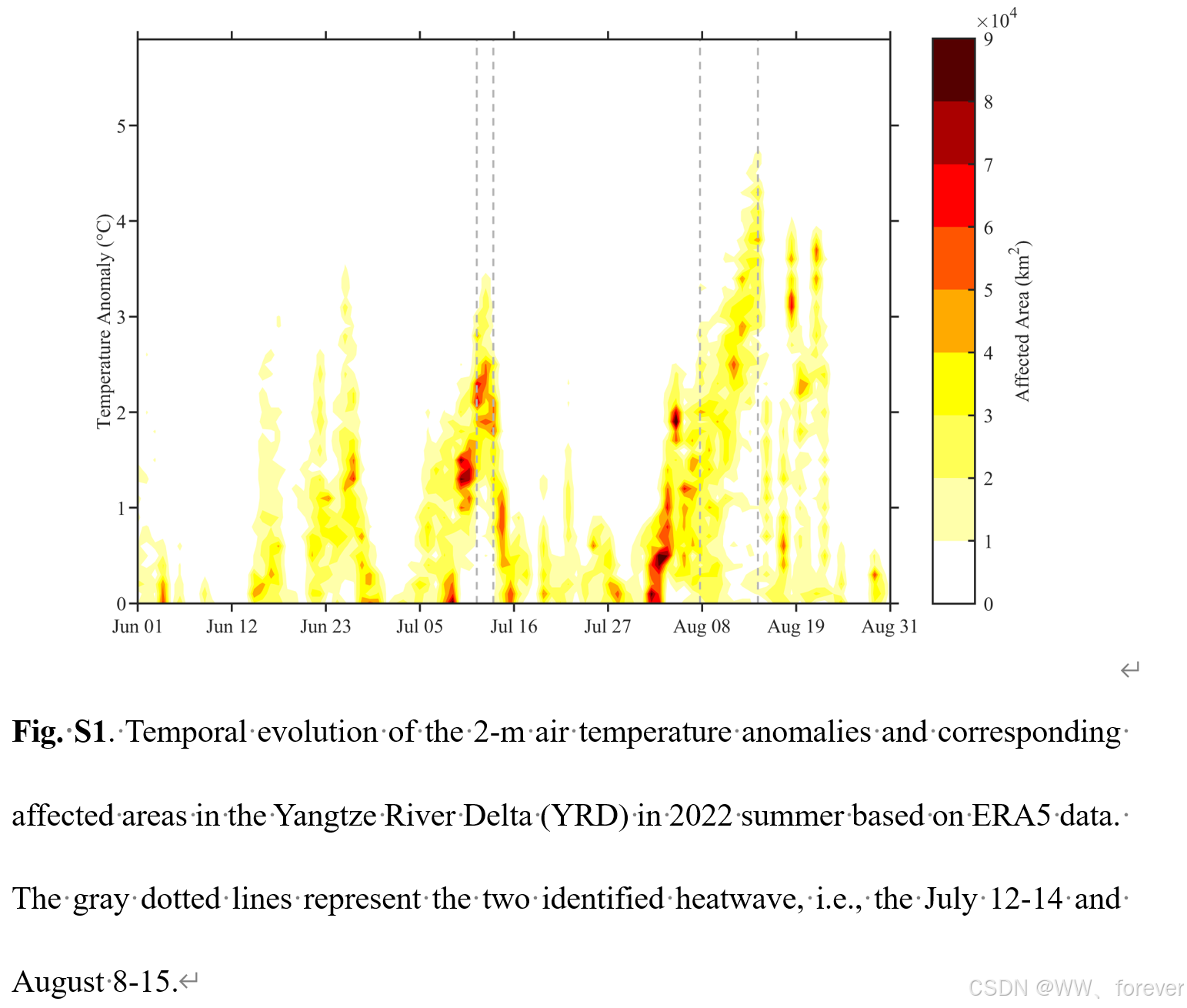
图的轴说明:
- X轴(横轴):时间(从6月1日到8月31日)。
- Y轴(纵轴):气温异常(Temperature Anomaly, 单位为°C),即某地当天的气温与历史气候平均值之差。
- 颜色(色块):代表该温度异常值对应的受影响面积(Affected Area),单位为平方公里(km²)。颜色越深,面积越大。
- 右侧色标:颜色代表不同的受影响面积(×10⁴ km²)。
本博客复现上述图形,详细介绍ERA5数据的下载、热浪事件的识别等多个步骤,并提供相应Python代码。
Step1:下载多年夏季气温/湿度数据-ERA5
ERA5数据下载步骤
ERA5数据的详细介绍可参考另一博客-【数据集】ERA5(欧洲中期天气预报中心)再分析数据介绍及下载。
- 数据集:ERA5 hourly data on single levels from 1959 to present
- 变量:2m air temperature(2m_temperature)
ERA5-Climate Data Store-查看个人API等进行配置。
API的配置教程-CDSAPI setup
基于Python下载ERA5数据
下载1970年至2024年6、7、8月的气温(2m_temperature)和湿度(2m_specific_humidity)数据,范围包括每个月的所有天数。
Areaf范围说明:北边界 (North), 西边界 (West), 南边界 (South), 东边界 (East)
完整Python代码如下:
import cdsapi
import calendar

c = cdsapi.Client()

years = list(range(1970, 2025))
months = ['06', '07', '08']

for year in years:
    for month in months:
        # 获取该月所有日期
        days_in_month = calendar.monthrange(year, int(month))[1]
        days = [f"{day:02d}" for day in range(1, days_in_month + 1)]
        hours = [f"{h:02d}:00" for h in range(24)]

        # 下载 2m 气温
        c.retrieve(
            'reanalysis-era5-single-levels',
            {
                'product_type': 'reanalysis',
                'variable': '2m_temperature',
                'year': str(year),
                'month': [month],
                'day': days,
                'time': hours,
                'area': [30.5, 106.0, 29.0, 107.5],  # 重庆主城区,N, W, S, E
                'format': 'netcdf',
            },
            f'chongqing_{year}_{month}_temperature.nc'
        )
基于Panoply查看.nc数据结构,如下: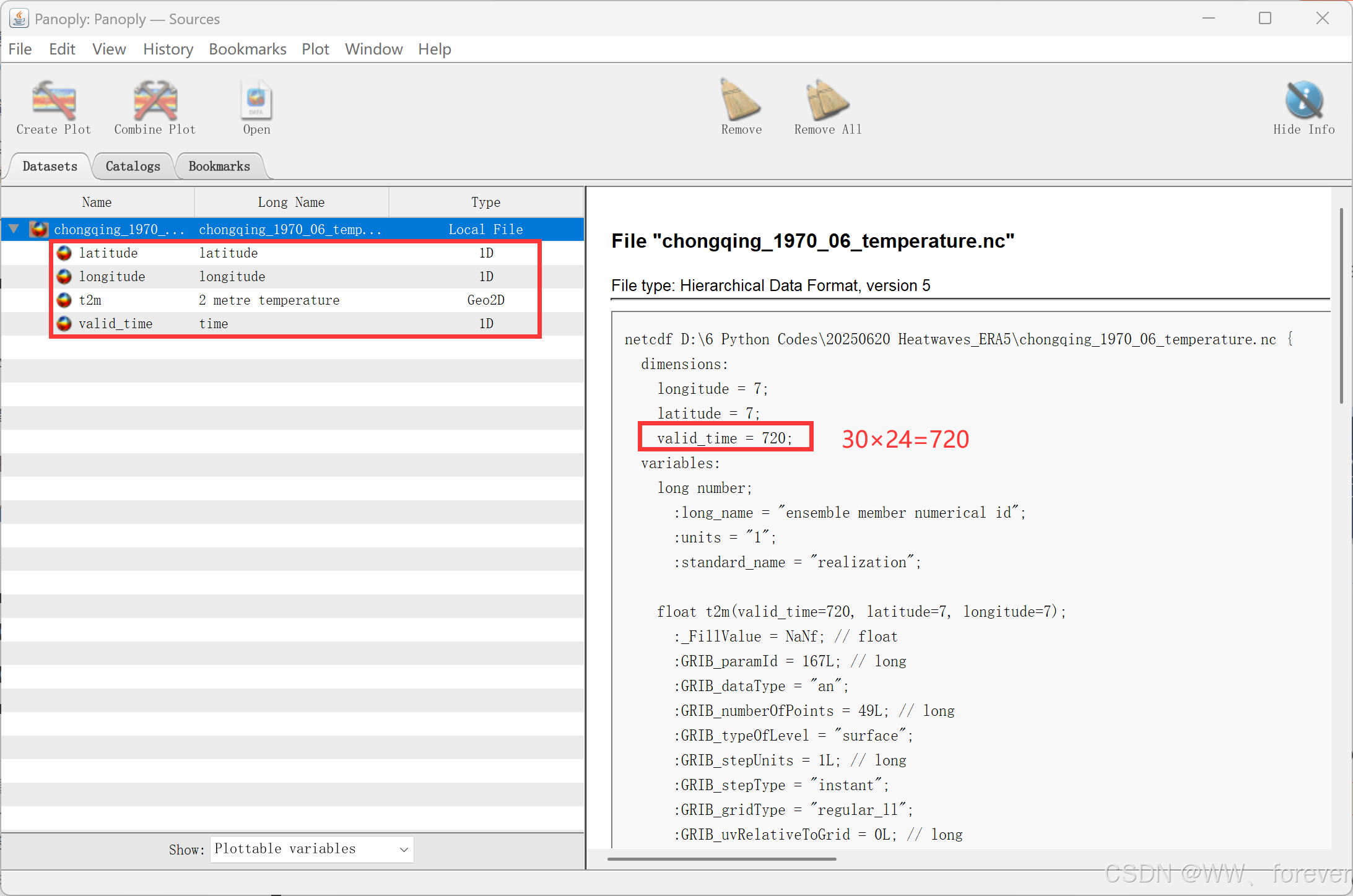
读取气温数据+计算日均/月均气温并绘图(Python代码)
首先,对每天取24小时平均,得到日平均气温;此外,计算各月的月均温。
绘制的月均气温如下:(此案例中选取的区域较小,为7×7方块)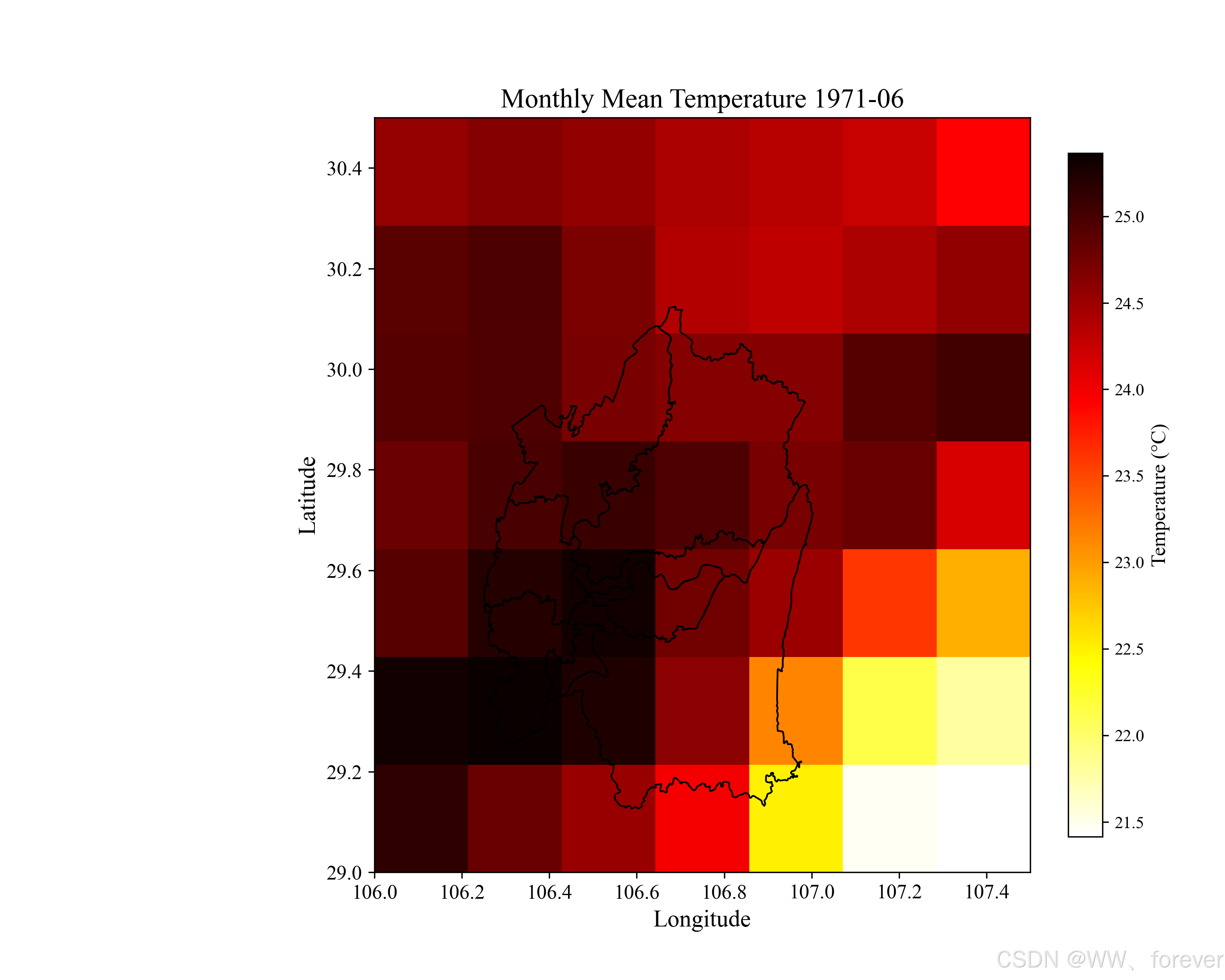
完整代码如下:
import os
import numpy as np
import pandas as pd
import xarray as xr
import rasterio
from rasterio.transform import from_origin
import geopandas as gpd
import matplotlib.pyplot as plt
from tqdm import tqdm

# 设置全局路径
basic_dir = r'D:\0 DataBase\7 EAR5\CQ_Summer\Ta_nc_1970-2024'
data_dir = os.path.join(basic_dir, 'Ta_nc_1970-2024')

output_dir = os.path.join(basic_dir, 'Ta_1970-2024')
os.makedirs(output_dir, exist_ok=True)

figure_dir = os.path.join(basic_dir, 'Figures')
os.makedirs(figure_dir, exist_ok=True)

# 设置重庆边界路径
shp_path = r'D:\0 DataBase\0 Chongqin Database\1 Boundary\CQcity.shp'
gdf = gpd.read_file(shp_path)

# 设置字体
plt.rcParams['font.family'] = 'Times New Roman'


# 保存 tif 的函数
def save_tif(data_array, out_path, lon, lat):
    transform = from_origin(lon.min(), lat.max(), abs(lon[1] - lon[0]), abs(lat[1] - lat[0]))
    with rasterio.open(
            out_path,
            'w',
            driver='GTiff',
            height=data_array.shape[1],
            width=data_array.shape[2],
            count=data_array.shape[0],
            dtype='float32',
            crs='EPSG:4326',
            transform=transform,
    ) as dst:
        for i in range(data_array.shape[0]):
            dst.write(data_array[i, :, :].values.astype('float32'), i + 1)


# 绘图函数
def plot_map(data, title, save_path, lon, lat, cmap='hot_r', vmin=None, vmax=None):
    fig, ax = plt.subplots(figsize=(10, 8))
    im = ax.imshow(
        np.flipud(data),
        cmap=cmap,
        extent=[lon.min(), lon.max(), lat.min(), lat.max()],
        vmin=vmin,
        vmax=vmax,
        origin='lower'
    )
    gdf.boundary.plot(ax=ax, edgecolor='black', linewidth=1)

    cbar = plt.colorbar(im, ax=ax, shrink=0.95, fraction=0.036, pad=0.04)
    cbar.set_label('Temperature (°C)', fontsize=12)
    cbar.ax.tick_params(labelsize=12)

    ax.set_title(title, fontsize=16)
    ax.set_xlabel('Longitude(°)', fontsize=14)
    ax.set_ylabel('Latitude(°)', fontsize=14)
    ax.tick_params(axis='both', labelsize=12)

    plt.savefig(save_path, dpi=300)
    plt.close()


# 主处理函数
def process_temperature_file(year, month):
    month_str = f"{int(month):02d}"
    filename = f'chongqing_{year}_{month_str}_temperature.nc'
    filepath = os.path.join(data_dir, filename)

    if not os.path.exists(filepath):
        print(f"文件不存在:{filename}")
        return

    # 输出文件路径
    tmax_path = os.path.join(output_dir, f'CQcity_Tmax_{year}{month_str}.tif')
    tmin_path = os.path.join(output_dir, f'CQcity_Tmin_{year}{month_str}.tif')
    tmean_path = os.path.join(output_dir, f'CQcity_Tmean_{year}{month_str}_mean.tif')

    # 如果所有文件都已存在,跳过
    if os.path.exists(tmax_path) and os.path.exists(tmin_path) and os.path.exists(tmean_path):
        print(f"{year}-{month_str} 已处理,跳过。")
        return

    ds = xr.open_dataset(filepath)

    # 正确选择变量
    t2m = ds['t2m'] - 273.15  # 转为摄氏度
    time = pd.to_datetime(ds['valid_time'].values)
    lat = ds['latitude'].values
    lon = ds['longitude'].values

    days = pd.to_datetime(np.unique(time.date))

    # 使用 groupby 将 t2m 按日期分组
    grouped = t2m.groupby('valid_time.date')

    tmax_list = []
    tmin_list = []

    for date, day_data in grouped:
        tmax = day_data.max(dim='valid_time')
        tmin = day_data.min(dim='valid_time')
        tmax_list.append(tmax)
        tmin_list.append(tmin)

    # 合并为 DataArray
    tmax_all = xr.concat(tmax_list, dim='time')
    tmin_all = xr.concat(tmin_list, dim='time')
    tmax_all['time'] = pd.to_datetime([pd.Timestamp(str(d)) for d in grouped.groups.keys()])
    tmin_all['time'] = pd.to_datetime([pd.Timestamp(str(d)) for d in grouped.groups.keys()])

    # 合并为 3D 数据
    tmax_all = xr.concat(tmax_all, dim='time')
    tmin_all = xr.concat(tmin_all, dim='time')
    tmean = t2m.mean(dim='valid_time')

    print("Tmax shape:", tmax_all.shape)
    print("Tmin shape:", tmin_all.shape)

    # 保存 tif
    save_tif(tmax_all, tmax_path, lon, lat)
    save_tif(tmin_all, tmin_path, lon, lat)

    with rasterio.open(
            tmean_path,
            'w',
            driver='GTiff',
            height=tmean.shape[0],
            width=tmean.shape[1],
            count=1,
            dtype='float32',
            crs='EPSG:4326',
            transform=from_origin(lon.min(), lat.max(), abs(lon[1] - lon[0]), abs(lat[1] - lat[0])),
    ) as dst:
        dst.write(tmean.values.astype('float32'), 1)

    # 绘图(每日)
    for i, day in enumerate(days):
        day_str = day.strftime('%Y-%m-%d')
        # plot_map(tmax_all[i].values, f'Daily Tmax on {day_str}', os.path.join(figure_dir, f'Tmax_{day_str}.png'), lon, lat)
        # plot_map(tmin_all[i].values, f'Daily Tmin on {day_str}', os.path.join(figure_dir, f'Tmin_{day_str}.png'), lon, lat)

    # 绘制月均温
    plot_map(tmean.values, f'Monthly Mean Temperature {year}-{month_str}',
             os.path.join(figure_dir, f'Tmean_{year}-{month_str}.png'), lon, lat)

    ds.close()
    print(f"{year}-{month_str} 处理完成 ✅")


# ---------------------------
# 设置起始和结束年份与月份
start_year, start_month = 1970, 6
end_year, end_month = 1976, 8

# 自动调用处理函数
for year in range(start_year, end_year + 1):
    for month in range(6, 9):  # 6, 7, 8月
        if year == start_year and month < start_month:
            continue
        if year == end_year and month > end_month:
            break
        process_temperature_file(year, month)
Step2:计算每日气温异常(Temperature Anomaly)
计算原理
气候基准期的多年平均气温(例如1970–2024年),用于计算“气温异常”:
Temperature Anomaly(x,y,t) = T2022(x,y,t) − Tclimate(x,y,t)
两个版本的气温异常(Temperature Anomaly)分析:
| 方法编号 | 方法描述 |
|---|---|
| 1️⃣ | 逐日序号法:对每年同一个日序(如6月15日)在1970–2024年间的值求平均,作为该日气候均值 |
| 2️⃣ | 滑动窗口法:对该日及其前后各7天的共15天数据求平均(跨月、跨年闭环处理),作为该日气候均值 |
完整的Python代码如下:
import os
import numpy as np
import rasterio
import datetime
import pandas as pd
from glob import glob
from tqdm import tqdm
import matplotlib.pyplot as plt
import calendar

"""
代码说明:
1、根据计算的日最高/日最低气温,计算日均气温(最大值/最小值)
方法1:按年序号平均
方法2:15日滑动平均(闭环)
2、计算气温异常:可指定时间段
"""

# 设置字体
plt.rcParams['font.family'] = 'Times New Roman'

# 加载 tif 为 numpy 数组
def load_tif(path):
    with rasterio.open(path) as src:
        data = src.read()
        profile = src.profile
    return data, profile

# 保存 tif
def save_tif(path, data, profile):
    profile.update(count=data.shape[0], dtype='float32')
    with rasterio.open(path, 'w', **profile) as dst:
        dst.write(data.astype('float32'))


### 方法一:按年序号平均
def compute_temperature_anomaly_dayofyear(tif_dir, output_dir, year_target=2022):
    os.makedirs(output_dir, exist_ok=True)

    # 构建年份和月日映射
    years = list(range(1970, 2025))
    date_range = pd.date_range(f'{year_target}-06-01', f'{year_target}-08-31', freq='D')

    for date in tqdm(date_range):
        day_index = f"{date.month:02d}{date.day:02d}"  # MMDD
        all_years_data = []
        profile = None

        for year in years:
            tif_path = os.path.join(tif_dir, f'CQcity_Tmax_{year}{date.month:02d}.tif')
            if not os.path.exists(tif_path):
                continue
            data, profile = load_tif(tif_path)
            band_index = date.day - 1
            if band_index < data.shape[0]:
                all_years_data.append(data[band_index])

        if len(all_years_data) == 0:
            continue

        all_years_data = np.stack(all_years_data, axis=0)
        clim_mean = np.nanmean(all_years_data, axis=0)

        # 提取目标年当天数据
        current_path = os.path.join(tif_dir, f'CQcity_Tmax_{year_target}{date.month:02d}.tif')
        current_data, _ = load_tif(current_path)
        today_data = current_data[date.day - 1]

        anomaly = today_data - clim_mean

        out_path = os.path.join(output_dir, f'CQcity_Tmax_anomaly_{date.strftime("%Y%m%d")}.tif')
        save_tif(out_path, anomaly[np.newaxis, :, :], profile)


### 方法二:15日滑动平均(闭环)
def compute_temperature_anomaly_rolling15(tif_dir, output_dir, year_target=2022):
    os.makedirs(output_dir, exist_ok=True)

    years = list(range(1970, 2025))
    date_range = pd.date_range(f'{year_target}-06-01', f'{year_target}-08-31', freq='D')
    all_dates = pd.date_range('06-01', '08-31', freq='D')

    for date in tqdm(date_range):
        # 构建 15 天窗口
        day_idx = (date - pd.Timestamp(f'{year_target}-06-01')).days
        window_indices = [(day_idx + i) % len(all_dates) for i in range(-7, 8)]
        window_dates = [all_dates[i] for i in window_indices]

        all_window_data = []
        profile = None

        # 每年每个窗口日
        for year in years:
            for d in window_dates:
                month = d.month
                day = d.day
                tif_path = os.path.join(tif_dir, f'CQcity_Tmax_{year}{month:02d}.tif')
                if not os.path.exists(tif_path):
                    continue
                data, profile = load_tif(tif_path)
                if day - 1 < data.shape[0]:
                    all_window_data.append(data[day - 1])

        if len(all_window_data) == 0:
            continue

        all_window_data = np.stack(all_window_data, axis=0)
        clim_mean = np.nanmean(all_window_data, axis=0)

        # 目标年当天数据
        current_path = os.path.join(tif_dir, f'CQcity_Tmax_{year_target}{date.month:02d}.tif')
        current_data, _ = load_tif(current_path)
        today_data = current_data[date.day - 1]

        anomaly = today_data - clim_mean

        out_path = os.path.join(output_dir, f'CQcity_Tmax_anomaly_{date.strftime("%Y%m%d")}.tif')
        save_tif(out_path, anomaly[np.newaxis, :, :], profile)


### 主函数
# --------------------------------------------------------
# Tmax 输入输出路径
tmax_dir = r'D:\0 DataBase\7 EAR5\CQ_Summer\Ta_1970-2024\Tmax'
tmax_out_dayofyear = r'D:\0 DataBase\7 EAR5\CQ_Summer\Ta_Anomaly\Tmax\Method1_DayOfYear'
tmax_out_rolling = r'D:\0 DataBase\7 EAR5\CQ_Summer\Ta_Anomaly\Tmax\Method2_Rolling15'

# Tmin 同理
tmin_dir = r'D:\0 DataBase\7 EAR5\CQ_Summer\Ta_1970-2024\Tmin'
tmin_out_dayofyear = r'D:\0 DataBase\7 EAR5\CQ_Summer\Ta_Anomaly\Tmin\Method1_DayOfYear'
tmin_out_rolling = r'D:\0 DataBase\7 EAR5\CQ_Summer\Ta_Anomaly\Tmin\Method2_Rolling15'

# 调用方法一
compute_temperature_anomaly_dayofyear(tmax_dir, tmax_out_dayofyear, year_target=2022)
compute_temperature_anomaly_dayofyear(tmin_dir, tmin_out_dayofyear, year_target=2022)

# 调用方法二
compute_temperature_anomaly_rolling15(tmax_dir, tmax_out_rolling, year_target=2022)
compute_temperature_anomaly_rolling15(tmin_dir, tmin_out_rolling, year_target=2022)
Step3:识别热浪事件
热浪计算原理
常见热浪识别准则(任选其一):
- 百分位法:某地日最高温连续 ≥ 3天超过90/95百分位。
- 绝对阈值法:如重庆主城区连续3天 Tmax ≥ 35°C。
可以先标记出热浪日,再聚合其空间影响范围。
完整的Python代码如下:
Step4:计算每一天的“受影响面积”
- 对每一天的温度异常字段,使用阈值(如1°C, 2°C…)筛选出“异常升温”的格点。
- 每个格点面积可根据经纬度估算(例如ERA5分辨率为0.25°≈25×25 km²)。
- 统计各温度异常等级下的面积总和,绘制等值线。
完整的Python代码如下:
参考

DAMO开发者矩阵,由阿里巴巴达摩院和中国互联网协会联合发起,致力于探讨最前沿的技术趋势与应用成果,搭建高质量的交流与分享平台,推动技术创新与产业应用链接,围绕“人工智能与新型计算”构建开放共享的开发者生态。
更多推荐

 5
5 0
0- 0


 已为社区贡献16条内容

所有评论(0)