印度小哥数据结构视频代码测试笔记
引子
最早看野火的开发板视频嵌入式Linux视频笔记----Linux基础入门
其中,P2 第1讲-为什么学习Linux开发 部分提到了C语言解释器GitHub - lotabout/write-a-C-interpreter: Write a simple interpreter of C. Inspired by c4 and largely based on it.
于是就看了手把手教你构建 C 语言编译器
看完发现没看懂,于是就去B站找文中提到的【如果要我说计算机专业最重要的三门课,我会说是《数据结构》、《算法》和《编译原理》。在我看来,能不能理解“递归”像是程序员的第一道门槛,而会不会写编译器则是第二道。】
于是就有了【强烈推荐】深入浅出数据结构 - 顶尖程序员图文讲解 - UP主翻译校对 (已完结)
看完了咖喱味的数据结构,感觉很有收获,于是决定把视频中的代码也测试下,就有了这篇笔记
我没翻墙,就用了评论里的别人整理的代码,修改了一点小错误,加了缩进,把部分C++代码改写为C代码
全部C/C++代码在这里https://download.csdn.net/download/gzc0319/88881845?spm=1001.2014.3001.5503
正文
P13: 双向链表的实现https://gist.github.com/mycodeschool/7429492 (C)
代码
/* Doubly Linked List implementation 双向链表的实现 */

#include<stdio.h>
#include<stdlib.h>


struct Node{
	int data;
	struct Node* next;
	struct Node* prev;
};


struct Node* head; // global variable - pointer to head node. 全局变量--链表头指针


//Creates a new Node and returns pointer to it.  创建结点,返回指针
struct Node* GetNewNode(int x) {
	struct Node* newNode = (struct Node*)malloc(sizeof(struct Node));	//动态分配内存

	newNode->data = x;
	newNode->prev = NULL;
	newNode->next = NULL;
	return newNode;
}


//Inserts a Node at head of doubly linked list 在链表头插入结点
void InsertAtHead(int x) {
	struct Node* newNode = GetNewNode(x);

	if(head == NULL) {
		head = newNode;
		return;
	}

	head->prev = newNode;
	newNode->next = head;	//曾经的第1个结点变为第2个结点
	head = newNode;
}


//Inserts a Node at tail of Doubly linked list 在链表尾插入结点
void InsertAtTail(int x) {
	struct Node* temp = head;
	struct Node* newNode = GetNewNode(x);

	if(head == NULL) {
		head = newNode;
		return;
	}

	while(temp->next != NULL) temp = temp->next; // Go To last Node 寻找最后1个结点

	temp->next = newNode;
	newNode->prev = temp;
}


//Prints all the elements in linked list in forward traversal order 从链表头开始打印所有元素
void Print() {
	struct Node* temp = head;

	printf("Forward: ");
	while(temp != NULL) {
		printf("%d ",temp->data);
		temp = temp->next;
	}

	printf("\n");
}


//Prints all elements in linked list in reverse traversal order. 从链表尾开始打印所有元素
void ReversePrint() {
	struct Node* temp = head;

	if(temp == NULL) return; // empty list, exit 空链表,退出

	// Going to last Node 找到最后一个结点
	while(temp->next != NULL) {
		temp = temp->next;
	}

	// Traversing backward using prev pointer 使用prev指针反向遍历
	printf("Reverse: ");
	while(temp != NULL) {
		printf("%d ",temp->data);
		temp = temp->prev;
	}

	printf("\n");
}


int main() {
	/*Driver code to test the implementation*/
	head = NULL; // empty list. set head as NULL.

	// Calling an Insert and printing list both in forward as well as reverse direction.
	InsertAtTail(2); Print(); ReversePrint();
	InsertAtTail(4); Print(); ReversePrint();
	InsertAtHead(6); Print(); ReversePrint();
	InsertAtTail(8); Print(); ReversePrint();
	InsertAtHead(1); Print(); ReversePrint();
}
运行效果
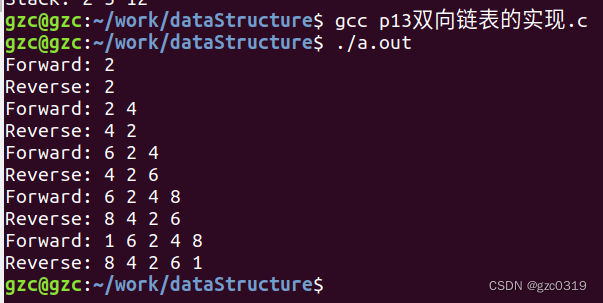
P15:使用数组实现栈 https://gist.github.com/mycodeschool/6878252 (C)
代码
// Stack - Array based implementation.  使用数组实现栈


// Creating a stack of integers.  整数栈

#include<stdio.h>


#define MAX_SIZE 101


int A[MAX_SIZE]; 	// integer array to store the stack  整型数组保存栈

int top = -1;		// variable to mark top of stack in array 栈头


// Push operation to insert an element on top of stack.  入栈

void Push(int x)

{

	if(top == MAX_SIZE -1) { // overflow case. 栈满

		printf("Error: stack overflow\n");

		return;

	}


	A[++top] = x;	//成功入栈

}


// Pop operation to remove an element from top of stack. 出栈

void Pop()

{

	if(top == -1) { // If stack is empty, pop should throw error.  栈空

		printf("Error: No element to pop\n");

		return;

	}


	top--;	//成功出栈

}


// Top operation to return element at top of stack.  读栈顶元素

int Top()

{

	return A[top];

}


// This function will return 1 (true) if stack is empty, 0 (false) otherwise 空栈返回1,否则0

int IsEmpty()

{

	if(top == -1) return 1;

	return 0;

}


// This function is just to test the implementation of stack.  测试栈的实现

// This will print all the elements in the stack at any stage. 打印栈中的所有元素

void Print() {

	int i;


	printf("Stack: ");

	for(i = 0;i<=top;i++)	printf("%d ",A[i]);

	printf("\n");

}


int main() {

	// Code to test the implementation.

	// calling Print() after each push or pop to see the state of stack.  每次出栈入栈均打印栈中的所有元素

	Push(2);Print();


	Push(5);Print();


	Push(10);Print();


	Pop();Print();


	Push(12);Print();

}
运行效果
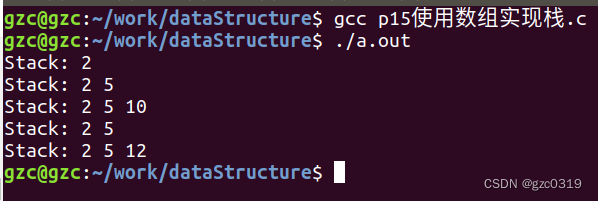
P18: 使用栈来检查表达式中的平衡括号https://gist.github.com/mycodeschool/7207410 (C++)
代码
/*
  C程序,使用栈来检查表达式中的平衡括号。
  给定一个由括号的打开和关闭字符组成的字符串表达式 - (),大括号 - {} 和方括号 - [],我们需要检查符号是否平衡。
*/

#include <stdio.h>
#include <stdbool.h>
#include <string.h>
#include <stdlib.h>

// 检查括号是否匹配
bool ArePair(char opening, char closing) {
    if (opening == '(' && closing == ')') return true;
    else if (opening == '{' && closing == '}') return true;
    else if (opening == '[' && closing == ']') return true;

    return false;
}


//输入参数为待检测字符串
bool AreParanthesesBalanced(const char *exp) {
    int stackSize = strlen(exp);
    char *stack = (char *)malloc(stackSize * sizeof(char));	//动态分配栈空间
    int top = -1;

    for (int i = 0; i < stackSize; i++) //碰到括号才执行,其他符号直接跳过
    {
        if (exp[i] == '(' || exp[i] == '{' || exp[i] == '[')
   	{
            stack[++top] = exp[i];	//入栈
        }
	else if (exp[i] == ')' || exp[i] == '}' || exp[i] == ']')
	{
            if (  top == -1 || !ArePair( stack[top--], exp[i] )  )
	    {
                free(stack);
                return false;
            }
        }
    }

    bool isBalanced = (top == -1);	//此时栈空则证明括号匹配
    free(stack);

    return isBalanced;
}

int main() {
    /* 测试函数 AreParanthesesBalanced */
    char expression[100];

    printf("Enter an expression: "); // 提醒用户输入表达式
    fgets(expression, sizeof(expression), stdin);

    // 从输入中删除换行符
    expression[strcspn(expression, "")] = '\0';

    if (AreParanthesesBalanced(expression))
        printf("Balanced\n");
    else
        printf("Not Balanced\n");

    return 0;
}
运行效果

P20: /输入由具体数字和加减乘除组合的后缀表达式【注意空格】,输出计算结果https://gist.github.com/mycodeschool/7702441 (C++)
代码
//输入由具体数字和加减乘除组合的后缀表达式【注意空格】,输出计算结果
//Enter Postfix Expression
//2 3 * 4 5 * + 9 -
//Output = 17

#include<stdio.h>
#include<stdlib.h>
#include<string.h>
#include<ctype.h>
#include<stdbool.h>

// 函数声明
int EvaluatePostfix(char *expression);
int PerformOperation(char operation, int operand1, int operand2);
bool IsOperator(char C);
bool IsNumericDigit(char C);


int main()
{
    char expression[100];

    printf("请输入后缀表达式:\n");
    fgets(expression, sizeof(expression), stdin);

    int result = EvaluatePostfix(expression);
    printf("输出结果:%d\n", result);

    return 0;
}

// 计算后缀表达式
int EvaluatePostfix(char *expression)
{
    int S[100]; 	// 栈的大小为100
    int top = -1; 	// 初始化栈顶指针

    for (int i = 0; i < strlen(expression); i++)
    {
        // 如果字符是分隔符【空格或逗号】,跳过
        if (expression[i] == ' ' || expression[i] == ',')
            continue;

        // 如果字符是操作符,弹出两个操作数,执行操作,并将结果压入栈中
        else if (IsOperator(expression[i]))
        {
            int operand2 = S[top--];
            int operand1 = S[top--];
            int result = PerformOperation(expression[i], operand1, operand2);
            S[++top] = result;
        }
        // 如果字符是数字,将其转换为整数并压入栈中
        else if (IsNumericDigit(expression[i]))
        {
            int operand = 0;
            while (i < strlen(expression) && IsNumericDigit(expression[i]))
            {
                operand = (operand * 10) + (expression[i] - '0');//十进制
                i++;
            }
            i--;
            S[++top] = operand;
        }
    }
    return S[top];
}

//判断是否是数字
bool IsNumericDigit(char C)
{
    if (C >= '0' && C <= '9')
        return true;
    return false;
}

//判断是否是加减乘除符号
bool IsOperator(char C)
{
    if (C == '+' || C == '-' || C == '*' || C == '/')
        return true;
    return false;
}


int PerformOperation(char operation, int operand1, int operand2)
{
    switch (operation)
    {
    case '+':
        return operand1 + operand2;
    case '-':
        return operand1 - operand2;
    case '*':
        return operand1 * operand2;
    case '/':
        return operand1 / operand2;
    default:
        printf("意外错误\n");
        return -1;
    }
}
运行效果

P21:使用栈将中缀表达式转换为后缀表达式 https://gist.github.com/mycodeschool/7867739 (C++)
代码
//使用栈将中缀表达式转换为后缀表达式
//利用中缀表达式和后缀表达式的共同特性:操作数顺序相同

#include <stdio.h>
#include <stdlib.h>
#include <string.h>

// 判断是否为操作符
int IsOperator(char C) {
    if (C == '+' || C == '-' || C == '*' || C == '/' || C == '$')
        return 1;
    return 0;
}

// 判断是否为操作数--字母或数字
int IsOperand(char C) {
    if (C >= '0' && C <= '9') return 1;
    if (C >= 'a' && C <= 'z') return 1;
    if (C >= 'A' && C <= 'Z') return 1;
    return 0;
}

// 获取操作符的权重
int GetOperatorWeight(char op) {
    int weight = -1;
    switch (op)
	{
        case '+':
        case '-':
            weight = 1;break;
        case '*':
        case '/':
            weight = 2;break;
        case '$':
            weight = 3;break;
    }
    return weight;
}

// 判断是否为右结合操作符
int IsRightAssociative(char op) {
    if (op == '$') return 1;
    return 0;
}

// 判断操作符 op1 是否具有比操作符 op2 更高的优先级
int HasHigherPrecedence(char op1, char op2) {
    int op1Weight = GetOperatorWeight(op1);
    int op2Weight = GetOperatorWeight(op2);

    if (op1Weight == op2Weight) {
        if (IsRightAssociative(op1)) return 0;
        else return 1;	//若操作符优先级相同,则栈中操作符op1因为早出现,所以优先级更高
    }
    return op1Weight > op2Weight ? 1 : 0;
}


// 将中缀表达式转换为后缀表达式
void InfixToPostfix(char *expression, char *postfix) {
    int top = -1; // 栈顶指针
    char stack[strlen(expression)]; // 栈

    for (int i = 0; i < strlen(expression); i++)
    {
        if (expression[i] == ' ' || expression[i] == ',') continue;	//忽略分隔符

        if (IsOperator(expression[i])) 		// 判断是否为操作符
		{
			while (top != -1  &&  stack[top]  !=  '('  &&  HasHigherPrecedence(stack[top], expression[i]))
			{
				*postfix++ = stack[top--];	//只有放入栈中的操作符优先级更高才可以放入后缀表达式
			}

			stack[++top] = expression[i];
		}
		else if (IsOperand(expression[i])) 	// 判断是否为操作数--字母或数字
		{
			 *postfix++ = expression[i];
		}
		else if (expression[i] == '(') 		// 发现左括号则入栈
		{
			stack[++top] = expression[i];
		}
		else if (expression[i] == ')') 		// 碰到右括号则弹出栈中内容,直到遇到匹配的左括号
		{
			while (top != -1 && stack[top] != '(')
			{
				    *postfix++ = stack[top--];
			}
		   	top--;
	    }
	}

	while (top != -1)
	{
	    *postfix++ = stack[top--];	//弹出最后几个操作符
	}
	*postfix = '\0';
}

int main() {
    char expression[100];
    printf("请输入中缀表达式:\n");
    scanf("%s", expression);

    char postfix[100];
    InfixToPostfix(expression, postfix);
    printf("输出后缀表达式:%s\n", postfix);

    return 0;
}
运行效果

P22: 用数组实现队列并进行入对出对操作https://gist.github.com/mycodeschool/7331785 (C++)
代码
//用数组实现队列并进行入对出对操作

#include <stdio.h>

#define MAX_SIZE 101 	// 队列的最大大小

// 定义一个名为Queue的结构体
typedef struct {
    int A[MAX_SIZE]; // 用于存储队列元素的数组
    int front, rear; // 队首和队尾指针
} Queue;

// 初始化队列
void initQueue(Queue *q) {
    q->front = -1;
    q->rear = -1;
}

// 判断队列是否为空
int isEmpty(Queue *q) {
    return (q->front == -1 && q->rear == -1);
}

// 判断队列是否已满--循环队列
int isFull(Queue *q) {
    return (q->rear + 1) % MAX_SIZE == q->front;
}

// 入队操作--对尾入对
void enqueue(Queue *q, int x) {
    printf("入队元素 %d\n", x);
    if (isFull(q)) {
        printf("错误:队列已满");
        return;
    }
    if (isEmpty(q)) {
        q->front = q->rear = 0;
    }
	else {
        q->rear = (q->rear + 1) % MAX_SIZE;
    }
    q->A[q->rear] = x;		// 入队
}

// 出队操作--对头出对
void dequeue(Queue *q) {
    printf("出队操作");
    if (isEmpty(q)) {
        printf("错误:队列为空");
        return;
    } else if (q->front == q->rear) {
        q->rear = q->front = -1;	// 队列只有1个元素
    } else {
        q->front = (q->front + 1) % MAX_SIZE;
    }
}

// 获取队首元素
int front(Queue *q) {
    if (q->front == -1) {
        printf("错误:无法从空队列中返回队首元素");
        return -1;
    }
    return q->A[q->front];
}

// 打印队列中的元素(仅用于测试)
void print(Queue *q) {
    int count = (q->rear + MAX_SIZE - q->front) % MAX_SIZE + 1;

    printf("队列:");
    for (int i = 0; i < count; i++) {
        int index = (q->front + i) % MAX_SIZE; // 从队首开始循环遍历时的索引
        printf("%d ", q->A[index]);
    }
    printf("\n\n");
}

int main() {
    // 测试代码,打印每次入队或出队后的队列元素
    Queue Q; // 创建一个队列实例
    initQueue(&Q); // 初始化队列
    enqueue(&Q, 2); print(&Q);
    enqueue(&Q, 4); print(&Q);
    enqueue(&Q, 6); print(&Q);
    dequeue(&Q); 	print(&Q);
    enqueue(&Q, 8); print(&Q);
}
运行效果
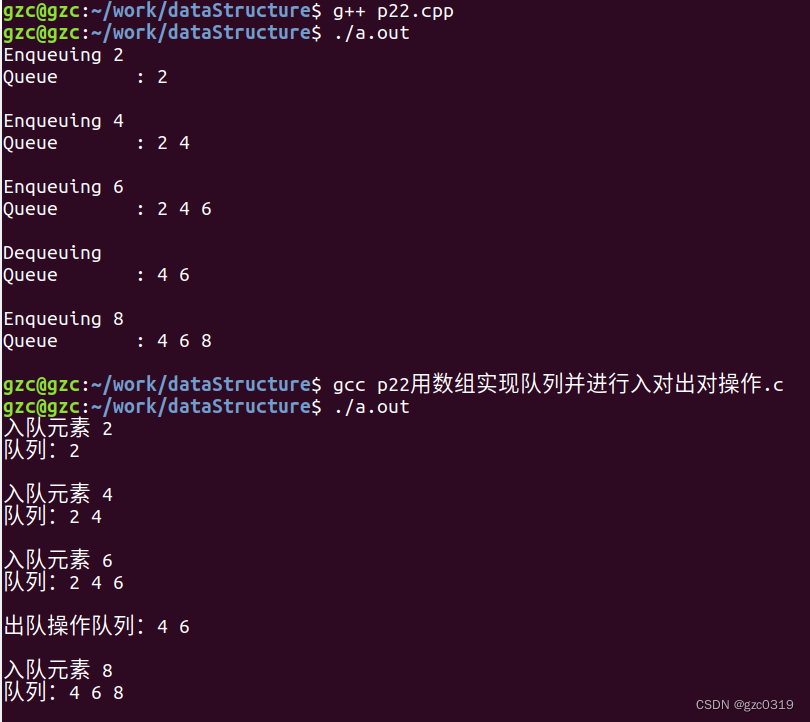
P23: https://gist.github.com/mycodeschool/7331785 (C++)
同P22
P24:用链表实现队列并进行入队出队操作 https://gist.github.com/mycodeschool/7510222 (C)
代码
//用链表实现队列并进行入队出队操作

#include <stdio.h>
#include <stdlib.h>

// 定义链表节点结构体
struct Node {
    int data; // 节点存储的数据
    struct Node* next; // 指向下一个节点的指针
};

// 两个全局变量,用于存储队列的队首和队尾节点的地址
struct Node* front = NULL;
struct Node* rear = NULL;

// 入队操作,将1个整数插入队列尾部
void Enqueue(int x) {
    struct Node* temp = (struct Node*)malloc(sizeof(struct Node));
    temp->data = x;
    temp->next = NULL;

    if (front == NULL && rear == NULL) {	//空队列
        front = rear = temp;
        return;
    }

    rear->next = temp;
    rear = temp;
}

// 出队操作,从队列头部移除1个整数
void Dequeue() {
    struct Node* temp = front;

    if (front == NULL) {
        printf("队列为空");
        return;
    }

    if (front == rear) {
        front = rear = NULL;	// 队列只有1个元素
    } else {
        front = front->next;
    }

    free(temp);
}

// 获取队首元素
int Front() {
    if (front == NULL) {
        printf("队列为空");
        return 0;
    }

    return front->data;
}

// 打印队列中的元素
void Print() {
    struct Node* temp = front;
    while (temp != NULL) {
        printf("%d ", temp->data);
        temp = temp->next;
    }
    printf("\n");
}

int main() {
    // 测试代码,每次入队或出队后打印队列中的元素
    Enqueue(2); Print();
    Enqueue(4); Print();
    Enqueue(6); Print();
    Dequeue(); Print();
    Enqueue(8); Print();
}
运行效果

P28:二叉搜索树的建立(插入) 与 查找 https://gist.github.com/mycodeschool/44e1a9183ab0e931f729 (C++)
代码
//二叉搜索树的建立(插入) 与 查找


#include <stdio.h>

#include <stdlib.h>


// 定义二叉搜索树节点结构体

struct BstNode {

    int data;

    struct BstNode* left;

    struct BstNode* right;

};


// 在堆中创建一个新的节点

struct BstNode* GetNewNode(int data) {

    struct BstNode* newNode = (struct BstNode*)malloc(sizeof(struct BstNode));


    newNode->data = data;

    newNode->left = newNode->right = NULL;

    return newNode;

}


// 向二叉搜索树中插入数据,返回根节点的地址

struct BstNode* Insert(struct BstNode* root, int data) {

    if (root == NULL) { // 如果树为空

        root = GetNewNode(data);

    }


    // 如果待插入的数据小于等于根节点的数据,则插入左子树

    else if (data <= root->data) {

        root->left = Insert(root->left, data);

    }


    // 否则,插入右子树

    else {

        root->right = Insert(root->right, data);

    }


    return root;

}


// 在二叉搜索树中搜索元素,如果找到元素则返回true

int Search(struct BstNode* root, int data) {

    if (root == NULL) {

        return 0;	//找到

    }

    else if (root->data == data) {

        return 1;	//未找到

    }

    else if (data <= root->data) {

        return Search(root->left, data);

    }

    else {

        return Search(root->right, data);

    }

}


int main() {

    struct BstNode* root = NULL; // 创建一个空的二叉搜索树


    /* 测试逻辑的代码 */

    root = Insert(root, 15);

    root = Insert(root, 10);

    root = Insert(root, 20);

    root = Insert(root, 25);

    root = Insert(root, 8);

    root = Insert(root, 12);


    // 询问用户输入一个数字

    int number;

    printf("请输入要搜索的数字:");

    scanf("%d", &number);


    // 如果找到了数字,打印 "FOUND"

    if (Search(root, number)) {

        printf("Found\n");

    }

    else {

        printf("Not Found\n");

    }

}
运行效果
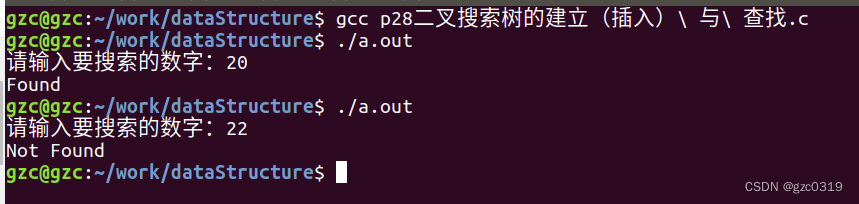
P33: 使用队列按层次遍历打印二叉树结点https://gist.github.com/mycodeschool/9507131 (C++)
核心思想:从队头取出一个节点访问,将节点的子节点加入队尾

代码
//使用队列按层次遍历打印二叉树结点
//核心思想:从队头取出一个节点访问,将节点的子节点加入队尾

#include <stdio.h>
#include <stdlib.h>

// 定义二叉树结点结构体
struct Node {
    char data;
    struct Node *left;
    struct Node *right;
};

// 函数:按层次遍历打印二叉树结点
void LevelOrder(struct Node *root) {
    if (root == NULL) return;

    // 使用队列存储待遍历的结点
    struct Node *queue[100];	//指针数组
    int front = -1, rear = -1;

    // 将根结点入队
    queue[++rear] = root;

    // 当队列不为空时,继续遍历
    while (front != rear) {
        struct Node *current = queue[++front];	// 出队并打印
        printf("%c ", current->data);

        // 左子结点入队
        if (current->left != NULL) {
            queue[++rear] = current->left;
        }

        // 右子结点入队
        if (current->right != NULL) {
            queue[++rear] = current->right;
        }
    }
}

// 函数:在二叉搜索树中插入结点
struct Node* Insert(struct Node *root, char data) {
    if (root == NULL) {
        root = (struct Node *)malloc(sizeof(struct Node));
        root->data = data;
        root->left = root->right = NULL;
    } else if (data <= root->data) {
        root->left = Insert(root->left, data);
    } else {
        root->right = Insert(root->right, data);
    }
    return root;
}

int main() {
    /* 创建示例二叉树
		M
	   B        Q
	 A    C          Z
    */
    struct Node *root = NULL;
    root = Insert(root, 'M'); root = Insert(root, 'B');
    root = Insert(root, 'Q'); root = Insert(root, 'Z');
    root = Insert(root, 'A'); root = Insert(root, 'C');

    // 按层次遍历打印结点
    LevelOrder(root);
	printf("\n");

    return 0;
}
运行效果

P34:使用递归进行二叉树前序 后序 中序遍历https://gist.github.com/mycodeschool/10016271 (C++)
代码
//使用递归进行二叉树前序 后序 中序遍历


#include<stdio.h>
#include<stdlib.h>

// 定义二叉树结点结构体
struct Node {
    char data;
    struct Node *left;
    struct Node *right;
};

// 前序遍历函数
void Preorder(struct Node *root) {
    if (root == NULL) return; 	// 递归结束条件:如果树/子树为空,返回并退出
    printf("%c ", root->data); 	// 打印数据
    Preorder(root->left); 		// 访问左子树
    Preorder(root->right); 		// 访问右子树
}

// 中序遍历函数
void Inorder(struct Node *root) {
    if (root == NULL) return; 	// 递归结束条件:如果树/子树为空,返回并退出
    Inorder(root->left); 		// 访问左子树
    printf("%c ", root->data); 	// 打印数据
    Inorder(root->right); 		// 访问右子树
}

// 后序遍历函数
void Postorder(struct Node *root) {
    if (root == NULL) return; 	// 递归结束条件:如果树/子树为空,返回并退出
    Postorder(root->left); 		// 访问左子树
    Postorder(root->right); 	// 访问右子树
    printf("%c ", root->data); 	// 打印数据
}

// 向二叉搜索树中插入节点的函数
struct Node* Insert(struct Node *root, char data) {
    if (root == NULL) {
        root = (struct Node *)malloc(sizeof(struct Node));
        root->data = data;
        root->left = root->right = NULL;
    } else if (data <= root->data) {
        root->left = Insert(root->left, data);
    } else {
        root->right = Insert(root->right, data);
    }
    return root;
}

int main() {
    /* 创建示例二叉树
       M
	 B   Q
	A   C   Z
    */
    struct Node *root = NULL;
    root = Insert(root, 'M'); root = Insert(root, 'B');
    root = Insert(root, 'Q'); root = Insert(root, 'Z');
    root = Insert(root, 'A'); root = Insert(root, 'C');

    // 前序遍历打印结点
    printf("Preorder: ");
    Preorder(root);
    printf("\n");

    // 中序遍历打印结点
    printf("Inorder: ");
    Inorder(root);
    printf("\n");

    // 后序遍历打印结点
    printf("Postorder: ");
    Postorder(root);
    printf("\n");

    return 0;
}
运行效果

P36: 在二叉搜索树中删除指定值的节点https://gist.github.com/mycodeschool/9465a188248b624afdbf (C++)
代码
//在二叉搜索树中删除指定值的节点

#include<stdio.h>
#include<stdlib.h>

// 定义二叉树结点结构体
struct Node {
    int data;
    struct Node *left;
    struct Node *right;
};

// 查找二叉搜索树中的最小值
struct Node* FindMin(struct Node* root) {
    while (root->left != NULL) {
        root = root->left;
    }
    return root;
}

// 在二叉搜索树中删除指定值的节点
struct Node* Delete(struct Node *root, int data) {
    if (root == NULL) {
        return root;
    }
	// 去左子树找
	else if (data < root->data) {
        root->left = Delete(root->left, data);
    }
	// 去右子树找
	else if (data > root->data) {
        root->right = Delete(root->right, data);
    }
	else {
		// 当前结点为叶子结点,直接删除
        if (root->left == NULL && root->right == NULL) {
            free(root);
            root = NULL;
        }
		// 当前结点为最小的结点,当前结点父结点指向当前结点子结点
		else if (root->left == NULL) {
            struct Node *temp = root;
            root = root->right;
            free(temp);
        }
		// 当前结点为最大的结点,当前结点父结点指向当前结点子结点
		else if (root->right == NULL) {
            struct Node *temp = root;
            root = root->left;
            free(temp);
        }
		// 当前结点有两个子节点,在右子树找到最小值作为根结点,然后删除右子树重复值
		else {
            struct Node *temp = FindMin(root->right);
            root->data = temp->data;
            root->right = Delete(root->right, temp->data);
        }
    }
    return root;
}

// 中序遍历(相当于从小到大遍历)二叉树并打印节点值
void Inorder(struct Node *root) {
    if (root == NULL) {
        return;
    }
    Inorder(root->left);
    printf("%d ", root->data);
    Inorder(root->right);
}

// 向二叉搜索树中插入节点
struct Node* Insert(struct Node *root, int data) {
    if (root == NULL) {
        root = (struct Node*)malloc(sizeof(struct Node));
        root->data = data;
        root->left = root->right = NULL;
    } else if (data <= root->data) {
        root->left = Insert(root->left, data);
    } else {
        root->right = Insert(root->right, data);
    }
    return root;
}

int main() {
    /* 创建一个示例二叉搜索树
		      5
		  3     10
		1   4      11
    */
    struct Node* root = NULL;
    root = Insert(root, 5); root = Insert(root, 10);
    root = Insert(root, 3); root = Insert(root, 4);
    root = Insert(root, 1); root = Insert(root, 11);

    // 删除值为5的节点,可以修改这个值来测试其他情况
    root = Delete(root, 5);

    // 中序遍历并打印节点值
    printf("Inorder: ");
    Inorder(root);
    printf("\n");

    return 0;
}
运行效果

P37: 在二叉搜索树中找到中序后继节点https://gist.github.com/mycodeschool/6515e1ec66482faf9d79 (C++)
逻辑

代码
// 在二叉搜索树中找到中序后继节点

#include<stdio.h>
#include<stdlib.h>

// 定义二叉树结点结构体
struct Node {
    int data;
    struct Node *left;
    struct Node *right;
};

// 在二叉搜索树中查找指定值的节点
struct Node* Find(struct Node* root, int data) {
    if (root == NULL) return NULL;
    else if (root->data == data) return root;	// 找到节点
    else if (root->data < data) return Find(root->right, data);
    else return Find(root->left, data);
}

// 在二叉搜索树中找到最小值的节点
struct Node* FindMin(struct Node* root) {
    if (root == NULL) return NULL;
    while (root->left != NULL)
        root = root->left;
    return root;
}

// 在二叉搜索树中找到中序后继节点
struct Node* Getsuccessor(struct Node* root, int data) {
    struct Node* current = Find(root, data);	// 先找到data对应的节点
    if (current == NULL) return NULL;
    if (current->right != NULL) { 	// 情况1:节点有右子树,中序后继节点就是右子树最小值
        return FindMin(current->right);
    }
    else { 							// 情况2:没有右子树 - O(h),中序后继节点就是某个祖先
        struct Node* successor = NULL;
        struct Node* ancestor = root;
        while (ancestor != current) {
            if (current->data < ancestor->data) {
                successor = ancestor; // 到目前为止,这是最深节点,当前节点在其左侧
                ancestor = ancestor->left;
            }
            else
                ancestor = ancestor->right;
        }
        return successor;
    }
}

// 中序遍历二叉树
void Inorder(struct Node* root) {
    if (root == NULL) return;
    Inorder(root->left); 		// 访问左子树
    printf("%d ", root->data); 	// 打印数据
    Inorder(root->right); 		// 访问右子树
}

// 在二叉搜索树中插入节点
struct Node* Insert(struct Node* root, int data) {
    if (root == NULL) {
        root = (struct Node*)malloc(sizeof(struct Node));
        root->data = data;
        root->left = root->right = NULL;
    }
    else if (data <= root->data)
        root->left = Insert(root->left, data);
    else
        root->right = Insert(root->right, data);
    return root;
}

int main() {
    /* 创建示例二叉树
         5
   	  3   10
    1   4    11
    */
    struct Node* root = NULL;
    root = Insert(root, 5); root = Insert(root, 10);
    root = Insert(root, 3); root = Insert(root, 4);
    root = Insert(root, 1); root = Insert(root, 11);

    // 中序遍历二叉树
    printf("Inorder Traversal: ");
    Inorder(root);
    printf("\n");

    // 查找某个节点的中序后继节点
    struct Node* successor = Getsuccessor(root, 1);
    if (successor == NULL) printf("No successor Found\n");
    else
        printf("Successor of 1 is %d\n", successor->data);
}
运行效果

图邻接表的构造与遍历
代码参考《计算机软件技术基础》徐士良 算法2.29和2.30
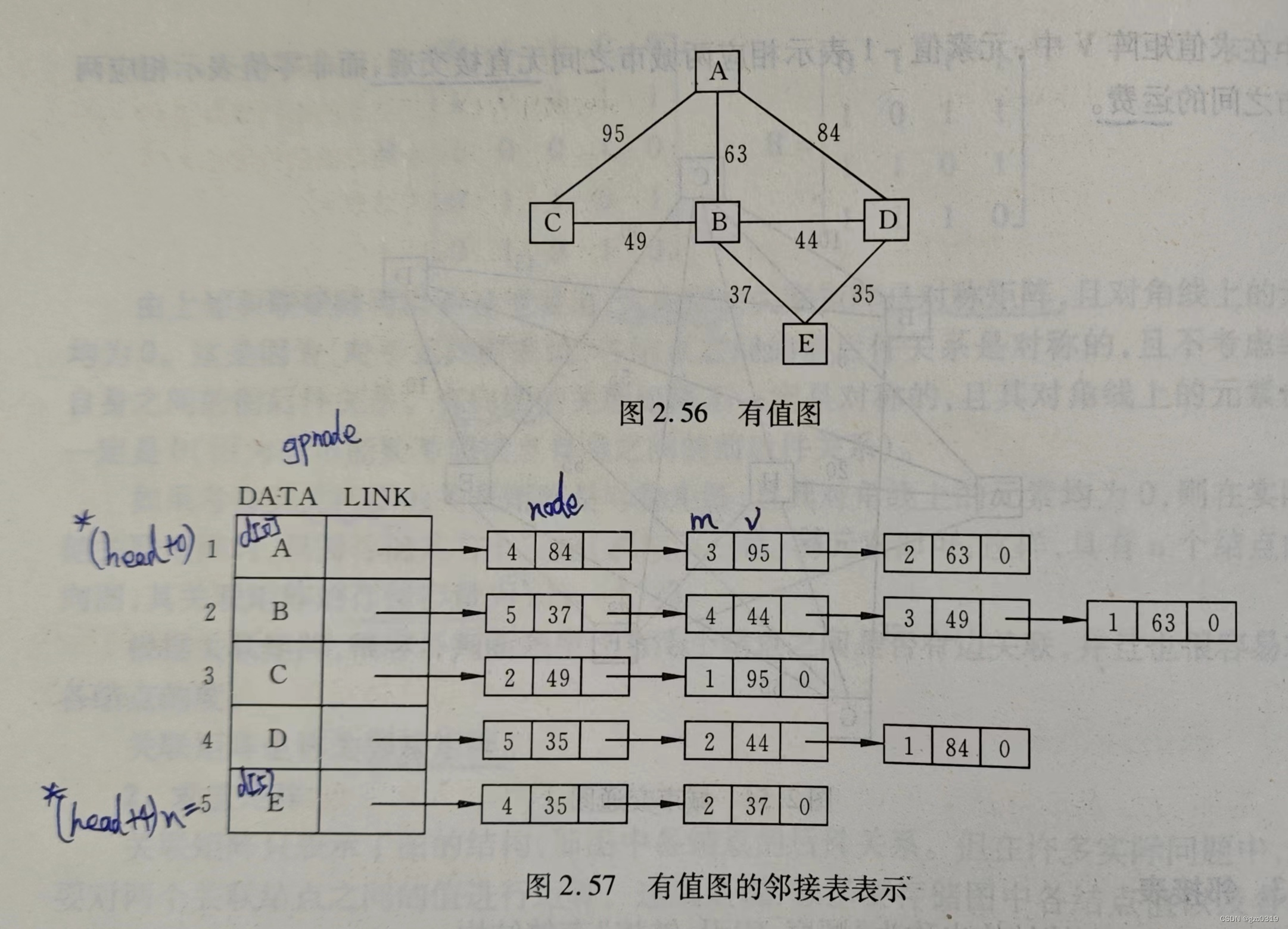

代码
// 图邻接表的构造与遍历
// 代码参考《计算机软件技术基础》徐士良 算法2.29和2.30

#include "stdio.h"
#include "stdlib.h"

struct node		// 单链表中节点结构
{
	int num;	// 图中节点编号
	int val;	// 节点值
	struct node *next;
};

struct gpnode	// 顺序存储空间中节点结构
{
	char data;
	struct node *link;
};

// 图邻接表的构造--该函数返回顺序存储空间的首地址
struct gpnode *creatgp(name,n)
int n;
char name[];
{
	struct gpnode *head;
	struct node *p;
	int k,num,val;			//节点编号和节点值

	head = (struct gpnode *)malloc(n*sizeof(struct gpnode));	//顺序存储空间

	// 依次对图中的每一个节点建立单链表
	for(k=0;k<n;k++)
	{
		(head+k)->data=name[k];		// A B C D E
		(head+k)->link=NULL;

		printf("input linked list of %c :\n",name[k]);
		scanf("%d,%d",&num,&val);	// 获取节点编号和节点值

		while(num>0)				// 编号为1 2 3 4 5
		{
			// 将新节点加入到链表头部
			p = (struct node *)malloc(sizeof(struct node));	// 单链表节点
			p->num = num;
			p->val = val;
			p->next = (head+k)->link;		// 新节点指向原来的第1个节点
			(head+k)->link = p;				// 将新节点链接到单链表表头

			scanf("%d,%d",&num,&val);
		}
	}
	return head;
}


// 图邻接表的遍历

// 递归函数
void static dfs(head,k,mark)
struct gpnode *head;
int k,*mark;
{
	struct node* p;

	printf("%c",(head+k-1)->data);	// 输出当前节点值
	mark[k-1] = 1;					// 记录当前节点的查访标志

	p = (head+k-1)->link;			// 当前节点的第一个后件节点

	while(p!=NULL)
	{
		if(mark[(p->num)-1]==0)		// 该节点未被查访
			dfs(head,p->num,mark);

		p = p->next;
	}
	return;
}


void dfsgp(head,n)
struct gpnode *head;
int n;
{
	int k,*mark;
	mark = malloc( n*sizeof(int) );	// 标志数组空间

	for(k=0;k<n;k++)
	{
		mark[k] = 0;		// 标志数组初始化
	}

	k = 1;					// 从第1个节点开始遍历
	dfs(head,k,mark);

	printf("\n");
	free(mark);
	return;
}


void main()
{
	struct gpnode *head=NULL;
	int n=5;
	char name[]={'A','B','C','D','E'};

	head = creatgp(name,n);

	dfsgp(head,n);
}
运行效果


DAMO开发者矩阵,由阿里巴巴达摩院和中国互联网协会联合发起,致力于探讨最前沿的技术趋势与应用成果,搭建高质量的交流与分享平台,推动技术创新与产业应用链接,围绕“人工智能与新型计算”构建开放共享的开发者生态。
更多推荐


 24
 0
- 0


 已为社区贡献1条内容

所有评论(0)